
Top CRM Software for Real Estate Developers in India
Find the best CRM software for real estate developers in India to streamline lead management, sales, marketing, and project operations efficiently.
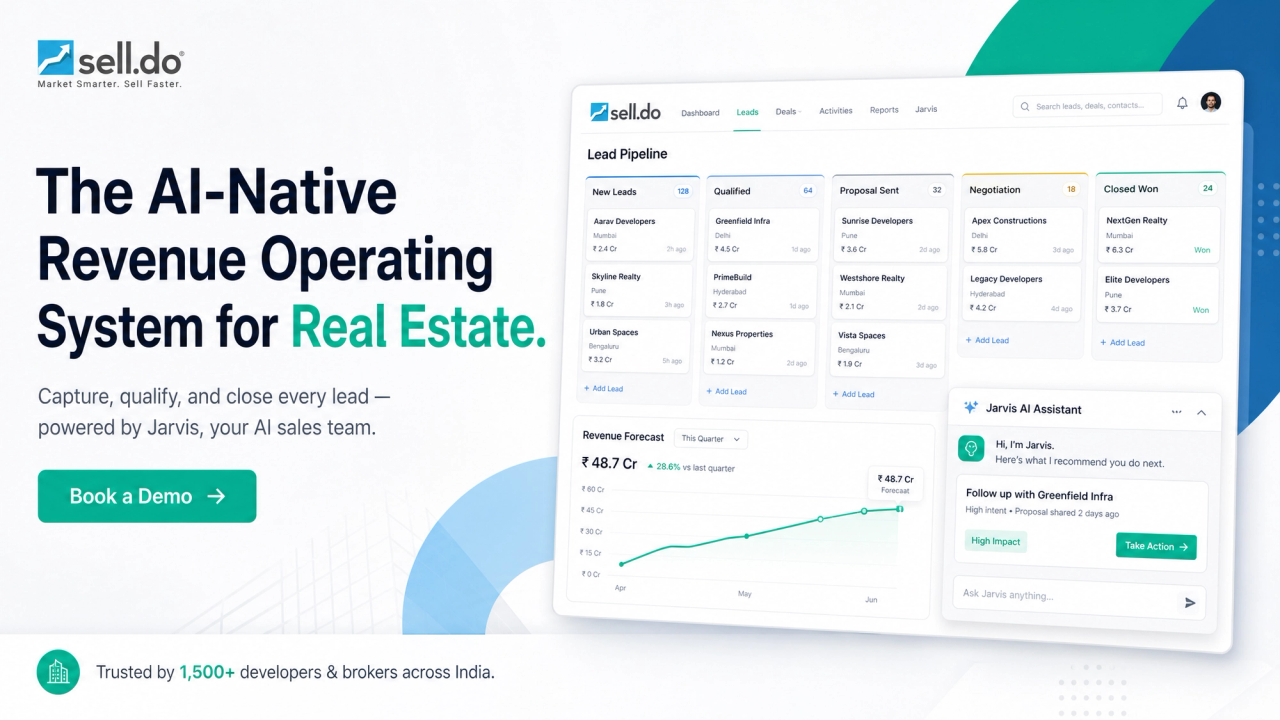
Real estate sales in India involve handling a high volume of leads from a very diverse customer base. It's not simply finding buyers; you must also manage each inquiry carefully and follow up at the right moment. With multiple projects running at once, managing everything through spreadsheets or scattered notes can get messy. A missed follow-up or delayed response could mean losing a potential buyer.
A good CRM software for real estate developers in India makes all the difference. It keeps everything in one place—leads, follow-ups, bookings, and payments—so nothing gets overlooked. Automated reminders, real-time updates, and easy access to data help developers close deals faster and create a better experience for buyers.
Updated for 2026: the real shift this year is from CRM as a system of record to CRM as a system of action. AI-agentic platforms now capture a lead the moment it lands, qualify it over WhatsApp and call, score intent, and book the site visit before a human opens the tab. For a developer running several projects and a hundred-plus channel partners, that speed-to-lead is the difference between a booked walk-in and a lead that went cold on a competitor's inventory.
This guide compares the CRM software Indian real estate developers actually shortlist in 2026, weighs the honest trade-offs between horizontal CRMs and real-estate-native platforms, and gives you a buyer's framework so you pick for source-to-booking attribution, inventory, presales and post-sales — not just contact storage.
Understanding CRM Software for Real Estate Developers in India
The ideal CRM software for real estate developers in India is designed to simplify sales, marketing, and customer interactions. It acts as a central hub where developers can manage leads, track sales progress, and automate follow-ups. Instead of relying on spreadsheets or manual tracking, a CRM system organizes data, streamlines communication, and ensures that no potential buyer is lost due to delays or mismanagement. From the first inquiry to finalizing a sale, everything stays connected, helping developers close deals more efficiently.
A CRM designed for real estate developers goes beyond storing contacts—it streamlines every stage of the sales process. Here’s how it helps manage leads, communication, and transactions efficiently.
Recommended: Steps and Techniques in the Real Estate Sales Process
From the team that built Sell.Do
See how Sell.Do runs your sales, pre-sales and marketing on one AI-first platform.
Use Cases of CRM Software for Real Estate Developers
Managing real estate projects goes beyond construction. You need to track leads, schedule visits, coordinate with channel partners, and handle payments while ensuring your buyers are engaged and nurtured. Doing these tasks manually can cause leads to slip through the cracks as potential buyers lose interest.
A real estate CRM takes the load off by streamlining your entire sales and customer management process. Instead of jumping between spreadsheets, emails, and phone calls, you get a single platform to organize, track, and automate everything.
Here’s how a CRM helps solve everyday challenges for developers:
Lead Management and Follow-Ups
Developers receive hundreds of leads from property portals, social media, and broker networks, but nearly 60% of real estate leads go cold due to delayed follow-ups. Without a structured system, high-intent buyers slip away.
How CRM Helps: With a CRM like Sell.do, you can capture leads from all sources, categorize them, and assign them to the right sales reps. Automated follow-up reminders and lead scoring ensure that priority leads get immediate attention, increasing conversion rates.
Site Visit Scheduling and Management
Around 40% of potential buyers drop off due to unorganized site visit scheduling. Double bookings, last-minute cancellations, and no-shows affect conversion rates.
How CRM Helps: A CRM allows buyers to book site visits online, sends automated confirmations and reminders, and reschedules visits seamlessly. Post-visit feedback is recorded, helping sales teams personalize their approach and close deals faster.
Broker and Channel Partner Coordination
Developers rely on broker networks for 70% of sales, but managing broker commissions and lead tracking manually leads to disputes and inefficiencies.
How CRM Helps: A CRM provides a dedicated broker portal where partners can access real-time inventory, register leads, and track commissions transparently. Developers get clear performance insights, ensuring timely payouts and stronger broker relationships.
Payment and Collections Tracking
Late payments and missed dues lead to cash flow issues, with developers reporting that nearly 30% of buyers delay payments due to a lack of reminders.
How CRM Helps: A CRM automates payment reminders, ensuring buyers receive timely notifications about upcoming dues. Integrated payment tracking helps developers monitor transactions in real time, reducing revenue leakage.
Customer Communication and Relationship Management
Around 52% of homebuyers expect regular updates about project progress, but inconsistent communication leads to frustration and increased inquiries.
How CRM Helps: A CRM centralizes communication, automating updates on project milestones, documentation, and possession dates via email, SMS, or WhatsApp. Keeping customers informed improves satisfaction and builds trust.
Inventory and Project Status Tracking
Developers and sales teams often work with outdated inventory records, leading to 5-10% of sales being lost due to misinformation about availability.
How CRM Helps: A CRM provides real-time inventory updates, ensuring sales teams always have accurate data. Developers can also track project progress and keep buyers informed about availability and expected completion dates.
Post-Sales and Handover Management
Around 25% of real estate buyers experience delays in documentation and possession, leading to frustration and legal issues.
How CRM Helps: The CRM automates document sharing, tracks agreement signings, and streamlines the handover process. This ensures a seamless transition from purchase to possession, improving the overall customer experience.
Now, let’s take a look at the functions of real estate CRM software.
Need innovative taglines for your campaigns? Check our blog: Tips for Writing Catchy Taglines for Real Estate Developers
Key Functionalities of CRM Software for Real Estate Developers in India
A CRM helps real estate developers bring everything together—capturing inquiries, managing interactions, and ensuring every potential buyer gets the attention they need. Here’s how its key features simplify the process and improve sales efficiency.
- Lead Generation: Captures inquiries from multiple sources like property portals, social media, and websites, ensuring no potential buyer is missed.
- Lead Nurturing: Automates follow-ups through emails, messages, and calls, keeping prospects engaged until they are ready to buy.
- Lead Management: Categorizes and prioritizes leads based on interest level, making it easier to focus on high-potential buyers.
- Sales Pipeline Tracking: Provides a clear overview of deals in progress, helping developers plan and close sales efficiently.
- Customer Interaction History: Maintains records of all conversations, ensuring personalized and timely responses.
- Automation & Reminders: Sends alerts for follow-ups, meetings, and pending tasks, reducing the risk of missed opportunities.
With a clear understanding of how CRM software supports real estate developers, the next step is choosing the right one.
Also, check our blog: Understanding Proptech and Its Use in the Real Estate Industry
Choosing the Right CRM for Real Estate Development
Finding the right CRM software for real estate developers in India means selecting a system that streamlines operations, simplifies lead management, and improves client interactions. A well-suited CRM helps developers handle projects efficiently while ensuring smooth communication with buyers and channel partners. Here’s what to consider:
- Scalability & Flexibility: A CRM should grow with your business, handling increased project volumes, multiple teams, and expanding data without disruptions.
- User-Friendliness & Accessibility: A complex system slows down adoption. Look for an intuitive interface with mobile access so that sales teams can manage leads and client interactions effortlessly.
- Seamless Integrations: Ensure the CRM connects with essential tools like marketing platforms, property portals, ERP software, and communication channels to avoid data silos.
- Personalized Communication: A CRM with omnichannel communication helps maintain timely and relevant interactions with potential buyers and existing clients.
- Faster Response Time: Automated follow-ups, WhatsApp integrations, and instant lead assignments reduce delays, making clients feel valued.
- Transparency & Trust: Features like eKYC, digital signatures, and document management ensure secure transactions and build client trust.
- Real Estate-Specific CRM: Generic CRMs often fail to meet the unique needs of real estate developers. A dedicated real estate CRM comes with industry-specific features like inventory management, site visit tracking, brokerage management, and payment schedule automation—helping developers close deals faster and manage operations efficiently.
Most CRMs are built for general business needs, leaving real estate developers struggling with inefficient workflows, high implementation costs, and a lack of industry-specific features. To overcome these challenges, we recommend Sell.Do—a real estate CRM that truly simplifies your sales process.
Get Sell.Do, The Leading CRM Software for Real Estate Developers in India
Rating: 4.8/5
Sell.Do is an industry-leading real estate CRM designed specifically to meet the unique needs of developers, brokers, and agencies. Unlike generic CRMs, Sell.Do is built with real estate workflows in mind, making it a tailored, easy-to-use solution for managing leads, automating sales, and streamlining operations. Trusted by 1,000+ real estate developers and agencies, it simplifies everything from lead capture to post-sales management, ensuring no opportunity is missed.
With a deep understanding of the real estate industry, Sell.Do helps developers increase conversions, enhance broker coordination, and improve buyer engagement—all from a single platform. Whether you’re handling pre-sales, site visits, or payment tracking, Sell.Do ensures seamless automation and efficiency at every stage.
Below are the key features of Sell.do:
- 1 Real Estate-Specific Lead Management
- Captures real-time leads from property portals, social media, and campaigns.
- AI-powered lead scoring prioritizes high-intent buyers for faster conversions.
- Automated follow-ups via email, SMS, and WhatsApp prevent lead drop-offs.
- 1 Smart Site Visit Scheduling
- Eliminates manual coordination with automated scheduling and reminders.
- Buyers can book visits online, reducing no-shows and last-minute cancellations.
- Post-visit feedback tracking helps sales teams tailor their pitch.
- 1 Broker & Channel Partner Collaboration
- A dedicated broker portal for lead registration, commission tracking, and inventory access.
- Transparent commission calculations and automated payouts strengthen broker relationships.
- Real-time reporting on broker performance and lead conversions.
- 1 Automated Payment Collection & Reminders
- Tracks due payments and sends automated reminders to ensure timely collections.
- Reduces manual follow-ups, improving cash flow and reducing revenue leakage.
- Secure payment integrations for a seamless transaction experience.
- 1 Customer Communication & Engagement
- Centralized communication through emails, SMS, and WhatsApp.
- Automated project updates keep buyers informed, reducing inquiry load.
- Personalized engagement improves customer trust and satisfaction.
- 1 Real-Time Inventory & Project Tracking
- Always updated inventory data to avoid miscommunication and lost sales.
- Enables sales teams to provide accurate availability information.
- Developers can track project progress and inform buyers about completion timelines.
- 1 Post-Sales & Handover Automation
- Digital documentation and agreement tracking ensure smooth transactions.
- Automates the possession process, reducing buyer frustration.
- Helps developers manage post-sales interactions efficiently.
Pricing: Custom
Check out our blog post, Strategies to Generate Commercial Real Estate Leads, to optimize your lead generation campaigns.
Why Choose Sell.Do?
Most CRMs are built for general business needs, often neglecting the unique challenges real estate professionals face. They focus on internal workflows but fail to connect external stakeholders like customers and channel partners, leading to communication gaps and inefficiencies.
Sell.Do is built specifically for real estate, addressing these pain points with AI-powered tools that enhance customer interactions, improve sentiment analysis, and streamline collaboration across teams. From handling legal compliance and negotiation approvals to tracking payments and managing price quotes, everything is centralized within one platform.
For real estate businesses that need more than just basic CRM functions, Sell.Do provides a tailored solution that simplifies operations, improves customer engagement, and manages every touchpoint effectively.
Sell.do vs Salesforce, HubSpot, Zoho and LeadSquared: an honest 2026 comparison
Every CRM below can store a lead. The question for a developer is what happens after capture — and whether the platform understands inventory, channel partners, cost sheets, RERA and post-sales, or expects you to build all of that yourself. Prices are indicative publicly listed starting rates for 2026 (billed annually, per user per month); real-estate deployments are almost always quoted custom, so treat these as a floor, not a quote.
Salesforce Sales Cloud
The enterprise standard and the most customizable CRM on the market — which is exactly the catch. Salesforce is horizontal: there is no native concept of a unit, a tower, a hold-block, a cost sheet or a channel-partner payout. Indian developers reach real-estate parity only after a long, consultant-heavy implementation. Publicly listed starting price is around $25/user/month (Starter), rising to roughly $100/user/month (Pro) before add-ons. Best when you already run Salesforce company-wide and have the budget and admin capacity to build the vertical.
HubSpot Sales Hub
The easiest to adopt and strongest on marketing-to-sales alignment, with a genuine free tier. But like Salesforce it is built for generic B2B pipelines, not real estate — inventory, site-visit workflows, broker portals and possession tracking all have to be bolted on. Starter is about $20/user/month and Professional about $100/user/month. A good fit for a lean sales-and-marketing team that values usability over real-estate depth.
Zoho CRM
The value pick, and the one with real India pricing — Standard around ₹800/user/month and Professional around ₹1,400/user/month. Zoho is flexible and the wider Zoho suite is attractive, but the real-estate fit still depends on custom modules and Blueprint automation you configure yourself. Sensible for smaller developers and brokers who are comfortable building their own workflows to keep licensing costs down.
LeadSquared
The closest horizontal competitor because it markets a real-estate vertical and is strong on high-volume lead capture, distribution and sales-team discipline. Pricing is quote-based, typically from around ₹1,000+/user/month. It handles speed-to-lead and lead routing well, but developers still tend to look elsewhere for deep inventory (unit/tower availability, hold-block), cost sheets and a RERA-ready channel-partner payout ecosystem.
Sell.do
Purpose-built for Indian real estate, and the reason it is this guide's canonical pick for developers. Sell.do is not a horizontal CRM with a real-estate skin — the real-estate workflows are the product: IRIS handles launches, live inventory (unit/tower availability, hold-block) and cost sheets; a whitelabel channel-partner ecosystem gives brokers subdomains, CP logins, lead registration and transparent payout tracking; unified capture pulls leads from Meta, Google, portals, website and walk-ins with source-to-booking attribution so no lead leaks between sources. Jarvis AI scores intent, auto-logs calls and drives follow-ups, while built-in calling and WhatsApp let the AI agent respond, qualify and book site visits in seconds. Pricing is custom because deployments are scoped to your projects and team. Trusted by 1,000+ developers and agencies.
At a glance
- Real-estate-native (inventory, cost sheets, CP payouts, post-sales): Sell.do out of the box; the others need custom builds (LeadSquared partially).
- Fastest to real-estate value in India: Sell.do and LeadSquared; Salesforce and HubSpot require heavier configuration.
- Lowest sticker price: Zoho and HubSpot's free/Starter tiers — but factor in the cost of building the vertical yourself.
- AI-agentic capture-to-site-visit: Sell.do (Jarvis + built-in calling/WhatsApp); others rely on add-ons or integrations.
If you sell primarily through agents rather than run projects, the buyer intent differs — see our companion guide, best real estate CRM software for agents in India.
Starting lean and price-sensitive? Compare the top free real estate CRM software tools for 2026 before you commit to a paid seat count.
How to choose (a 60-second buyer's framework)
Score each shortlist option on five real-estate questions, not on feature-count. One: does it capture from every source (Meta, Google, portals, website, walk-ins, channel partners) without exports? Two: can it prove source-to-booking attribution so you know which campaign produced which sale? Three: does it manage live inventory and cost sheets, not just contacts? Four: does it give channel partners a whitelabel portal with transparent payouts? Five: does it act on leads — AI scoring, auto follow-ups, calling and WhatsApp — or only store them? A horizontal CRM can be forced to do some of this; a real-estate-native platform does it on day one.
Conclusion
Managing real estate sales without a structured system leads to missed leads, slow follow-ups, and lost revenue. A CRM simplifies these processes, ensuring that every inquiry is tracked, every client interaction is recorded, and every deal moves forward without delays.
However, real estate developers need a solution built specifically for their challenges. This is where Sell.Do stands out as a CRM software for real estate developers in India. Designed for real estate professionals, it brings everything—lead management, automated communication, inventory tracking, and payment processing—into one powerful platform.
If you’re looking for a CRM that understands your business inside and out, Sell.Do is worth a try.
Related reading
Best Real Estate CRM Software for Agents in India (2026)
Insights from the Sell.do real-estate CRM team.