
Real Estate CRM with Inventory Management: One System for Leads + Units (2026)
Running leads in a CRM and units in a spreadsheet costs you deals. Here’s what a real estate CRM with inventory management should do — and how to evaluate one in 2026.
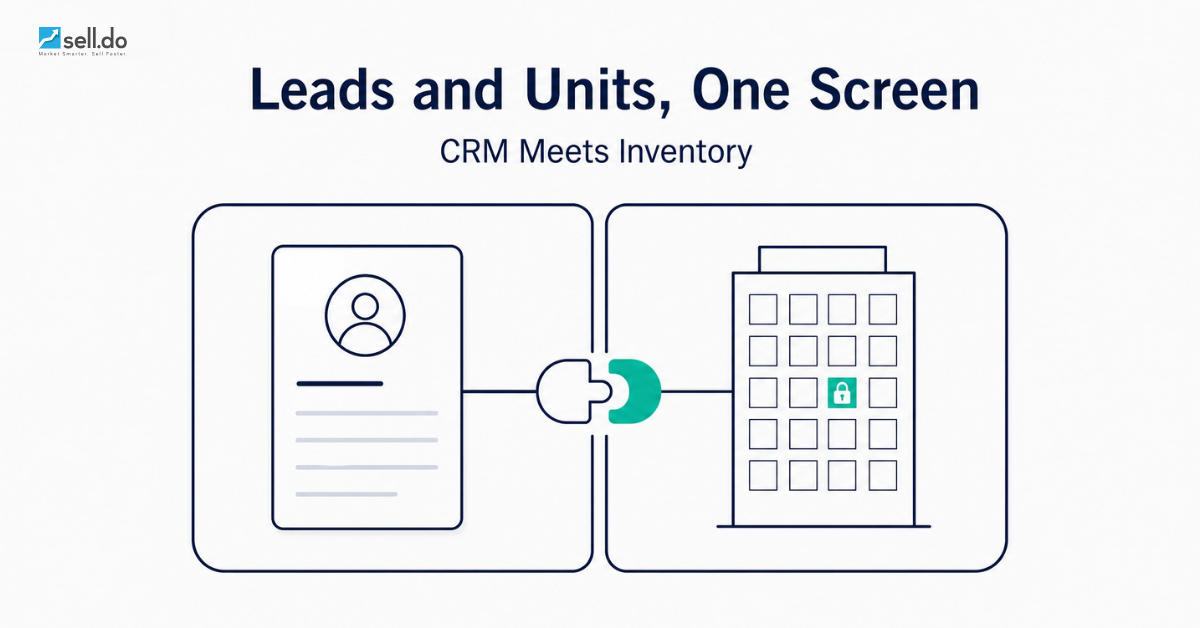
Most Indian developers run two disconnected systems. Leads live in a CRM. Units live in a spreadsheet, an ERP, or an inventory tool the sales team can barely see. So when a hot lead asks "is a 3BHK on the 12th floor still available, and what’s the all-in cost?", the sales rep puts the buyer on hold, pings the CRM manager, waits for a fresh availability sheet, then calls back an hour later. By then the buyer has moved on. This guide is about closing that gap: what a real estate CRM with inventory management actually is, what it should do, and how to evaluate one in 2026.
Why leads and inventory shouldn’t live in separate systems
A CRM knows who your buyers are. An inventory system knows what you have to sell. Keep them apart and every handoff between the two leaks time and money. With roughly a million-plus unsold units sitting across India’s top seven cities (2025 housing-market trackers), the developers who win are the ones who can match the right buyer to the right available unit in seconds, not hours.
The disconnect shows up in familiar ways: reps quote units that were blocked yesterday, two salespeople soft-block the same flat for different buyers, cost sheets are built by hand in Excel and go out with pricing errors, and management never gets a clean live view of what’s sold, held, or available per tower. Each of these is a symptom of the same root cause — leads and units aren’t in one system.
From the team that built Sell.Do
See how Sell.Do runs your sales, pre-sales and marketing on one AI-first platform.
What “a real estate CRM with inventory management” actually means
It’s not a generic CRM with a "products" tab. Real estate inventory is structured — project, tower, floor, unit, configuration, facing, area, status — and it changes by the hour. A CRM built for this ties every lead and booking to a live unit. At minimum, expect:
- Structured inventory: project → tower → floor → unit with configuration, carpet/built-up area, facing, PLC, and real-time status (available, held, blocked, booked).
- Hold-block logic: a rep can soft-hold a unit against a specific lead for a set window, so two people can’t sell the same flat — and holds auto-expire.
- Automated cost sheets: pull base price, floor rise, PLC, taxes, and charges from the unit master so quotes go out consistent and error-free.
- Live availability to sales: the person on the call sees current inventory without asking anyone — no WhatsApp-ing the inventory manager for a fresh sheet.
- Unit-to-booking traceability: when a lead converts, the unit flips to booked and flows into post-sales (agreement, collections, possession) without re-keying.
What changes on the ground when leads + units are one system
The point isn’t tidier data — it’s a faster, cleaner sale. A unified system means a rep can qualify a lead, filter live inventory to units that match the budget and configuration, hold one, and generate an accurate cost sheet in the same screen, on the same call. Speed-to-answer is a conversion lever: the longer a buyer waits for "is it available and what does it cost", the colder they get.
It also protects the top of the funnel. A unified platform captures leads from Meta, Google, portals, the website, walk-ins, and channel partners into one place, then matches them to available units — the same never-lose-a-lead discipline covered in our real estate lead management playbook. And it gives management a single live view of inventory health per project instead of a spreadsheet that’s already stale by the time it lands in the inbox.
How to evaluate a CRM with inventory management (2026 checklist)
If you’re comparing options, pressure-test each one against how Indian real estate actually sells:
- Is inventory truly real-time and shared? Availability the whole sales team sees live, not a nightly export.
- Does it handle holds and double-booking? Time-boxed soft-holds tied to a lead, with auto-release.
- Are cost sheets automated and auditable? Driven by the unit master, with a trail of who quoted what.
- Does capture + calling + WhatsApp come built in? So leads are worked where they land, without bolt-on tools.
- Does it carry through to post-sales? A booked unit should flow into agreements, collections, and possession, not stop at "won".
For a deeper feature-by-feature view of the inventory side specifically, our real estate inventory management software buyer’s guide breaks down unit/tower/availability management in detail; this guide is about the intersection — why that inventory belongs in the same system as your leads. For the older question of whether a generic CRM can even do this well, see can CRMs manage inventory in real time.
Where Sell.do fits
Sell.do is an AI-agentic CRM built for Indian real estate, and inventory isn’t an add-on — it’s core. IRIS, Sell.do’s launches-and-inventory engine, manages project, tower, and unit availability with hold-block logic and automated cost sheets, sitting in the same platform that captures and qualifies your leads. A presales or sales rep can see a lead’s requirement, filter live units that fit, hold one, and send a correct cost sheet without leaving the lead record.
Because capture, built-in calling and WhatsApp, Jarvis AI lead scoring, inventory, and post-sales all live in one place, a booking traces cleanly from the source campaign to the exact unit to collections — the source-to-booking traceability developers keep asking for. One system for leads and units means fewer manual sheets, fewer double-blocks, and far less lag between "interested" and "booked".
One system, fewer leaks
Running leads and inventory apart is a quiet tax on every deal — paid in hold time, pricing errors, and buyers who cool off while a rep hunts for a fresh availability sheet. A real estate CRM with inventory management removes that tax by putting the who and the what in one screen. If you’re a developer evaluating this, look at how a real-estate-native, AI-agentic platform handles leads and units together rather than stitching two tools. See the AI-agentic CRM built for Indian real estate, and book a walkthrough to see IRIS inventory and lead management working in one flow.
Related reading
Top CRM software for real estate developers in India
Real estate inventory management software: a 2026 buyer’s guide
Real estate post-sales management in 2026: from booking to possession
Insights from the Sell.do real-estate CRM team.