
Real Estate Lead Management: The First-Touch-to-Booking Playbook (2026)
A complete 2026 guide to real estate lead management for Indian developers and brokers: the full first-touch-to-booking lifecycle, stage-by-stage, and the metrics that matter.
- Why real estate lead management is different in India
- The lead management lifecycle: from first touch to booking
- 1. Capture — pull every source into one place, tagged
- 2. Qualify — score leads so reps work the right ones first
- 3. Nurture — stay in front until they are ready to move
- 4. Site visit — the highest-intent moment; do not fumble the TAT
In Indian real estate, the problem was never lead volume. A single project launch can flood your team with hundreds of enquiries in a weekend — from Meta and Google ads, 99acres, MagicBricks and Housing, your website, hoardings and channel partners. The real problem is what happens in the next five minutes, the next five days, and the next five weeks.
Most developers and brokers lose deals not because leads dry up, but because leads leak: an enquiry that never got called back, a hot buyer who cooled while waiting for a follow-up, a site visit that was booked and then forgotten. Lead management is the discipline that closes that gap — moving every enquiry along a defined path so nothing sits untouched and every rupee of ad spend is traceable to an outcome.
This guide lays out the full first-touch-to-booking lifecycle for Indian real estate teams in 2026, the benchmarks worth measuring at each stage, and where a purpose-built real estate CRM changes the maths.
Why real estate lead management is different in India
Speed-to-lead decides everything. Buyers contacted within the first five minutes of an enquiry are far more likely to qualify than those reached even 30 minutes later — and in a WhatsApp-first market, the first team to respond, on the channel the buyer actually uses, usually wins the site visit. Add multi-portal and channel-partner sourcing (which makes deduplication and source tagging non-negotiable), RERA-compliant record-keeping, and a consideration cycle that runs for weeks or months, and it becomes clear why a generic sales pipeline built for one-call software deals does not fit real estate.
Good lead management in India therefore has to do four things at once: capture from every source without leakage, respond fast on WhatsApp and phone, nurture patiently across a long cycle, and keep every touch tied back to the campaign that produced it.
From the team that built Sell.Do
See how Sell.Do runs your sales, pre-sales and marketing on one AI-first platform.
The lead management lifecycle: from first touch to booking
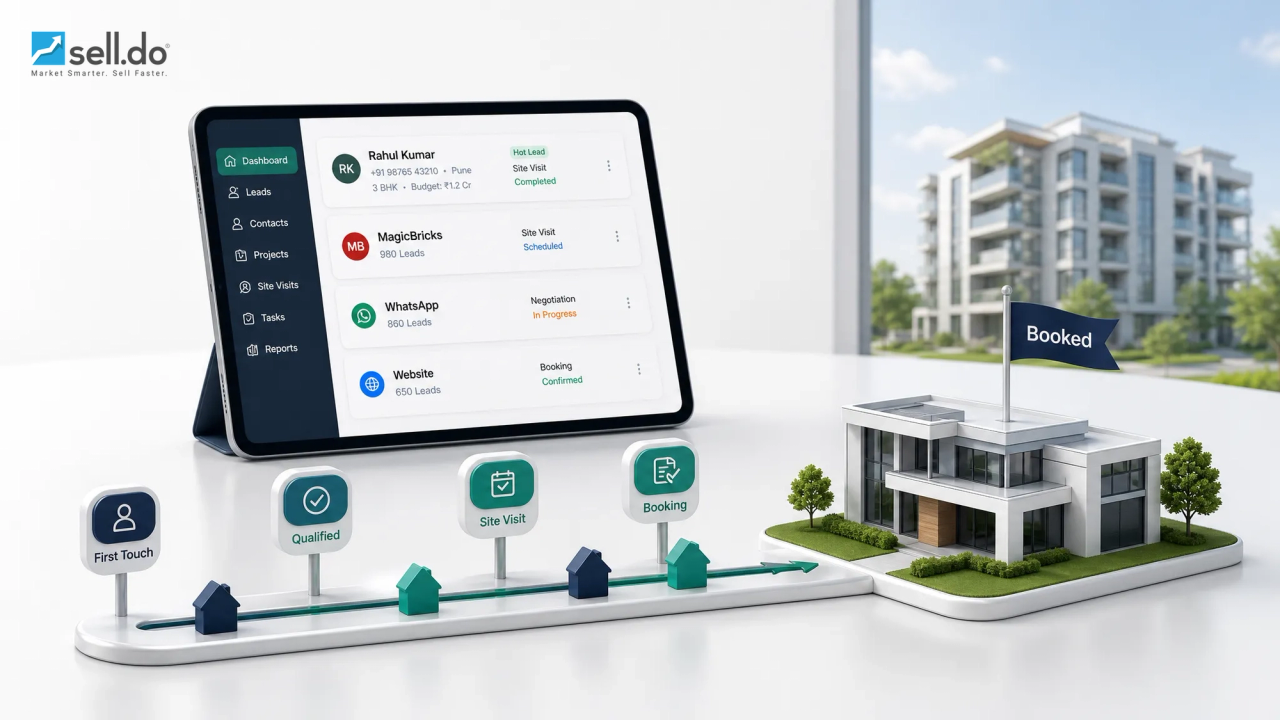
Every enquiry, regardless of source, should move through the same five stages. Treating them as one continuous lifecycle — rather than disconnected tasks owned by different people — is what separates teams that convert 3–4% of enquiries from teams stuck at 1%.
1. Capture — pull every source into one place, tagged
With automatic lead capture, enquiries from Meta and Google, portals like 99acres and MagicBricks, website forms, missed calls, walk-ins and channel partners land in one centralized database — each tagged with its true source. Leakage almost always begins the moment leads are exported to a spreadsheet and manually re-keyed. A CRM that captures at source (and de-duplicates automatically) means the same buyer enquiring twice does not become two half-worked leads, and marketing gets clean source data to measure cost per lead against.
2. Qualify — score leads so reps work the right ones first
Leads keep coming, and the more you get, the more overwhelming they feel without a way to sort them. Qualification separates the buyers worth a call today from the ones worth an automated nurture. Automated lead scoring assigns a Hot, Warm or Cold rating against predefined criteria — budget fit, configuration and locality preference, timeline and engagement — so reps start with Hot leads instead of dialing top-to-bottom. This is also where the MQL-vs-SQL distinction matters: a marketing-qualified enquiry is not yet ready for a sales push, and treating it like one burns the lead.
3. Nurture — stay in front until they are ready to move
Because the buying cycle runs for weeks, most leads are not lost — they are simply not ready yet. Nurturing keeps you present across that gap with a mix of WhatsApp messages, emails, and timely calls, each carrying a distinct reason to re-engage (a new inventory drop, a price update, a site-visit invite). Drip sequences and pre-built message templates let a small team run dozens of parallel nurtures without a rep manually writing every follow-up, while still keeping the tone human.
4. Site visit — the highest-intent moment; do not fumble the TAT
A booked site visit is the single strongest predictor of a booking, which makes this the worst stage to drop the ball. Schedule the visit, confirm and remind on WhatsApp, assign the right sales rep, and track first-response TAT so no confirmed-intent buyer waits. Teams that measure lead-to-site-visit conversion and site-visit-to-booking conversion separately can see exactly where deals stall — and fix the specific stage rather than guessing.
5. Booking and handoff — close the loop and feed attribution back
When a booking happens, the lifecycle should not just end — it should report back. Tying the booking to its originating campaign gives marketing true source-to-booking attribution, so budget shifts to the sources that actually produce sales, not just the cheapest clicks. From there, bookings flow into agreements, collections and possession, and the same record that started as a cold enquiry becomes a documented, RERA-ready sale.
How a real estate CRM automates each stage
Automation plays an instrumental role in streamlining these stages, reducing workload and eliminating repetitive work for sales reps. Concretely, a real estate CRM improves lead management across four aspects:
Generate leads from multiple sources: leads are automatically sourced from social platforms, email, website forms and portals, stored in a centralized database with proper tagging, and integrated with ad-analytics data so campaign performance sits alongside the leads it produced.
Automated lead segregation: incoming leads are sorted automatically by personal details, configuration preference, budget comfort and more, so you can always pull up and engage the right leads at the right time instead of drowning in an undifferentiated list.
Automated lead qualification: lead scoring validates leads as Hot, Warm or Cold against predefined rules, letting reps engage high-potential buyers immediately and avoid wasting time on leads with little chance of converting.
Automated lead nurturing: through the multi-stage engagement before a customer acts, templatized WhatsApp and email follow-ups keep every lead warm with the right message for each scenario — with far less manual effort from the team.
The lead management metrics worth tracking in 2026
You cannot fix what you do not measure. The metrics that actually move bookings are: first-response time / speed-to-lead (are hot leads reached within minutes?), cost per lead by source and campaign, lead-to-site-visit conversion, site-visit-to-booking conversion, follow-up / TAT compliance across the team, and source-to-booking attribution. Tracking these on a live dashboard — rather than reconstructing them from spreadsheets at month-end — is what turns lead management from a hope into a system. A real estate CRM dashboard built for these numbers surfaces the leaking stage before the quarter is lost.
Spreadsheets vs a CRM: when to graduate
A spreadsheet is a fine place to start, and for a handful of leads a month it works. It breaks the moment volume, speed and a team are involved: there is no built-in calling or WhatsApp, no automatic TAT alerts when a lead goes cold, no de-duplication, no attribution, and every rep keeps their own version until the numbers no longer agree. If you are still running leads out of Excel, this free lead-tracking template and the signs it is time to move on is the right next step before you commit to a platform.
Conclusion
Basic lead management tools can automate parts of this process, but real estate lead management is a full lifecycle, not a single feature. With a purpose-built platform like Sell.do, capture, scoring, nurturing, site-visit scheduling and booking live in one ecosystem — with built-in calling and WhatsApp, Jarvis AI lead scoring and auto-logged follow-ups — so leads move from first touch to booking without leaking in between, and every sale traces back to the campaign that started it.
Get a real estate CRM built for Indian developers and brokers, and you turn higher lead volumes, cleaner data and an effective qualification process into one system that eliminates repetitive work and lets your team focus on the buyers most likely to book.
Related reading
Best Real Estate CRM Software for Developers in India (2026)
Real Estate CRM Dashboards & Analytics: What to Track in 2026
Insights from the Sell.do real-estate CRM team.