
Steps and Tips for Perfect Real Estate Drip Campaigns
Learn how to create effective real estate drip campaigns that ensure consistent communication and help you get more conversions.
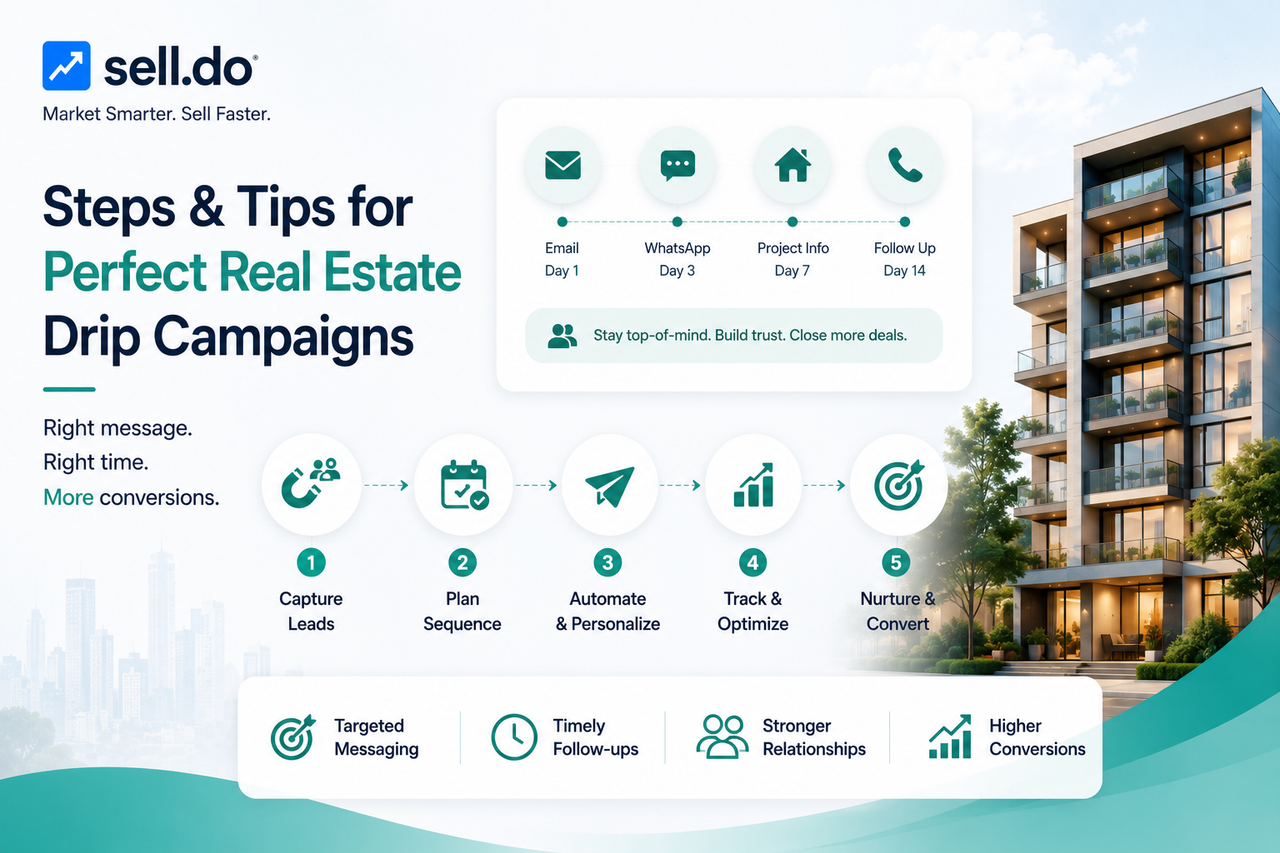
Most real estate teams know they should "follow up."
Very few do it well.
The usual problem isn't effort---it's timing, relevance, and fatigue. Leads either hear too much too soon or don't hear back at all. That's exactly where real estate drip campaigns earn their place.
A good drip campaign keeps conversations moving quietly in the background. No pressure. No chasing. Just consistent, useful communication that feels natural when the buyer or seller is finally ready to act.
If drip marketing for real estate feels confusing or over-engineered, this guide walks through it the way sales teams actually use it---not how software demos show it.
What Is a Drip Campaign in Real Estate?
A drip campaign in real estate is essentially a planned sequence of messages that are sent over time. These messages are automated, but the intent behind them is human---to stay relevant without being intrusive.
Let's say someone enquires on your website.
Day one: they receive a short acknowledgement.
A few days later: something useful---project details, buying tips, or market context.
Later: a soft nudge toward the next step.
That's a drip.
Unlike one-time promotional emails, real estate drip campaigns adjust based on behaviour. Someone who clicks, reads, or replies moves forward. Someone who doesn't get space.
This is why drip campaigns are more effective than bulk emails. They don't assume intent. They respond to it.
From the team that built Sell.Do
See how Sell.Do runs your sales, pre-sales and marketing on one AI-first platform.
How to Create a Real Estate Drip Campaign That Actually Works?
The biggest mistake teams make is jumping straight into automation. Tools don't fix unclear thinking.
Here's what needs to come first.
Start With One Goal
Every drip campaign for realtors should answer one question:
What action should this person take next?
Not ten actions. One.
Site visit.
Pricing discussion.
Loan eligibility check.
Re-engagement.
If you can't define that, the campaign will wander---and so will your leads.
Segment More Than You Think You Need To
"Buyer" is not a segment. Neither is "seller."
Good drip marketing for real estate separates people by:
- Stage of intent
- Budget range
- Project type
- Location preference
- Past engagement
Smaller lists perform better. Always.
Write for the Moment They're In
Someone early in their journey doesn't want inventory dumps.
Someone ready to close doesn't want education emails.
This is where many email drip campaigns for real estate fail---they talk at leads instead of with them.
Decide Frequency Before You Write Content
Timing matters more than copy.
Cold leads need space.
Warm leads need momentum.
Hot leads need relevance, not reminders.
If people start skipping emails, it's not always the message---it's the rhythm.
Automate, But Don't Lock Yourself In
Automation should support conversations, not replace them.
Your CRM should allow sales teams to pause, edit, or exit a drip when a lead engages. This flexibility is what separates useful automation from annoying automation.
Types of Real Estate Drip Campaigns You Should Be Running
Welcome Sequences
This sets expectations. Not selling---just clarity. Who you are, what they'll receive, and how often.
- Email 1 (Day 0):
Thanks for checking out our projects. Over the next few weeks, we'll share short updates on pricing trends, availability, and things most buyers ask before booking a visit. - Email 2 (Day 2):
Here's how we usually help buyers narrow choices---budget, location, and timeline. No spam. You can unsubscribe anytime.
Educational Campaigns
These work especially well for long decision cycles. Guides, checklists, explanations. Nothing promotional. Just helpful.
Email:
Buying under construction vs ready-to-move: what changes in cost, risk, and timelines?
→ Includes a simple checklist or explainer, no CTA except "Save this for later."
Re-Engagement Campaigns
Quiet leads aren't dead leads. Most just aren't ready yet. A simple check-in with a new context often brings them back.
- Email:
You looked at 2BHK options in Whitefield earlier this year. Buyer demand has shifted since then---sharing what's changed (and what hasn't). - Soft CTA: "Want updated options?"
Property Update Campaigns
Highly effective when driven by behaviour. The more specific, the better.
Email:
The 2BHK you viewed last week now has only 3 units left on higher floors.
Includes: unit size, floor range, price band
CTA: "View updated floor plans"
Post-Sale Campaigns
Often ignored. Also, where referrals come from. Stay present even after the deal is done.
- Email:
Your booking is complete Here's what usually happens next---agreement timelines, payment milestones, and site updates. - Follow-up email (30 days later):
If you know someone planning to buy nearby, we're happy to help---no obligation.
Event & Open House Campaigns
Reminders before. Follow-ups after. One clear CTA per message.
- Email 1 (3 days before):
Reminder: Site visit this Saturday, 11 AM. Parking details and Google Maps link inside. - Email 2 (Post-event):
Thanks for visiting. Based on what you liked, here are 2 similar units you may want to see.
Market & Seasonal Updates
These positions inform you as informed without pushing inventory every time.
Email:
Why festive-season offers look bigger---but don't always reduce final prices.
CTA: "Want to understand offers for your budget?"
Real Estate Drip Campaign Email Templates (How Teams Actually Use Them)
Templates aren't shortcuts. They're starting points.
High-performing real estate drip campaign templates still get customized---names, locations, intent signals, language tone.
The most effective sequences usually include:
- A short welcome email
- One or two value-driven messages
- A soft CTA
- A pause
Anything longer should justify its place.
Things to Double-Check Before You Go Live
- Are emails personalised beyond just the name?
- Is the CTA clear, or buried?
- Can sales intervene if a lead replies?
- Is performance being tracked at the campaign level---not just email level?
- Are you sending value even when you're not selling?
If the answer to any of these is no, fix that first.
Why Does Your CRM Determine Drip Campaign Success?
Running real estate drip campaigns manually doesn't scale. Running them blindly doesn't convert.
You need visibility into:
- Lead behaviour
- Engagement trends
- Drop-offs
- Timing patterns
CRMs built specifically for real estate workflows---like Sell.Do---are designed around these realities. They allow marketing automation without losing sales control, which is where most generic CRMs fall short.
How Sell.Do's Email Marketing Enables Better Drip Campaigns
Sell.Do's email marketing isn't a standalone feature---it's tightly integrated with lead management, sales activity, and automation.
Here's what that means in practice:
Emails triggered by real behaviour, not fixed schedules
Instead of sending emails just because "Day 3" has arrived, Sell.Do lets you trigger emails based on actions---property views, site visits, inactivity, or stage movement in the pipeline.
Deep visibility into engagement
You don't just see who received an email. You see:
- Opens
- Clicks
- Response patterns
- Which content actually nudges buyers forward
This allows sales and marketing teams to adjust follow-ups instead of guessing.
Smart segmentation without manual lists
Leads can be segmented dynamically based on:
- Project interest
- Location preference
- Budget range
- Buyer stage (new, warm, inactive, post-visit, post-booking)
So your drip campaigns stay relevant---even as lead data changes.
Automation without losing sales control
One of the biggest fears sales teams have with automation is losing context. Sell.Do avoids this by keeping email automation connected to:
- Lead owners
- Follow-up tasks
- Call history
- Site visit activity
Marketing automation supports sales---it doesn't replace it.
Consistent brand communication at scale
Whether you're sending welcome emails, educational drips, or post-sale updates, Sell.Do ensures messaging stays consistent across thousands of leads---without overwhelming teams or buyers.
If you want to see how email-driven drip campaigns work inside a real estate CRM---end to end---book your demo here:
https://www.sell.do
FAQs
How long should a real estate drip campaign run?
Most effective real estate drip campaigns run between one and three months. Long-term nurture campaigns can continue at a lower frequency.
What email frequency works best?
Cold leads: once every 7--10 days
Warm leads: once every 3--5 days
Hot leads: fewer emails, more relevance
When do leads start unsubscribing?
Usually, when emails feel repetitive or irrelevant---not because there are "too many." Frequency without value causes churn.
What deliverability practices matter most in 2026?
Authenticated domains, gradual warm-up, clean lists, consistent engagement, and avoiding sudden spikes in volume.
Should teams use pre-made templates?
Yes---but only as a base. The best-performing drip campaigns for realtors are customised to audience behaviour.
What conversion rates are realistic?
Cold nurture: 1--3%
Warm nurture: 5--10%
Re-engagement: 2--5%
Tracking this consistently is far easier inside a real estate-focused CRM.
If drip campaigns feel mechanical, they'll perform that way.
When they're built around timing, intent, and restraint, they quietly become one of the most dependable tools in a real estate sales engine.
How does Sell.Do's inbuilt email feature support real estate drip campaigns?
Sell.Do supports drip campaigns by integrating email directly into the real estate sales lifecycle---right from lead capture to post-sale engagement.
Emails aren't sent in isolation; they are tied to lead stages, follow-ups, site visits, and buyer intent. This ensures drip campaigns stay contextual and relevant instead of feeling like generic newsletters.
Can Sell.Do trigger emails based on buyer behaviour and lead activity?
Yes. Sell.Do allows emails to be triggered based on real buyer actions such as:
- Lead creation from portals, ads, or website forms
- Property or project interest
- Site visit completion or no-shows
- Inactivity for a defined period
- Movement between sales stages
This behaviour-driven approach ensures emails go out when buyers are most likely to engage, not just on fixed timelines.
How is Sell.Do's email marketing different from generic CRM email tools?
Generic CRMs treat email as a standalone marketing function. Sell.Do treats email as part of the sales workflow.
Key differences include:
- Emails are connected to lead ownership and follow-up activity
- Automation is aligned with real estate pipelines, not generic funnels
- Sales, pre-sales, and marketing teams work on the same lead context
- Email performance is viewed alongside calls, site visits, and deal progress
This ensures automation supports conversion rather than operating in silos.
Can Sell.Do segment leads automatically for targeted drip campaigns?
Yes. Sell.Do enables dynamic lead segmentation based on:
- Project or property interest
- Location and budget preferences
- Buyer stage (new, warm, inactive, booked, post-sale)
- Engagement history and activity patterns
As lead data changes, segments update automatically---keeping drip campaigns accurate without manual list management.
Insights from the Sell.do real-estate CRM team.