
What Is an AI-Agentic CRM — And Why Real Estate Needs One Before Everyone Else
Agentic AI CRMs don't just suggest — they capture, qualify, follow up, and update on their own. Here's what that means and why Indian real estate is the first industry where it pays off.
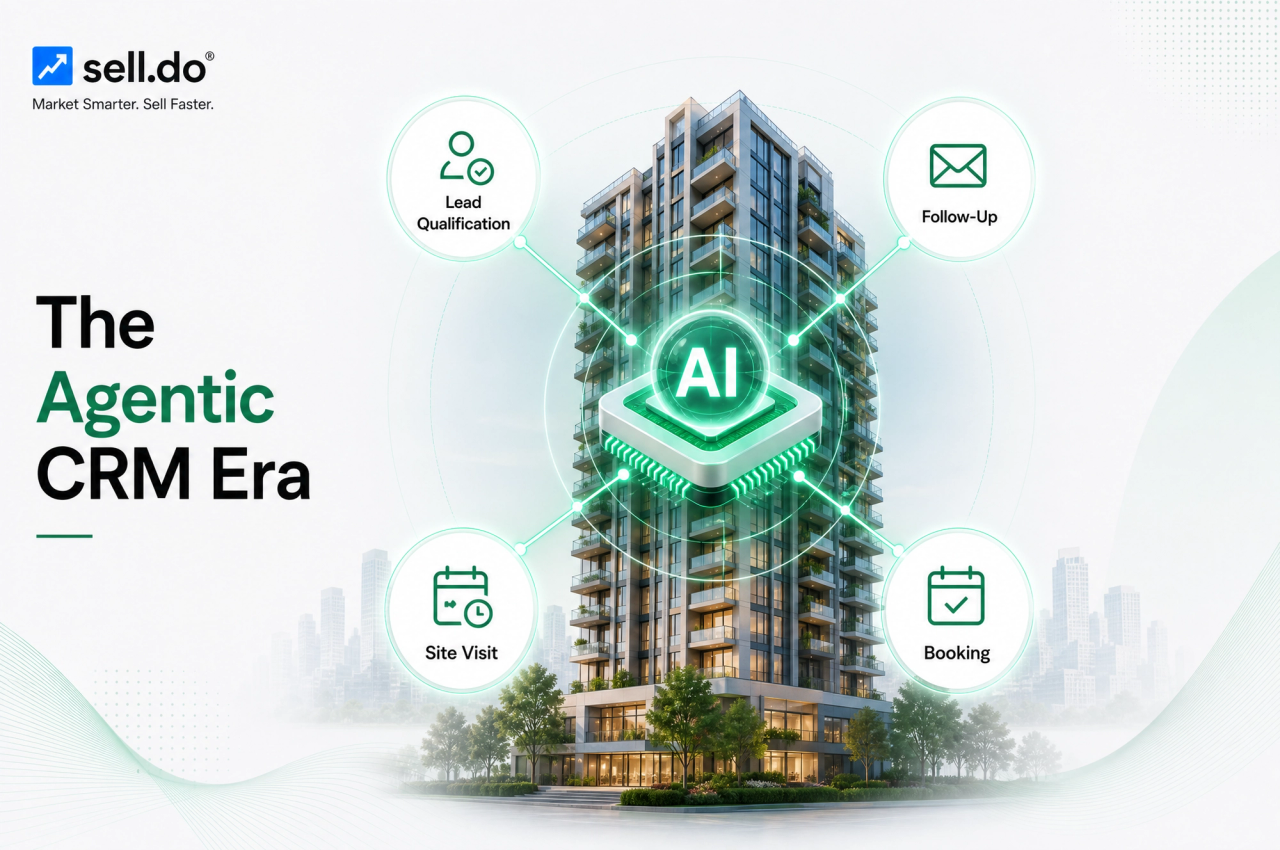
- Assistive AI vs agentic AI: the difference that matters
- Why real estate is the perfect first home for agentic AI
- The five things an AI-agentic CRM does on its own
- 1. Captures and tags every lead, from every source, instantly
- 2. Responds and qualifies in seconds, on the channel the lead prefers
- 3. Follows up relentlessly, on schedule, without being told
Every real estate CRM sold in India today claims to have "AI." Most of it is a smarter autocomplete: it suggests a follow-up, drafts a reply, or flags a hot lead, and then waits for a human to actually do the work. For a builder running three projects with 4,000 monthly leads, or a channel partner juggling calls between site visits, "AI that suggests" is just one more dashboard to ignore. The leads still leak. The follow-ups still miss their TAT. The spreadsheet still wins.
An AI-agentic CRM flips that. Instead of suggesting, it acts — capturing, tagging, replying, qualifying, following up, and updating records on its own, and only pulling a human in when a decision genuinely needs one. This is the defining CRM shift of 2026, and Indian real estate is arguably the first industry where it pays for itself in weeks rather than quarters. This guide explains what "agentic" actually means, why the sector is the perfect proving ground, and exactly what an AI-agentic CRM does that an assistive one never will.
Assistive AI vs agentic AI: the difference that matters
The easiest way to understand the shift is by who holds the to-do list. Assistive AI hands the list back to you: it writes a draft, scores a lead, summarises a call — then a salesperson has to open the tab, read it, and click. Agentic AI holds the list itself. Given a goal ("qualify this lead and book a site visit") and permission to act, it takes the steps, checks the result, and escalates only exceptions.
Three capabilities separate the two. First, autonomy — the system executes multi-step workflows without a click at each stage. Second, tool use — it can place a call, send a WhatsApp template, update a stage, and schedule a task through real integrations, not just generate text. Third, a feedback loop — it observes what happened (did the lead reply, did the call connect) and decides the next action instead of stopping. Most of what the corpus of older "AI in real estate" articles describe is assistive; the agentic layer is what's new in 2026.
If you want the longer view on how these systems are already changing day-to-day lead handling, our piece on how AI is changing the way real estate teams manage leads and sales is a good companion read to this pillar.
From the team that built Sell.Do
Let Jarvis qualify, follow up and forecast — so your team sells, not types.
Why real estate is the perfect first home for agentic AI
Agentic AI needs three things to create value: high transaction value, high volume of repetitive decisions, and a hard cost to slowness. Indian real estate has all three in abundance.
Consider the economics. A single booking is worth lakhs to crores in revenue, so even a small lift in conversion is material. Yet the work between a lead landing and a booking is overwhelmingly repetitive: call, tag, follow up, remind, re-follow-up. And speed is brutal — lead-response research has long shown that contacting a web lead within the first five minutes makes it many times more likely to qualify than a call an hour later, yet most Indian developers and brokers still take hours to make first contact because a human has to see the lead first. Every one of those gaps is a job an agent can do the instant a lead arrives.
Layer on the channel reality. India is a WhatsApp-first market — over 500 million users, with WhatsApp message open rates commonly cited at 70-90% against 20-30% for email. Leads come from Meta and Google click-to-WhatsApp ads, 99acres, MagicBricks, Housing, the website, walk-ins, and channel partners, all at once. Keeping that river tagged to the right source and campaign, so you can later prove which rupee produced which booking, is exactly the kind of relentless, error-prone bookkeeping that humans hate and agents excel at.
The five things an AI-agentic CRM does on its own
Strip away the marketing and an agentic CRM for real estate reduces to five autonomous jobs. If a platform can't do these without a human clicking at each step, it's assistive, not agentic.
1. Captures and tags every lead, from every source, instantly
The agent watches all inbound channels and creates a clean, de-duplicated lead the moment one arrives — with the source, campaign, and sub-source tagged automatically. No exports, no spreadsheets, no "which portal did this come from?" The tagging is the unglamorous foundation of attribution: get it wrong and every CPL and campaign-ROI report downstream is fiction. For builders especially, this source-to-booking traceability is the difference between guessing and knowing where the marketing budget should go.
2. Responds and qualifies in seconds, on the channel the lead prefers
The instant a lead lands, the agent opens the conversation — a WhatsApp reply, an SMS, or an outbound call — and runs first qualification: budget, configuration, location, timeline. It answers common questions from the project's own data and, when the lead is genuinely interested, books a site visit into the sales team's calendar. This is where speed-to-lead stops being a slogan. For channel partners, whose entire edge is being first to call, an agent that never sleeps and never forgets is a structural advantage — a theme we explore in how real estate channel partners can use AI to sell smarter.
3. Follows up relentlessly, on schedule, without being told
Most leads don't convert on first contact; they convert on the fourth or fifth touch. An agentic CRM owns that cadence. It schedules and executes follow-ups, retries missed calls, sends the next WhatsApp nudge, and enforces TAT/SLA so a lead is never sitting untouched past its deadline. When a follow-up needs a human — a price negotiation, a custom query — it hands off with full context instead of dropping the thread. This single behaviour is what closes the lead-leakage hole that costs Indian developers and brokers the majority of their unworked pipeline.
4. Scores and prioritises, so the team works the right leads first
Not all leads deserve equal effort. Predictive scoring reads behaviour — how fast they replied, what they asked, whether they clicked the brochure, past site-visit history — and ranks the pipeline so presales spends its hours on leads most likely to book. Teams that adopt AI lead scoring commonly report a meaningful lift in lead-to-conversion, because human attention finally flows to where it converts rather than to whoever shouted last.
5. Logs, updates, and reports — so nobody does data entry
The quiet killer of every CRM roll-out is data entry. Salespeople won't log calls, so the pipeline is always stale, so the reports lie. An agentic CRM removes the chore: it auto-logs calls, transcribes and summarises them, updates the stage, and keeps the record current without anyone typing. In Sell.do, this is the job of Jarvis AI — predictive lead scoring, automatic call logging, and auto follow-ups that keep the pipeline honest with far less manual entry. Clean data isn't a nice-to-have; it's the fuel every other agentic behaviour runs on.
Agentic vs assistive: a quick side-by-side
When you're evaluating platforms, hold each claimed "AI" feature against this list. Assistive AI on the left, agentic on the right:
- Suggests a follow-up you still have to send → Sends the follow-up and retries until it connects.
- Drafts a WhatsApp reply for approval → Replies, answers the FAQ, and books the site visit.
- Flags a hot lead on a dashboard → Calls the hot lead first and routes it to the right rep.
- Summarises a call after you paste the notes → Logs and summarises the call automatically, updates the stage.
- Shows you a CPL report if the data is clean → Keeps the data clean by tagging every lead at capture.
What to look for before you buy an AI-agentic CRM
Agentic capability is easy to claim and hard to deliver. Five questions cut through the demo:
- Does it act, or only advise? Ask to see it place a real call and send a real WhatsApp inside the workflow — not generate text you then copy.
- Is it built for Indian real estate? Source tagging for 99acres/MagicBricks/Housing, RERA-aware fields, WhatsApp Business API, and rupee-priced plans matter more than a generic global feature list.
- Does it capture from every source without exports? Meta, Google, portals, website, walk-ins, and channel partners should flow in unified and pre-tagged.
- Can it prove attribution to booking? You should be able to trace a booking back to its exact source and campaign — the reporting is only as good as the capture-time tagging.
- What happens on the exceptions? A good agent hands off to a human with full context; a bad one either stops or barrels ahead. Test the edge cases, not the happy path.
If your shortlist still includes a heavyweight global platform, it's worth reading why Indian developers are increasingly choosing a real-estate-native, India-priced option in our Salesforce alternative for real estate breakdown, and comparing the wider field in our guide to the top CRM software for real estate developers in India.
Where this goes in 2026 and beyond
The trajectory is clear: the CRM stops being a place you go to record work and becomes the thing that does the work. Over the next two years, expect first-touch qualification to be handled almost entirely by AI voice and chat, presales headcount to shift from dialling to closing, and attribution to become real-time rather than a month-end reconciliation. The developers and brokers who win won't be the ones with the most salespeople — they'll be the ones whose CRM never lets a lead go cold and can prove which rupee produced which booking. The same forces are reshaping demand generation too, as we cover in why AI search is quietly changing the real estate lead funnel.
The uncomfortable part for late adopters is that agentic advantage compounds. A CRM that qualifies and follows up autonomously gathers cleaner data, which sharpens its scoring, which improves conversion, which funds more marketing — a flywheel a manually-run competitor simply cannot match. That's why the honest recommendation for 2026 is not "add AI to your CRM" but "move to a CRM that is agentic by design."
Related reading
- Top CRM software for real estate developers in India
- Salesforce alternative for real estate: why Indian developers are switching in 2026
- How AI is changing the way real estate teams manage leads and sales
The bottom line
An AI-agentic CRM doesn't just tell your team what to do — it does the repetitive, time-critical work itself and escalates only what needs a human, which is exactly the shape of the problem in high-volume, WhatsApp-first Indian real estate. If you want to see agentic capture, instant WhatsApp and calling, AI lead scoring, and auto follow-ups working together on real leads, see the AI-agentic CRM built for Indian real estate at Sell.do. Book a walkthrough and bring your messiest source mix — that's where the difference between assistive and agentic shows up fastest.
Insights from the Sell.do real-estate CRM team.