
Salesforce Alternative for Real Estate: Why Indian Developers Are Switching in 2026
Salesforce is powerful, but it was built for generic SaaS pipelines, not property sales. Here is what it really costs an Indian developer in 2026, the five real-estate gaps that push teams to switch, and how to plan a clean migration.
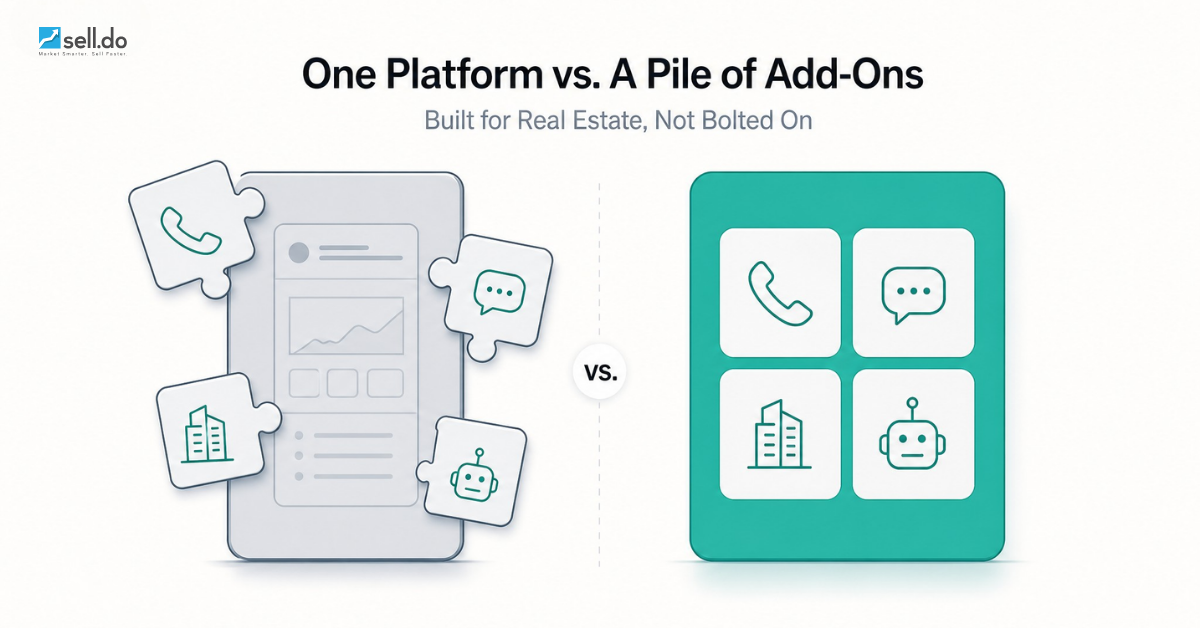
If you run sales for a real estate developer in India, you have probably had this conversation with your leadership: Salesforce is the most powerful CRM in the world, so why does closing a booking still feel like fighting the software? The honest answer is that Salesforce was built for generic B2B SaaS pipelines, not for how property actually gets sold in India. In 2026, with Agentforce adding a new layer of per-conversation cost and developers under pressure on margins, more sales heads are asking a sharper question: is there a real-estate-native alternative that does the same job for a fraction of the cost and the setup?
This is not a takedown. Salesforce is excellent at what it was designed for. But the gap between a horizontal enterprise platform and a property sales floor is exactly where leads leak, attribution breaks, and your team ends up living in spreadsheets anyway. Here is what switching actually looks like.
What Salesforce really costs an Indian developer in 2026
The sticker price is only the start. Salesforce Sales Cloud Enterprise lists at around $165 per user per month (roughly Rs 14,000), billed annually. For a 40-person sales, presales, and channel team that is over Rs 65 lakh a year before you have automated anything. Then come the real numbers most developers only discover after signing:
- Implementation: real-estate workflows (inventory, site visits, channel partners) are not native, so you pay a system integrator to build them. Six-figure-rupee to multi-lakh engagements running three to six months are common.
- Add-ons: calling, WhatsApp, and dialer functionality that Indian teams treat as basics are third-party plugins or extra clouds, each with its own licence.
- Agentforce: the 2026 agentic layer is priced per conversation (about $2 each on published rates). At real-estate lead volumes, an AI that qualifies every inbound lead can turn into a variable bill you cannot forecast.
None of this makes Salesforce a bad product. It makes it an expensive way to solve a problem it was not shaped for. For a fuller side-by-side, our list of Salesforce competitors for real estate teams lays out the landscape; this article is about why teams actually make the move.
From the team that built Sell.Do
See how Sell.Do runs your sales, pre-sales and marketing on one AI-first platform.
The five gaps that push real estate teams to switch
- Inventory and launches. Property sells at the unit and tower level with hold-block logic, availability sync, and cost sheets. A generic opportunity object cannot see your inventory, so presales quotes stale units and bookings collide.
- Presales calling and WhatsApp. In India, speed-to-lead is decided over a call and a WhatsApp reply, not an email drip. If dialer and WhatsApp are bolt-ons, your first-touch TAT slips and hot leads go cold.
- Channel partners. A large share of developer sales comes through brokers. You need whitelabel CP portals, subdomains, CP logins, and payout tracking that are RERA-ready. Building that on a horizontal CRM is a project in itself.
- Attribution tagging. Every developer wants to know which campaign produced which booking. That requires source-to-booking tagging across Meta, Google, portals, walk-ins, and CPs, wired in from lead capture, not reconstructed later in a spreadsheet.
- Agentic AI that does the work. The 2026 shift is from AI that suggests to AI that acts: auto-qualify, auto-follow-up, auto-log calls. The question is not whether you get agentic AI, but whether it is real-estate-aware and priced predictably.
If most of those five sound like your daily firefight, the problem is not your team. It is that you are running a property sales floor on tooling designed for software deals. It helps to separate lead management from generic CRM before you shop for a replacement.
What a real-estate-native alternative looks like
This is where Sell.do fits. It is an AI-agentic CRM built specifically for Indian real estate, so the five gaps above are the product, not a customisation project. Unified lead capture pulls Meta, Google, portals, website, walk-ins, and channel partners into one place with source tagging intact, so there are no exports and no leakage. Calling and WhatsApp are built in, and the AI agent auto-responds, qualifies, and books site visits in seconds. Jarvis AI handles predictive lead scoring, auto-logs calls, and drives follow-ups so your team does less data entry. IRIS manages launches and inventory down to unit, tower, availability, hold-block, and cost sheets. And the channel-partner ecosystem ships with whitelabel portals, CP logins, and payout tracking that are RERA-ready.
The cost story is different too: instead of enterprise per-seat pricing plus a multi-lakh integration plus per-conversation AI, the real-estate workflows are already there on day one. We break the feature-by-feature case down further in how Sell.do scores over Salesforce as a real estate CRM.
How to plan a clean switch
Switching a live sales floor sounds scary; it does not have to be. A pragmatic migration runs like this:
- Export cleanly: pull leads, activities, and bookings with their source tags intact so attribution survives the move.
- Map stages: align your Salesforce pipeline stages to the new lead lifecycle before import, not after.
- Pilot one project: run a single tower or campaign on the new system for two to three weeks, measure first-touch TAT and site-visit conversion, then roll out.
- Cut over channel partners last: onboard CPs onto whitelabel logins once the core team is comfortable, so payouts and RERA records stay clean.
Related reading
- Salesforce Competitors Every Real Estate Team Needs in 2026
- Why a specialised real estate CRM beats a horizontal one
- Think Beyond CRM, With Sell.do
If Salesforce is costing you more in licences, integration, and per-conversation AI than it returns in bookings, it is worth seeing the alternative built for your world. Take a walkthrough of the AI-agentic CRM built for Indian real estate and see unified capture, built-in calling and WhatsApp, IRIS inventory, and channel-partner portals working together on your own funnel. Bring your toughest attribution question; that is exactly where a real-estate-native platform pulls ahead.
Insights from the Sell.do real-estate CRM team.