
AI Search Is Quietly Killing the Real Estate Lead Funnel — What Marketers Must Do in 2026
Zero-click search is near 60% and AI Overviews now answer the questions that used to feed your blog traffic. Here's how Indian real estate marketers rebuild the lead funnel for 2026.
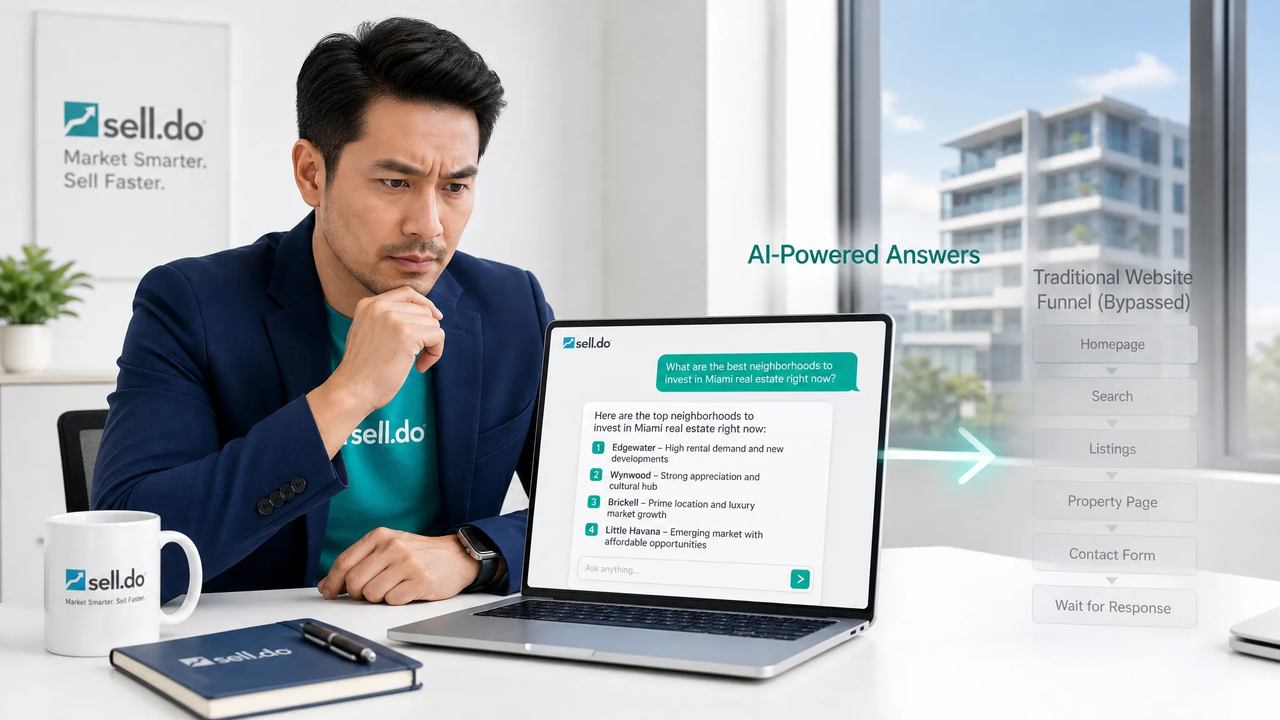
- The funnel you built assumes a click that's vanishing
- Why this hits Indian real estate marketers harder
- The counter-intuitive upside: AI-sourced leads convert better
- What real estate marketers must do in 2026
- 1. Optimise to be the cited answer, not just the top rank
- 2. Rebuild capture for fewer, higher-intent visits
For a decade, the Indian real estate marketing playbook ran on one assumption: a buyer searches, reads your content, and clicks through to your site, where you capture the lead. That assumption is quietly breaking. Zero-click search — where the buyer gets their answer without visiting any website — has climbed to roughly 60% of all Google searches, and closer to 77% on mobile, which is where most property research in India happens. The click your funnel depends on is disappearing before it reaches you.
The funnel you built assumes a click that's vanishing
Google's AI Overviews and standalone tools like ChatGPT, Gemini and Perplexity now answer the exact top-of-funnel questions that used to send traffic to real estate blogs. "Stamp duty in Maharashtra 2026", "is Wakad a good area to invest", "Godrej vs Kolte-Patil resale value" — these are increasingly answered on the results page or inside a chat window, with no visit to the page that did the research. The informational content that fed your retargeting pools and email lists is still being read; it just isn't earning the click anymore.
The harder part for SEO teams: being cited by an AI answer is not the same as ranking first. Analyses through 2025 found the overlap between the sources AI answers cite and the traditional top-ten organic links fell from around 70% to under 20%. In other words, the page ranked #1 on Google is often not the page the AI quotes. The old scoreboard — positions and impressions — no longer tells you whether buyers are actually encountering your brand.
From the team that built Sell.Do
See how Sell.Do runs your sales, pre-sales and marketing on one AI-first platform.
Why this hits Indian real estate marketers harder
Property buying is one of the most research-heavy journeys there is — locality, builder reputation, RERA status, price trends, loan eligibility. That long informational phase is exactly where AI answers are strongest, and exactly the phase most real estate content was built to capture. When that traffic thins out, the middle of the funnel starves: fewer blog readers to retarget, fewer newsletter sign-ups, smaller top-of-funnel from which to nurture. For developers running multi-project brand campaigns and for brokers who rely on organic discovery, the pipeline gets narrower at the top before you feel it at booking.
The counter-intuitive upside: AI-sourced leads convert better
There's a genuine silver lining, and it reframes the whole problem. Early data suggests visitors who arrive after an AI answer convert at up to 4.2x the rate of ordinary organic visitors. They've already had their basic questions answered, so the ones who still click through are further down the decision path and higher intent. The trade is fewer visits but hotter ones. That single fact should change where you spend effort: less energy chasing raw traffic volume, far more on capturing and responding to the high-intent few who do reach you.
What real estate marketers must do in 2026
1. Optimise to be the cited answer, not just the top rank
Generative engine optimisation (GEO) and answer engine optimisation (AEO) are about being quotable. AI models lift clean, specific, well-attributed statements — a precise stamp-duty figure, a dated price-trend number, a clearly structured comparison. Practical moves: lead sections with a direct one-sentence answer, use FAQ and structured data, cite your sources with dates, and make your entities (project names, localities, builder names) unambiguous. Get your numbers quoted and your brand travels with them, even in a zero-click answer.
2. Rebuild capture for fewer, higher-intent visits
If every visit is more valuable, wasting one is more expensive. The visitor who clicks through from an AI answer is ready to talk — so the path from page to conversation has to be instant. Click-to-WhatsApp on every landing page, an AI agent that replies in seconds and books a site visit, and no lead sitting in a form waiting for a callback tomorrow. This is where an omnichannel capture setup earns its keep: Sell.do pulls leads from Meta, Google, portals, website and WhatsApp into one place and its built-in AI agent responds instantly, so a high-intent visit turns into a booked conversation instead of a cold form entry.
3. Fix attribution for a zero-click world
When the first touch happens inside an AI answer you never see, last-click attribution quietly lies to you — it credits the WhatsApp click or the branded search that closed the deal and hides the content that started it. The fix is to stop grading marketing on clicks and impressions alone and start measuring what actually matters: cost per qualified lead and cost per booking, by source and campaign. Sell.do's source-to-booking reporting ties every rupee of spend to bookings rather than vanity traffic, which is exactly the lens you need when top-of-funnel visits shrink but their quality rises.
4. Diversify beyond Google discovery
The more of your demand depends on a single organic channel, the more exposed you are to its next algorithm shift. Build owned and direct channels that AI can't disintermediate: WhatsApp broadcast lists (India has 500M+ WhatsApp users and 70-90% open rates versus 20-30% for email), a well-tagged channel-partner network, portal presence, and first-party data from past enquiries. These are relationships, not rankings, and they keep producing leads regardless of what the search results page does next.
The bottom line
AI search isn't ending real estate marketing — it's compressing it. Fewer visits, higher intent, less patience for slow follow-up. The teams that win in 2026 will optimise to be cited, treat every remaining visit as precious, and measure bookings instead of clicks. The funnel isn't dead; it's just narrower and faster, and it rewards whoever captures and responds first.
If AI search is thinning your top of funnel, the answer is to capture and convert the high-intent leads that still reach you before they cool off. Sell.do unifies every source into one AI-agentic platform — instant WhatsApp and calling response, AI lead scoring, and cost-per-booking attribution by source. See the AI-agentic CRM built for Indian real estate, or book a walkthrough to map it to your funnel.
Related reading
Insights from the Sell.do real-estate CRM team.