
How to Use a CRM to Improve Real Estate Marketing in India (2026)
How developers and brokers use a CRM to capture every source, tag campaigns at capture and report from spend to booking.
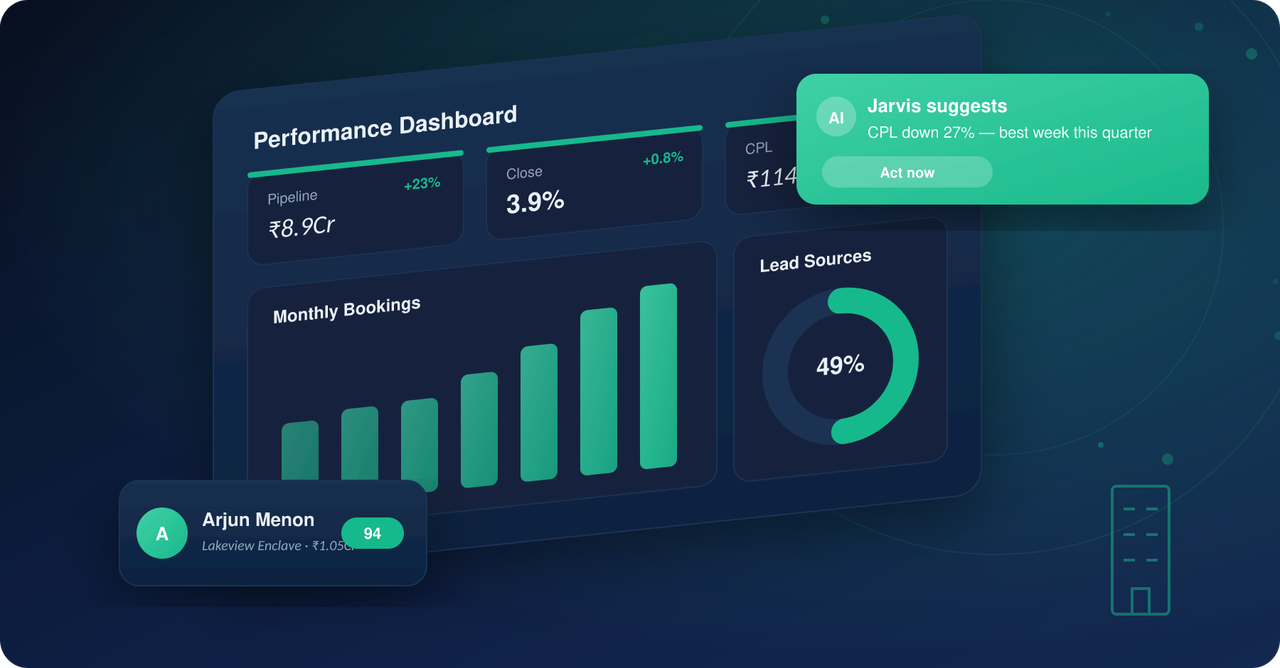
Most real estate marketing teams in India are judged on cost per lead, and most CRMs are bought to store those leads. The gap between the two is where budget leaks: campaigns are tagged inconsistently, leads from portals and Meta land in different sheets, and nobody can say which spend produced a booking. Used properly, the CRM is the system that closes that gap.
This guide is written for marketing heads at developers and for the broker and channel-partner teams who run their own campaigns. It covers what a CRM should do for marketing, the workflows that matter, and the measures worth tracking.
The short answer
A CRM improves real estate marketing when it does four things: captures every lead from every source into one place, tags each lead with its campaign at the moment of capture, makes the sales follow-up measurable, and carries that tag all the way to the booking. Everything else (scoring, nurturing, dashboards) depends on those four.
From the team that built Sell.Do
See how Sell.Do runs your sales, pre-sales and marketing on one AI-first platform.
1. Capture every source without exports
Indian real estate leads arrive from Meta lead forms, Google Ads, 99acres, MagicBricks, Housing, your website, walk-ins, hoardings with a missed-call number, and channel partners. If any of these still reaches the team as a spreadsheet or a forwarded email, the lead is already ageing. Connect each source directly so the lead appears in the CRM within seconds, with its source filled in. See our list of must-have real estate CRM integrations for what to connect first.
2. Tag campaigns at capture, not afterwards
Attribution fails when tagging is manual. Use a consistent structure (source, campaign, project, creative or keyword) that the CRM applies automatically from the lead form or tracking link. When a lead is later found to be a duplicate, the CRM should keep the first touch and log the repeat enquiry rather than creating a second record. This is what makes a number like cost per booking possible; our piece on cost per lead vs cost per booking explains why that is the metric to manage.
3. Segment and nurture with real data
Once leads carry source, project interest, budget and stage, marketing can send relevant messages instead of blasts. Practical segments for a developer include: enquired but not called, called but no site visit, visited but not booked, and cold leads from a previous launch. For brokers, useful segments are buyer versus investor, ready-to-move versus under-construction, and budget band. Trigger WhatsApp and email from stage changes, and keep the cadence tied to the buyer's decision window, which is long in real estate. The email marketing guide covers seven triggered emails worth setting up.
4. Make sales follow-up part of the marketing loop
Marketing spend is wasted if the first call comes late. Track first-response time (TAT) by source and by team, and feed it back to marketing: a source with a good cost per lead but a poor contact rate usually needs a form change or a routing fix, not more budget. Lead quality complaints from sales are easier to settle when both teams look at the same dashboard.
5. Report from spend to booking
A useful marketing report in a real estate CRM answers these questions without exporting anything:
- Cost per lead by source and campaign, using the spend you enter or sync.
- Contact rate and site-visit rate by source, so you see quality and not only volume.
- Cost per site visit and cost per booking by campaign.
- Which projects and creatives produce visits that convert.
- Duplicate and untagged lead share, as a data-health check.
If you are setting this up, the CRM dashboards and analytics guide lists what to track and why.
A 30-day plan to put this in place
- Week 1: list every lead source, connect the top three by volume, and agree one tagging convention.
- Week 2: turn on duplicate handling, assign owners by source or project, and set a first-response target.
- Week 3: build the segments above and switch on two triggered WhatsApp or email flows.
- Week 4: review cost per visit and cost per booking by campaign, and move budget from the weakest campaign to the strongest.
Common mistakes
- Treating the CRM as a contact list. If marketing cannot see stage and outcome, it is only storage.
- Letting each agency or channel partner use its own tag names, which makes reports unreadable.
- Optimising only for cost per lead. A cheap lead that nobody can reach is expensive.
- Sending the same message to every lead regardless of stage.
How Sell.do supports this
Sell.do is an AI-agentic CRM and sales and marketing platform built for Indian real estate. It brings leads from Meta, Google, portals, your website, walk-ins and channel partners into one place, applies campaign tags at capture, and carries them through site visits and bookings, with calling and WhatsApp built in. You can read how this works for campaigns on the marketing automation module or book a walkthrough at https://www.sell.do/.
Frequently asked questions
What should a real estate marketer look at first in a CRM?
Source and campaign tagging. If tags are inconsistent, every later report is unreliable, so fix capture and naming before building dashboards.
Can a CRM reduce cost per lead?
Indirectly. A CRM does not buy cheaper leads, but source-level reporting shows which campaigns waste spend, and faster follow-up raises the share of leads you turn into visits, which lowers cost per booking.
Do brokers need this as much as developers?
Yes, in a lighter form. Brokers benefit most from capturing every portal and social lead, avoiding lead leakage, and tracking call turnaround time.
Related reading
Insights from the Sell.do real-estate CRM team.