
Paid Lead Gen for Indian Real Estate (2026): Cutting CPL Across Google & Meta
The hub for paid lead generation in Indian real estate: Google Ads, Meta lead ads, Click-to-WhatsApp and portals, 2026 CPL benchmarks, and how source-to-booking attribution cuts cost without cutting volume.
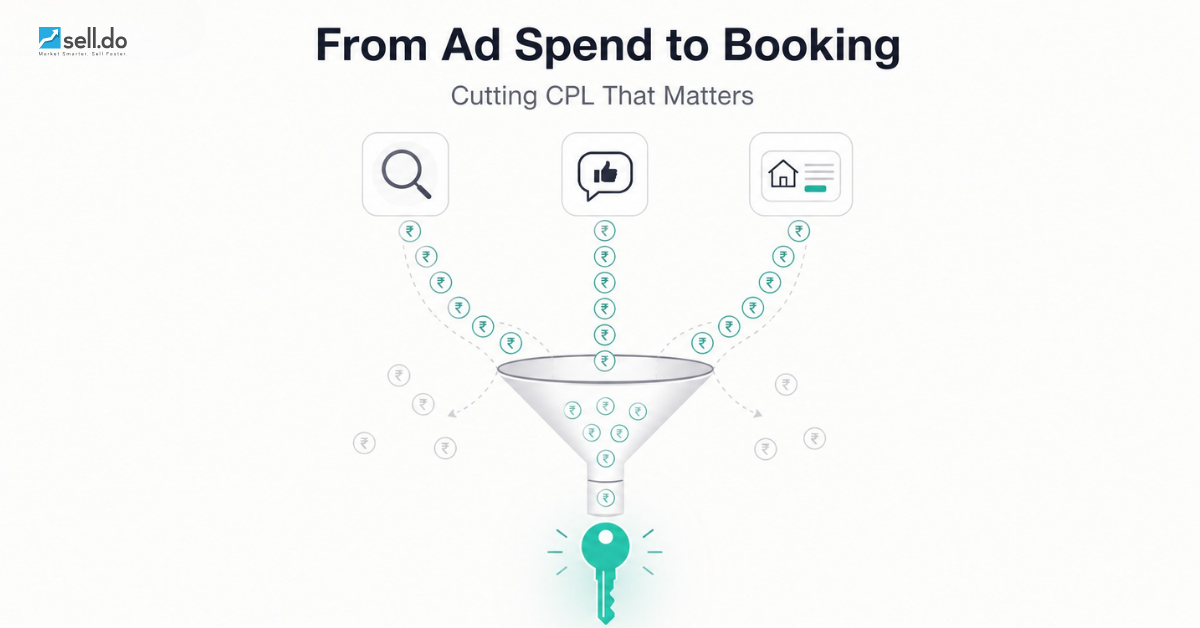
For most Indian real estate marketing teams, the paid-media problem in 2026 is not spend, it is leakage. Budgets on Google and Meta keep climbing, cost per lead creeps up every quarter, and yet the one number leadership actually cares about, which campaign produced which booking, stays a black box. You can see 4,000 leads in a dashboard and still not answer whether the ₹8 lakh you put into a Pune project last month returned two bookings or twenty.
This guide is the hub for paid lead generation in Indian real estate: how Google Ads, Meta lead ads, Click-to-WhatsApp, and property portals actually work for developers and brokers, what leads really cost in 2026, and how to cut CPL without cutting volume. The through-line is source-to-booking attribution, because a cheaper lead that never becomes a site visit is not a win. If you run paid media for a developer or a channel-partner team, this is the map.
Stop optimising the wrong number
The single most expensive mistake in real estate paid media is optimising cost per lead in isolation. A Meta campaign that delivers leads at ₹150 looks four times better than a Google Search campaign at ₹600, right up until you notice the ₹150 leads never pick up the phone and the ₹600 leads book flats. CPL rewards volume; bookings reward intent, and the two rarely move together.
The fix is to measure the whole ladder, from cost per click to cost per lead to cost per site visit to cost per booking, and to judge every channel on the last rung, not the first. We walk through that metric ladder in detail in Cost Per Lead vs Cost Per Booking, which is the measurement companion to this acquisition guide.
From the team that built Sell.Do
Real-time pipeline, CPL and forecast dashboards — no spreadsheets.
What real estate leads actually cost in India (2026)
CPL varies wildly by city, ticket size, and channel, but the working ranges Indian teams are seeing in 2026 look like this. Use them as sanity checks, not targets, because a ₹2.5 crore luxury project and a ₹45 lakh affordable one should never carry the same CPL.
- Meta (Facebook + Instagram) lead ads: ₹150 to ₹2,000 per lead, cheapest for affordable/mid housing, higher for premium and NRI targeting.
- Google Search: ₹300 to ₹2,500 per lead, more expensive but far higher intent because the buyer is actively searching for a location or project.
- Property portals (99acres, MagicBricks, Housing): often billed as packages or per-response; effective CPL swings by locality demand and how fast you respond.
- Click-to-WhatsApp ads: can cut effective CPL by up to 40% versus form leads, because the conversation starts instantly and contactability is far higher.
The pattern is consistent: intent costs more up front and pays more at the end. Google and portal leads cost more per lead but convert to site visits at higher rates; broad Meta prospecting is cheap per lead but leaks hard unless you qualify fast. Budget across the mix rather than chasing the lowest CPL line in the report.
The Google Ads playbook for real estate
Google captures buyers at the moment of intent, which is why it deserves the top of your paid stack even at a higher CPL. Three moves matter most in 2026.
1. Lead with high-intent Search, not just Performance Max
Performance Max is seductive because it spends easily, but for real estate it often buries budget in cheap Display and Discovery placements that produce junk leads. Anchor on Search campaigns for location + intent queries (“3 BHK in Wakad”, “flats near Hinjewadi”, “<project name> price”) where the buyer has already declared what they want. Use PMax as a supplement with a clear negative-placement list, not as the whole account.
2. Match the landing page to the query
Sending a “2 BHK in Baner” searcher to a generic homepage wastes the click. Build project- and locality-specific landing pages with the price, floor plan, and a single clear action (get a call back / book a visit / chat on WhatsApp). A tighter page lifts conversion rate, which lowers effective CPL more reliably than any bid tweak.
3. Feed conversions back to Google
Google’s bidding is only as smart as the signals you give it. If you only track form fills, it optimises for form fills, including the fake ones. Feed qualified leads and, ideally, site visits and bookings back as offline conversions so the algorithm learns which clicks become buyers. This is where source-to-booking tagging stops being a reporting nicety and becomes a bidding weapon.
The Meta playbook: lead ads, Click-to-WhatsApp, and creative
Meta is where volume and cheap reach live, and where discipline matters most. The same targeting that fills your pipeline can flood it with unqualified leads if you let the platform optimise for the wrong event.
- Prefer instant forms with qualifiers. Add budget and possession-timeline questions to the lead form so you thin out tyre-kickers before they hit your team.
- Run Click-to-WhatsApp for speed. A conversation that starts the second someone taps beats a form that sits in a queue. Contactability and CPL both improve.
- Let Advantage+ audiences do the work, then constrain by geography. Broad targeting with a tight radius around the project usually beats hand-built interest stacks in 2026.
- Refresh creative relentlessly. Walkthrough video and price-led carousels fatigue fast; the ad, not the audience, is usually why CPL drifts up.
For the audience and targeting mechanics in depth, see our detailed guide to Facebook ad targeting for real estate, which drills into the interest, lookalike, and geo layers this pillar only summarises.
Click-to-WhatsApp deserves its own emphasis because WhatsApp is how Indian buyers actually want to talk. Our WhatsApp-first real estate playbook covers open rates, templates, and automation; paired with paid ads it is the single highest-leverage CPL lever most teams are underusing.
Portals are a paid channel too, so treat them like one
99acres, MagicBricks, and Housing sit in a strange gap: teams pay real money for them but rarely track them with the rigour of a Google or Meta account. That is a mistake. A portal lead has a cost, a response-time sensitivity, and a conversion rate, exactly like a paid-ad lead. Pull portal responses into the same system, tag the source, and measure cost per booking by portal the same way you would by campaign. You will usually find one portal quietly outperforming the others for a given micro-market, which tells you where to concentrate spend.
The CPL multiplier nobody budgets for: speed and zero leakage
Here is the uncomfortable truth about paid lead gen: the biggest CPL improvement rarely comes from the ad account. It comes from what happens in the first sixty seconds after the lead arrives. A paid-for lead that is called within a minute converts several times better than one called an hour later, and every lead that is never called, called once and dropped, or landed in the wrong rep’s queue is budget set on fire.
Effective CPL is total spend divided by usable leads, not raw leads. If a quarter of your leads never get contacted, your real CPL is a third higher than the report says. Plugging leakage is mathematically identical to cutting CPL, and it is free.
This is where the acquisition story meets operations. Unified capture from Meta, Google, portals, your website, and channel partners into one system, with auto-tagging by source, instant routing, built-in calling and WhatsApp, and AI scoring, is what turns cheap leads into contacted leads. It is also the difference between a broker who loses deals to lead leakage and one who never does. If you are still exporting spreadsheets between your ad accounts and your sales team, that gap is your real CPL problem.
Source-to-booking attribution: the developer’s superpower
For developers running multiple projects and campaigns, attribution tagging is the whole game. When every lead carries its source, campaign, and creative from capture all the way to booking, three things become possible: you can kill campaigns that produce leads but no bookings, you can feed real bookings back to Google and Meta so their algorithms chase buyers instead of form-fillers, and you can defend your marketing budget with a clean line from rupee spent to flat sold.
Concretely, that means tagging at capture (never after), keeping the tag intact through calling and site visits, and writing bookings back as offline conversions to the ad platforms. Sell.do reports CPL and campaign ROI by source and campaign in one place and supports offline conversion write-back, so the loop from spend to booking closes without a data team stitching exports together. That is what lets you answer the black-box question, which campaign booked the flat, on demand.
Brokers and channel partners: paid leads on a tighter budget
Developers can absorb a bad month; a broker running ₹50,000 of Meta spend cannot. For channel partners the paid-lead maths is unforgiving, which makes discipline non-negotiable. Two rules carry most of the weight. First, never run ads to a channel you cannot respond to within minutes, because a broker’s entire edge is speed and personal follow-up. Second, tag ruthlessly, because a broker who cannot tell a 99acres lead from a Meta lead from a referral cannot decide where the next rupee goes.
Click-to-WhatsApp is especially powerful here: it lets a small team start real conversations instantly without a call centre, and it keeps every lead in one thread rather than scattered across SIM cards and notebooks. Combined with correct tagging and a never-lose-a-lead workflow, it lets a two-person brokerage compete with a developer’s presales floor on responsiveness. If you want the acquisition fundamentals from the ground up, our guide on using a CRM to generate real estate leads pairs well with this paid pillar.
How to split a paid budget across channels
There is no universal split, but a useful starting frame for a single active project in 2026 is to weight toward intent while keeping a prospecting engine running. A common working mix is roughly 40% to Google Search for buyers already looking, 35% to Meta (a large share of it Click-to-WhatsApp) for reach and speed, and 25% to the portals that perform best in that micro-market, then rebalance monthly on cost per booking rather than CPL. The exact numbers matter less than the habit: review by outcome, move money toward what books flats, and starve what only produces cheap, uncontactable leads.
One more shift worth planning for now: buyers increasingly start in AI search and answer engines, not just Google’s blue links, which changes where organic and paid discovery overlap. We cover that transition in how AI search is reshaping the real estate lead funnel; it is the demand-side context for every rupee you spend on ads this year.
A 2026 CPL-reduction checklist
- Judge every channel on cost per site visit and cost per booking, not CPL alone.
- Anchor Google on high-intent Search; use PMax only with tight negatives.
- Add budget and timeline qualifiers to Meta lead forms.
- Shift a share of Meta budget to Click-to-WhatsApp for faster contact and lower effective CPL.
- Match landing pages to the exact query or ad; one page, one action.
- Capture every source into one system and tag at the point of capture.
- Call new leads inside a minute; alert on any lead that goes untouched.
- Write qualified leads, site visits, and bookings back to Google and Meta as offline conversions.
Where to go from here
Paid lead gen in Indian real estate is won at the ends: sharper intent at the top, and zero leakage plus clean attribution at the bottom. Get both right and CPL takes care of itself. If you want to see every rupee of CPL and campaign ROI tracked by source and campaign in one place, with source-to-booking attribution built in, Sell.do was built for exactly this. Book a walkthrough and bring your messiest campaign; that is the one worth mapping end to end.
Related reading
Insights from the Sell.do real-estate CRM team.