
Real Estate Startup Ideas for India in 2026: Where the Proptech Gaps Actually Are
Most lists of real estate startup ideas repeat the same three businesses. Here are the operational gaps in Indian proptech in 2026 that are still genuinely unbuilt.
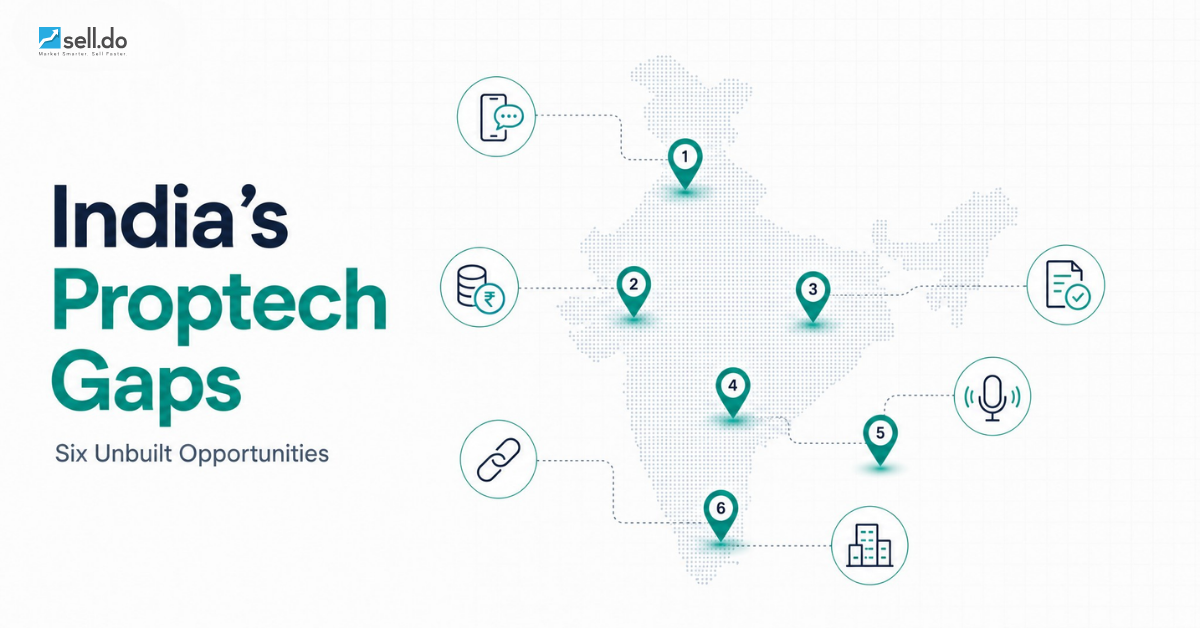
- Start with the size of the operational problem, not the size of the market
- Gap 1: The broker back office nobody has finished building
- Gap 2: Post-sales and collections, the most under-built layer in the sector
- Gap 3: Channel-partner payouts and RERA hygiene
- Gap 4: Voice-first, vernacular AI for people who do not sit at a desk
- Gap 5: Attribution that survives the offline handoff
Every few months another list of "real estate startup ideas" makes the rounds, and almost all of them describe the same three businesses: a listing portal, a co-living brand, and a fractional-ownership platform. Those markets are crowded and expensively funded. The interesting gaps in Indian proptech in 2026 are further down the stack, in the unglamorous operational work that developers, brokers and channel partners still do on WhatsApp, in Excel, and in the heads of two or three people who cannot go on leave.
This piece is written for founders and operators looking for a real wedge. It maps where the workflow actually breaks in Indian real estate, why those breaks have survived a decade of proptech funding, and what a defensible product in each gap would need to look like. If you want the view from the other side, our roundup of the proptech innovators already operating here is a useful companion read.
Start with the size of the operational problem, not the size of the market
The headline numbers are easy to quote. India's real estate sector is widely projected to approach $1 trillion by 2030 (NITI Aayog and IBEF estimates), and the top seven cities have absorbed roughly 4.5-4.7 lakh residential units a year while carrying an unsold overhang of 5.5-6 lakh units (Anarock's year-end data). Those numbers tell you the sector is big. They do not tell you where software can win.
The better question is: which repeated action, done thousands of times a month by someone whose income depends on it, is currently done badly? On that test, most of the money in Indian real estate is still lost between the enquiry and the site visit, and between the booking and the final collection. That is where the gaps are.
From the team that built Sell.Do
See how Sell.Do runs your sales, pre-sales and marketing on one AI-first platform.
Gap 1: The broker back office nobody has finished building
A mid-sized broking firm in Pune or Gurugram typically runs enquiries from four to eight sources at once: Meta and Google campaigns, portals like 99acres and MagicBricks, its own website, walk-ins, and referrals from sub-brokers. Each source lands in a different inbox. The classic failure is not a bad pitch, it is a lead that nobody called for eleven hours.
Speed matters more than most founders assume. The Lead Response Management research popularised by Harvard Business Review found that responding within five minutes made a lead dramatically more likely to qualify than responding after thirty. When the same buyer has filled three portal forms in one evening, being second is close to being nowhere.
What a product here has to solve: capture from every source without a CSV export, automatic and correct source tagging, a turnaround-time dashboard that a proprietor can read in ten seconds, and re-assignment when the first call does not happen. This is the space Sell.do already occupies for brokers and channel partners, so a new entrant needs a sharper wedge, for example a single vertical (plotted developments, commercial leasing, resale) where the tagging and payout logic differ enough to justify a purpose-built tool.
Gap 2: Post-sales and collections, the most under-built layer in the sector
Ask any developer's finance head where the pain is and they will not say lead generation. They will say collections. Between booking and possession sit demand letters, milestone-linked payments, home-loan disbursements from a dozen lenders, agreement execution, and a customer who wants a status update on WhatsApp at 9 pm.
Most of this still runs on spreadsheets stitched to Tally, with a two-person CRM department chasing payments by phone. The gap is a post-sales product that treats collections like a pipeline: demand letters tied to construction milestones, lender-wise disbursement tracking, an owner-facing status view, and escalation when a payment slips. Expect a long sales cycle and deep accounting integration work, which is precisely why the space is still open.
Gap 3: Channel-partner payouts and RERA hygiene
The channel-partner ecosystem sells a large share of Indian residential inventory, and it is administered with astonishing informality. A developer may work with two hundred CPs across a launch; brokerage disputes take months; RERA registration status lives in a folder of PDFs.
A credible product would combine three things that today live apart: CP onboarding with RERA number validation and expiry alerts, attributed lead ownership so two CPs cannot claim the same buyer, and payout computation that runs off booked-and-collected value rather than a manual sheet. Whitelabel CP portals exist, including inside Sell.do, but the payout-and-compliance layer is thin across the market and highly defensible once a developer's finance team depends on it.
Gap 4: Voice-first, vernacular AI for people who do not sit at a desk
The site executive, the CP's field agent and the collections caller do not use software with a keyboard. They use a phone, in Marathi, Telugu, Hindi or Gujarati, often on a two-wheeler. Meanwhile WhatsApp is effectively the customer channel: Meta has reported over 500 million users in India, and for most buyers it is the only channel they will answer.
The opportunity is not another chatbot. It is turning what already happens on calls and WhatsApp into structured data: transcription and summarisation in Indian languages, automatic follow-ups, intent scoring, and site-visit booking without anyone typing. AI-agentic CRM platforms are moving here, so a startup needs an edge in the hard part: accented, code-mixed Indian speech in noisy environments.
Gap 5: Attribution that survives the offline handoff
Marketing teams can tell you the cost per lead of a Meta campaign. Very few can tell you the cost per booking, because the journey breaks the moment a lead becomes a phone call and then a site visit and then a cheque. That break is why developers over-invest in whatever channel reports the cheapest CPL and under-invest in whatever quietly produces buyers.
Closing the loop means stitching campaign, source, sub-source, CP, site visit and booking into one chain and keeping the tag intact through re-assignments and duplicate merges. Our guide to what actually works in Indian real estate lead generation covers the demand side; the attribution side is where the unbuilt product sits, especially for developers running multiple projects across cities with separate agencies.
Gap 6: Tooling built for the developer doing two projects, not twenty
Enterprise platforms are priced and configured for large developers. The long tail, a builder doing one or two projects of 150-300 units in a tier-2 city, is served by nothing in particular: a website from a local agency, a spreadsheet for inventory, and WhatsApp for everything else.
A stripped-down, self-serve product for that segment, covering unit availability and hold-block, cost sheets, a booking form and basic collections, priced at a level a small builder pays without a procurement process, is a largely unaddressed market. The catch is distribution: you have to reach thousands of small builders cheaply, usually through architects, RERA consultants or local CP networks.
How to pressure-test a real estate startup idea before you build it
- Name the person who loses money today. If you cannot name a role (a CP proprietor, a collections manager, a project marketing head) and quantify their loss in rupees, the idea is a feature.
- Check whether the workflow is regulated. RERA, GST on under-construction property, and lender processes create both compliance burden and defensibility. Products that absorb compliance work get renewed.
- Ask what it replaces. Indian real estate teams do not adopt a tool alongside WhatsApp and Excel; they adopt something that removes one of them. If your product adds a fourth place to look, it will be abandoned in a quarter.
- Test whether it survives a market downturn. Lead-generation spend is cut first. Collections, compliance and inventory tooling are not.
- Confirm the buyer and the user are reachable. A brilliant product for site executives that only a promoter can approve needs a promoter-facing ROI story from day one.
What a decade of Indian proptech should teach the next founder
The pattern is consistent: consumer-facing discovery attracted the capital, and operational software quietly kept the customers. The businesses that compounded were embedded in a developer's or broker's daily process, where switching means retraining a sales team and migrating five years of lead history.
If you are scanning the market for where to build, read the operational gaps above alongside a view of where proptech investment and adoption are actually moving. The two together tell you something a funding table alone will not: the sector's remaining inefficiency is concentrated in the handoffs, not in the search.
Related reading
- Top Proptech Examples and How They Are Changing Real Estate
- Understanding Proptech and Its Use in the Real Estate Industry
- Real Estate Marketing Strategies for Developers and Brokers in India
Building in this space, or buying instead of building?
Most of the gaps above need deep, unfashionable integration with how Indian developers and brokers already work: every lead source in one place, tagging that survives re-assignment, calling and WhatsApp built in, and attribution that runs from campaign to booking. If you are a developer or broking firm weighing whether to build that internally, see what an AI-agentic platform already does out of the box first.
Take a walkthrough of the AI-agentic CRM built for Indian real estate at https://www.sell.do/ and see how unified capture, built-in calling and WhatsApp, and source-to-booking attribution fit together in one system.
Insights from the Sell.do real-estate CRM team.