
Channel Partner Management for Real Estate Developers: The Complete 2026 Playbook
The developer-side playbook for channel partner management in India: empanelment and RERA checks, lead-tagging rules that kill disputes, brokerage ladders, payout SLAs, whitelabel partner portals and quarterly tiering.
- The lead came in at 11:04 a.m. Nobody knows which partner it belongs to.
- Why the channel still carries Indian residential sales
- Step 1 — Source and empanel with an actual filter
- Step 2 — Lead tagging: the rule that prevents 90 per cent of disputes
- Step 3 — Design a brokerage ladder, not a flat rate
- Step 4 — Treat payout as an SLA, not an accounts function
The lead came in at 11:04 a.m. Nobody knows which partner it belongs to.
A Pune developer we will call Anaya runs three live projects and 140 empanelled channel partners. On a good Saturday, roughly 60 per cent of her walk-ins arrive through those partners. On the same Saturday, her presales head fields four WhatsApp messages disputing who sourced the same buyer, two partners complain that a booking done in March is still unpaid, and one partner has stopped sending leads entirely because the last three he sent were never called back.
None of that is a partner problem. It is a channel partner management problem, and it is the single most under-engineered part of most Indian developers' sales operations. Developers spend months negotiating brokerage slabs and almost no time designing the operating system that decides how a partner is empanelled, how their leads get tagged, how disputes get settled, and how fast they get paid.
This is the developer-side playbook. It covers sourcing and empanelment, RERA and KYC checks, lead-tagging and dispute rules, brokerage ladders, payout SLAs, whitelabel partner portals, and performance tiering. If you are on the other side of the table — a broker trying to get on a developer's panel — start with our guide on how to get empanelled with a developer instead.
From the team that built Sell.Do
See how Sell.Do runs your sales, pre-sales and marketing on one AI-first platform.
Why the channel still carries Indian residential sales
Channel partners are not a legacy cost line. In most Indian metros, empanelled partners and consultants source somewhere between 40 and 70 per cent of residential primary sales, and the share runs higher during a launch, when a developer needs velocity in the first 45 days rather than a slow drip of digital leads. Anarock and JLL India have both reported that channel-led volumes rose through 2024-25 as launch pipelines expanded into Tier-2 markets, where a developer has no owned brand recall and the local broker does.
The economics are also different from what most CFOs assume. A digital lead in a Mumbai or Bengaluru residential campaign can cost ₹900 to ₹2,500 at the top of the funnel, and converts to a site visit somewhere between 8 and 15 per cent of the time. A channel partner lead costs nothing until it books, then costs 1.5 to 2.5 per cent of the deal value. On a ₹1.2 crore ticket that is ₹1.8 lakh to ₹3 lakh — expensive per booking, but paid only on success, and typically closing 3 to 5x faster than a cold portal lead because the partner has already done the qualification.
The mistake is treating this as a purely commercial relationship. Partners are a distribution network, and distribution networks decay quietly when the operating rules are vague. A partner who is not paid on time does not send you an angry email; he simply routes his next buyer to the project down the road.
Step 1 — Source and empanel with an actual filter
Most developers empanel anyone who walks in with a RERA agent registration. The result is a panel of 200 names where 20 produce 85 per cent of the bookings and the other 180 generate tagging disputes. Build a filter instead.
- Segment before you sign. Institutional consultants (the national IPCs and large organized firms) bring NRI and investor demand and process discipline, but negotiate harder on brokerage and expect co-marketing. Regional aggregators bring volume in a specific micro-market. Independent local brokers bring the walk-in who lives two kilometres away. Your panel needs all three, in deliberate proportion — not whoever showed up.
- Verify RERA agent registration, and record the number. Section 9 of RERA requires an agent to be registered with the state authority to facilitate a sale in a registered project. Store the registration number, validity date, and state against the partner record, and set an expiry reminder. An unregistered agent on your panel is your compliance exposure, not theirs.
- Collect the commercial documents once. PAN, GST registration status, cancelled cheque, and the signed empanelment agreement. Ninety per cent of payout delays in Indian real estate trace back to a missing GST number or a PAN mismatch discovered at invoice stage, six months after the booking.
- Set a review date at signing. A 90-day probation with a stated minimum — say, three qualified site visits — makes deactivation an administrative step rather than an awkward conversation.
Write the empanelment agreement so it answers the questions that actually cause fights later: what counts as a sourced lead, how long the tagging holds, what happens when two partners claim the same buyer, when brokerage is due, and what triggers deactivation. Most standard templates cover none of these clearly.
Step 2 — Lead tagging: the rule that prevents 90 per cent of disputes
Tagging is where channel partner management either works or collapses. The dispute is almost always the same: the buyer registered on your website in January, visited with Partner A in March, and booked with Partner B in May. Who gets paid?
You need three rules, written down and applied without exception.
- Registration before visit. A partner registers the buyer's name and phone number in your system *before* bringing them to site. A lead registered after the visit is not a valid claim. This single rule eliminates retrospective claiming, which is the most common form of dispute.
- A stated tagging validity. Most Indian developers use 30, 60 or 90 days. Pick one, publish it, and let it expire automatically. An open-ended tag means a partner who registered a name two years ago can claim a booking he had nothing to do with.
- First-source wins, with a house-lead carve-out. If the buyer already exists in your CRM from a Meta or Google campaign or a direct website enquiry, the lead is a house lead and the partner earns a reduced or zero brokerage — stated in the agreement as a percentage, not decided case by case.
The rules only hold if the system enforces them. Manual tagging in a spreadsheet means the presales executive decides, under pressure, at the moment of booking. In Sell.do, partner-sourced leads carry their source tag from the moment of registration, deduplicate against the existing lead database automatically, and surface a conflict flag before the booking is confirmed rather than after the brokerage invoice is raised. If you want the broader picture of where leads disappear between capture and booking, we mapped it in the lead leakage guide.
Step 3 — Design a brokerage ladder, not a flat rate
A flat 2 per cent for every partner rewards the partner who sends one booking a year exactly as much as the one who sends fifteen. A ladder — slabs that rise with cumulative performance in a defined period — costs you almost nothing on the low end and buys loyalty at the top.
A workable structure for a residential project in a metro:
- Base slab: 1.5 to 2 per cent on the first two bookings in a quarter.
- Second slab: 2.25 per cent from the third booking onward in the same quarter.
- Third slab: 2.5 per cent plus a launch bonus, from the sixth booking.
- Inventory-linked kicker: an additional 0.25 to 0.5 per cent on slow-moving stock — the higher floors, the odd-facing units, the larger configurations sitting on your IRIS availability sheet for 90 days.
That last one is the lever most developers never use. A ladder tied to inventory turns your partner network into an instrument for clearing exactly the units you need cleared, rather than a general-purpose sales force competing for the same easy 2BHKs your own team is already selling. The full mechanics of slabs, TDS treatment under Section 194H, and dispute-proofing the invoice trail are covered in our brokerage and payouts breakdown.
Step 4 — Treat payout as an SLA, not an accounts function
Ask any active channel partner in India what determines where he sends his next buyer, and payout reliability will beat brokerage percentage almost every time. A partner earning 2 per cent paid in 21 days will outsell a 2.5 per cent developer who pays in 120 days, because the broker's own business runs on working capital.
Publish a payout SLA with explicit trigger points and hold to them:
- Trigger: brokerage becomes due on a stated milestone — typically agreement registration plus receipt of the first 10 per cent, not "on possession".
- Invoice window: partner raises a GST-compliant invoice within 15 days of the trigger.
- Payment window: 21 to 30 days from a clean invoice, with TDS deducted at source and the certificate issued.
- Escalation: a named person and a 48-hour response commitment for disputed or delayed payments.
Then make the status visible. Most payout escalations are not really about money; they are about the partner having no idea where his invoice sits. A portal that shows each booking, its milestone status, the invoice stage and the expected payment date removes the majority of those calls from your sales team's day.
Step 5 — Give partners a portal, not a WhatsApp group
The default operating surface for Indian channel partner management is a WhatsApp group with 140 members, where inventory sheets, price revisions and lead registrations all scroll past each other. It is fast to set up and impossible to audit.
A whitelabel partner portal — running on your own subdomain, carrying your project branding — changes the relationship in four concrete ways:
- Self-serve lead registration with instant tagging confirmation, so the partner has proof of registration and your team has a timestamp.
- Live inventory visibility with hold-and-block, so a partner can see which units are actually available and place a temporary hold during a site visit instead of calling the sales head.
- Cost sheets generated on demand, at the current approved price, which ends the problem of partners quoting a price list that was revised three weeks ago.
- A payout ledger showing bookings, milestones, invoices raised and payments released.
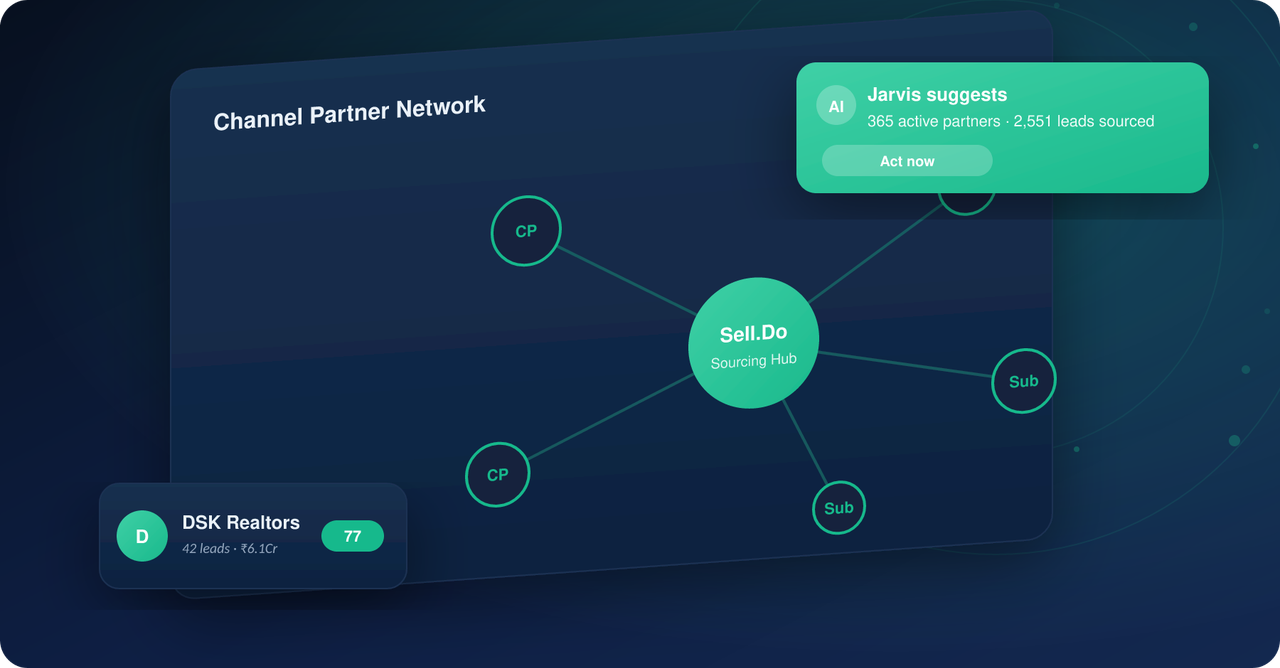
Sell.do's channel-partner module runs exactly this as a whitelabel portal with individual partner logins on your subdomain, connected to the same inventory and lead database your in-house presales and sales teams use — so there is one source of truth rather than a developer version and a partner version that drift apart by Friday. Partners on the receiving end of a well-run portal describe the difference well in this piece on what partners want from a CRM.
Step 6 — Tier your panel on performance, quarterly
A panel is not a static list. Run a quarterly review on four numbers per partner: leads registered, site visits conducted, bookings closed, and lead-to-visit quality ratio. Then sort into tiers.
- Tier A (top 10 to 15 per cent): early access to new launches, the best brokerage slab, co-branded marketing support, direct line to the sales head.
- Tier B (the working middle): standard slabs, standard inventory access, quarterly training on the project and the portal.
- Tier C (inactive or low quality): a single conversation, then deactivation. A partner registering 40 leads a quarter with two site visits is consuming your presales capacity, not adding to it.
Publish the tier criteria. A partner who knows that six bookings moves him to early launch access behaves differently from one who suspects the good projects are allocated by relationship.
The attribution loop most developers never close
Here is the question your sales review should be able to answer in ten seconds and usually cannot: of last quarter's bookings, how many came from each partner, at what effective cost, and how does that compare with the cost per booking from your own Meta and Google spend?
Closing that loop requires partner-sourced leads to sit in the same system as digital leads, with source tagging that survives from first touch to booking. When they do, the comparison becomes actionable: you discover that your ₹42 lakh quarterly digital spend produced 19 bookings at ₹2.2 lakh each, while your top eight partners produced 34 bookings at an effective ₹2.6 lakh in brokerage — and that the partners' bookings closed in 31 days against 74. That changes how you allocate the next quarter's launch budget in a way no amount of channel-versus-digital debate in a review meeting ever will.
A 30-day plan to fix your channel partner operations
- Week 1: Export your current panel. Mark every partner with zero bookings in the last two quarters. Verify RERA registration and GST details for the remainder; you will find gaps.
- Week 2: Write the three tagging rules and the payout SLA. Circulate them as a one-page addendum to the empanelment agreement. Ambiguity you leave now becomes a dispute in month four.
- Week 3: Move lead registration out of WhatsApp into a system that timestamps and deduplicates. Even a basic form beats a group chat, though a portal with inventory and cost sheets is what actually changes partner behaviour.
- Week 4: Run the first tiering review. Publish the criteria. Have the deactivation conversations with Tier C, and the early-access conversation with Tier A.
None of this requires a bigger channel team. It requires the rules to be written once and enforced by the system rather than re-litigated by a presales executive on a Saturday afternoon.
Related reading
- Channel Partners in Real Estate: role, benefits and how the model works — the foundational explainer, useful to share with a new partner during onboarding.
- Top Real Estate Channel Partners and Consultants in India (2026) — how to evaluate and pick institutional partners for a launch.
- Channel Partner Brokerage and Payouts in India (2026) — slabs, TDS, timelines and dispute-proofing the invoice trail.
Run your channel like a system
Sell.do gives developers a whitelabel channel-partner portal on their own subdomain, with partner logins, self-serve lead registration and automatic tagging, live IRIS inventory with hold-block and cost sheets, and a payout ledger — all connected to the same CRM your presales and sales teams already work in. See the whitelabel channel-partner module, or book a walkthrough with your own panel structure and brokerage ladder and we will show you what the first quarter of clean attribution looks like.
Insights from the Sell.do real-estate CRM team.