
Top Real Estate Channel Partners & Consultants in India (2026): How Developers Should Pick One
The four types of channel partners in Indian real estate, the seven criteria that actually predict CP performance, and the due-diligence questions developers should ask before empanelling one in 2026.
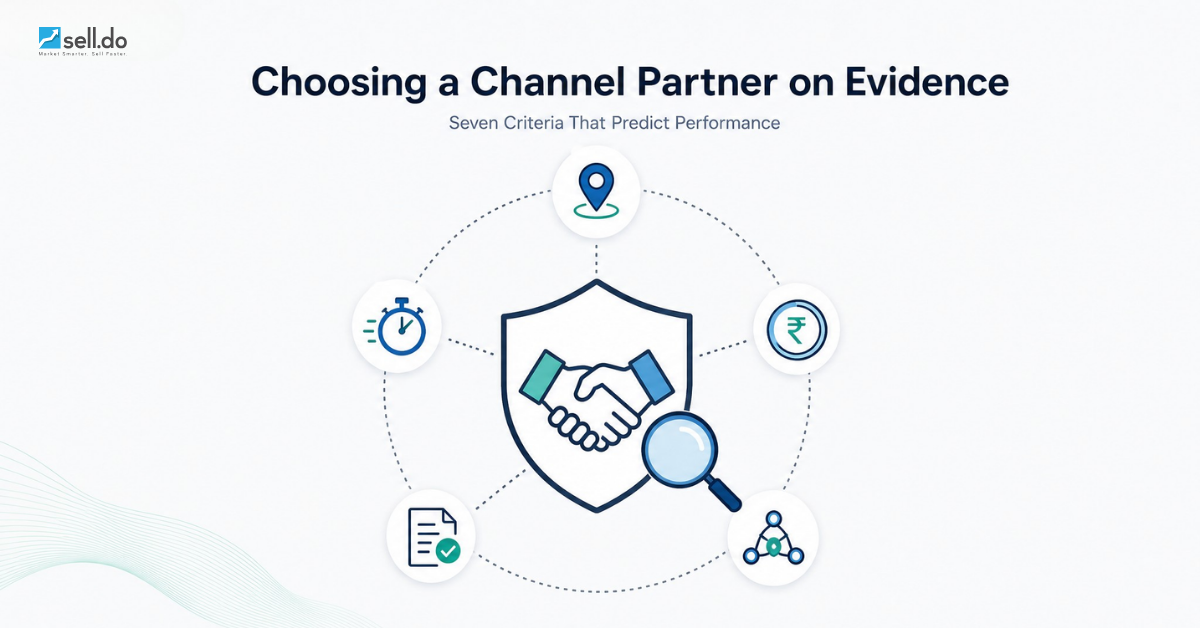
Ask ten Indian developers who their best channel partner is and you will get ten different answers. The honest answer is rarely a brand name: it is the CP who tags every lead correctly, calls it within the hour, and does not double-claim your bookings at agreement stage. Firm size predicts almost none of that. Operating discipline predicts all of it.
Why "top 10 channel partners" is the wrong question
Channel partners drive a large share of residential walk-ins for most Indian developers, especially in pre-launch phases and Tier-2 and Tier-3 markets. But a CP firm's brand is a weak proxy for the outcome you actually care about: source-to-booking traceability. More than 85,000 real estate agents are now registered across state RERA authorities as of early 2026, and the empanelled base of a single national consultancy runs into tens of thousands. Anarock alone publicly states it has worked with over 80,000 channel partners. You are not picking from a top-10 list. You are picking an operating model.
If you are still mapping what a CP actually does in the Indian market, start with our primer on the role and advantages of a channel partner in real estate, then come back to the selection criteria below.
From the team that built Sell.Do
Onboard channel partners and track every sourced lead in one place.
The four kinds of channel partners in India — and what each is good for
1. National consultancies and advisory firms
Anarock, JLL India, CBRE India, Knight Frank India and Colliers India run mandate-led residential and commercial businesses with research, capital-markets and advisory arms attached. Anarock describes a team of roughly 1,800 real estate specialists across India and the Middle East. Best for: large launches, NRI and HNI demand, institutional-grade reporting, and projects where formal governance on the mandate matters more than the lowest brokerage slab.
2. Tech-led aggregators and platforms
Square Yards, PropTiger and Housing (REA India) and NoBroker distribute through technology first — digital consultations, virtual tours, structured lead handoffs, large inside-sales floors. Best for: volume top-of-funnel and multi-city coverage on a single contract. Watch for: attribution disputes when the same buyer arrives through a portal form and a CP within the same month, which is exactly the scenario your tagging rules have to settle automatically.
3. Regional and micro-market specialists
Firms such as InvestoXpert in Delhi NCR and HomeBazaar in MMR, plus city-focused consultancies in Pune, Bengaluru, Hyderabad and Chennai, carry the relationships that convert. They know which society, school catchment and budget band your inventory actually sells to. Best for: conversion quality and site-visit-to-booking ratios. Watch for: capacity limits when two of their mandates launch in the same fortnight.
4. Independent brokers and CP networks
The long tail of one- to ten-person firms still moves an enormous share of Indian residential inventory, particularly in Tier-2 and Tier-3 cities. Best for: cost efficiency and local trust. Watch for: no CRM, records that live only in personal WhatsApp threads, and the lead leakage that inevitably follows.
Seven criteria that actually predict CP performance
- RERA registration and validity. Verify the agent registration number on the relevant state portal — every state and UT runs its own authority (MahaRERA, UP-RERA, Karnataka RERA, TNRERA and so on) with a public, searchable register. Check the expiry date, not just the number.
- Micro-market depth over city coverage. A CP closing ten units a quarter within a 3 km radius of your site beats a pan-India logo with no local team on the ground.
- Lead-tagging discipline. Ask how every enquiry gets stamped with source, sub-source and CP ID at the moment of capture, before a human touches it. This single answer determines your attribution accuracy for the entire launch.
- TAT commitment in writing. First call within X minutes, three attempts inside 24 hours, site visit scheduled within 72. Then insist it is measurable in your system, not reported from theirs.
- Payout and brokerage transparency. Agree the slab, the milestone that triggers it (booking, agreement or registration), TDS treatment, cancellation clawback and the dispute window before the mandate — not after the first cancellation.
- Conflict of interest. Is the CP simultaneously selling three competing projects in your micro-market at your price band? Ask for the current mandate list in writing.
- Tech readiness. Can their team work inside your CP portal — logins, live inventory, lead status updates — or will they email you an Excel every Friday?
The due-diligence questions to ask before you empanel
- What is your RERA agent registration number and expiry date, and in which states is it valid?
- How many units of comparable ticket size did you close in this micro-market in the last two quarters?
- How many salespeople will be dedicated to this project, by name, and who is the escalation owner?
- What is your average first-response time on a fresh lead, and how do you measure it today?
- Which competing projects are you currently mandated for in this catchment?
- How do you record site visits, buyer feedback and lost reasons — and will we see them live?
- What is your escalation path when the same buyer is claimed by two parties?
- Are your team members willing to operate inside our CRM's channel-partner portal?
- What brokerage slab and payout milestone are you assuming, and what happens on cancellation?
- Can we run a 60-day pilot mandate on a defined inventory block before full empanelment?
The system matters more than the shortlist
The strongest CP firm in the country will still leak leads if your side of the pipe is manual. The failure patterns repeat across developers: enquiries that arrive untagged, a CP-sourced buyer who also filled a portal form and is now claimed twice, follow-ups living on a salesperson's personal WhatsApp, and payout disputes that only surface at agreement stage. We have mapped where lead leakage actually happens in detail — most of it is fixable in configuration, not in negotiation.
This is the gap Sell.do's channel-partner module is built for: whitelabel CP portals and subdomains with individual partner logins, automatic source and CP tagging at capture across Meta, Google, portals, website and walk-ins, real-time unit and tower availability so CPs stop pitching blocked inventory, and payout tracking tied to booking milestones. The TAT and first-response dashboards are what turn "we think this CP is performing" into a number you can put in a review meeting.
Four red flags worth walking away from
- No verifiable RERA agent registration in the state where they will sell.
- Refusal to work inside your CRM or CP portal — this is nearly always about controlling a lead database, not about convenience.
- Brokerage agreed as a flat lump sum with no milestone trigger and no cancellation clawback.
- A "network of 500 sub-brokers" with no named, accountable team assigned to your project.
Related reading
- Role and Advantages of a Channel Partner in Real Estate
- Real Estate Lead Leakage: Where Brokers Lose Deals — and How to Plug Every Gap (2026)
- Importance of Channel Partners in Tier-2 and Tier-3 Cities
Choose on evidence, then run it on a system
Pick your channel partners on micro-market evidence and operating discipline rather than the size of the logo. Then give the relationship infrastructure that tags every lead at source, shows live inventory to every partner, and settles payouts without an email trail. See the whitelabel channel-partner module in Sell.do at https://www.sell.do/, or book a walkthrough and we will map it to the CP network you already work with.
Insights from the Sell.do real-estate CRM team.