
Channel Partners in Real Estate: Role, Benefits and How the Model Works in India (2026)
A channel partner in real estate sells a developer's inventory for a brokerage. Here is the role, the commission structure, the RERA rules and the operating layer that makes a partner network actually work in India.
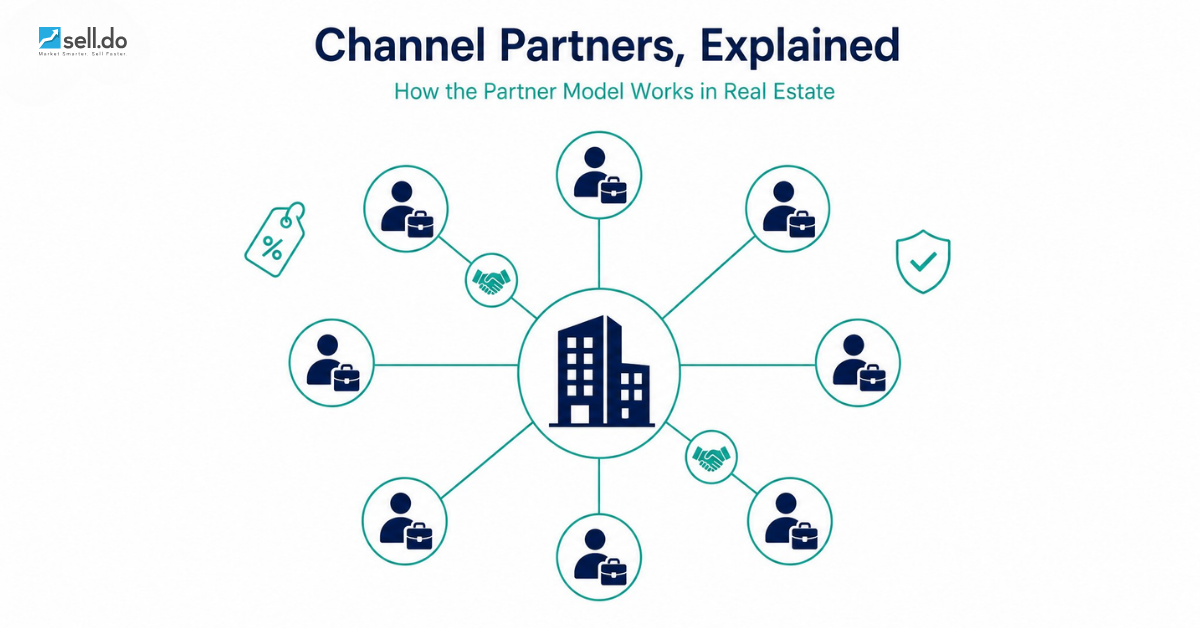
A channel partner in real estate is an independent broker, agency or consultant who sells a developer's inventory on the developer's behalf, and is paid a brokerage by the developer rather than by the buyer. In Indian primary sales, they are not a side channel. For most launches outside a developer's home city, they are the channel.
For developers, channel partners buy reach that no in-house team can match on day one: a network of sub-brokers, a live database of active buyers, and feet on the ground in the tier-2 and tier-3 markets where a growing share of demand now sits. For the partner, developer empanelment is access to inventory, launch pricing and a brokerage slab without carrying the cost of building the project.
The model works. What breaks is the operating layer around it: who owns which lead, who called first, which site visit counts, and when the brokerage actually gets paid. This guide covers both halves, the role and the machinery, for Indian real estate in 2026.
What Is a Channel Partner in Real Estate?
A channel partner is a registered real estate agent or agency that markets and sells a specific developer's projects under a formal empanelment agreement. They are an extension of the developer's sales team, not a neutral intermediary. Their revenue is a percentage of the ticket size, paid by the developer, typically after the booking is confirmed and a defined slab of the payment has been collected.
Three things define the relationship in India:
- Empanelment, not employment. The partner signs an agreement per project or per developer, agreeing to a brokerage slab, a lead-registration process and, often, an exclusivity window on any lead they source.
- RERA registration is mandatory. Under the Real Estate (Regulation and Development) Act, anyone facilitating the sale of a RERA-registered project must hold a valid agent registration in that state. Registration is state-wise, so a partner selling across Maharashtra and Karnataka needs both. Developers who empanel unregistered partners carry the compliance risk with them.
- The buyer usually pays nothing. Because the developer pays the brokerage, working with a channel partner on a primary-market purchase is generally free to the buyer, which is why buyers use them for shortlisting, site visits and negotiation.
For a view of who the larger organised partners in the market are and how to shortlist one, see our guide to the top real estate channel partners and consultants in India.
From the team that built Sell.Do
See how Sell.Do runs your sales, pre-sales and marketing on one AI-first platform.
Channel Partner vs Broker vs Agent: What Actually Differs
The three words get used interchangeably on site visits, and the distinction matters mostly for who pays and what the person is accountable for.
- Who pays them. A channel partner is paid by the developer out of the project's marketing and sales budget. A broker in a resale or rental transaction is paid by the buyer, the seller or both.
- Which market they work. Channel partners work primary sales, new and under-construction inventory sold by the developer. Brokers work both primary and secondary, and typically own the resale and rental side.
- Who they represent. A channel partner represents the project. A broker represents a client in the transaction.
- What they are measured on. Channel partners are measured on site visits generated and bookings closed for a specific project. Brokers are measured on transactions closed across whatever inventory they can access.
- Registration. In India, both need RERA agent registration to deal in RERA-registered projects. The label on the visiting card does not change that obligation.
In practice most Indian firms are both at once: a channel partner for three developers' launches and a broker on resale in the same micro-market. The useful question is not what to call them but which hat they are wearing on a given lead, because that decides who pays and who owns the lead. Our breakdown of the differences between a real estate agent and a broker goes deeper on the licensing side.
What Channel Partners Actually Do
The role looks different depending on which side of the table you are on.
For Developers
- Extend reach into micro-markets and buyer segments the in-house team does not cover, including NRI demand routed through partners with overseas desks.
- Fill the site-visit calendar in the pre-launch and launch windows, when velocity matters more than margin.
- Convert a fixed marketing cost into a variable one. Brokerage is paid on outcomes; a media budget is spent whether or not it books.
- Feed back real pricing and product objections from the market within days, not after a quarter of slow sales.
For Channel Partners and Their Sub-Brokers
- Access to inventory, floor plans, cost sheets and launch pricing without the capital risk of development.
- A brokerage slab that scales with ticket size, plus performance incentives on volume in most empanelment agreements.
- Co-branded marketing support, digital creatives and, from better-run developers, a partner portal with live availability.
For Homebuyers
- A shortlist across multiple projects in one conversation, filtered by budget, configuration and possession timeline.
- Coordinated site visits, often with transport, across projects in a single day.
- Help with the paperwork chain: booking form, allotment letter, agreement for sale, home-loan documentation and registration.
- Negotiation on price, payment plan, floor-rise and amenity charges, using knowledge of what the developer has actually been closing at.
For Investors
- Early visibility on pre-launch and soft-launch pricing before public release.
- Micro-market rental yield and appreciation context that does not show up in a brochure.
- Support on exit: finding the next buyer when the investor wants to sell before possession.
Channel Partner Commission Structure in Indian Real Estate
Brokerage is the part of the relationship that generates the most disputes, so it is worth being precise about how it is normally structured.
- A percentage of the agreement value. Residential primary-sales brokerage in India commonly sits in a low single-digit percentage of the unit's agreement value, with the exact slab negotiated per project. Slabs are usually higher on slow-moving inventory, larger configurations and pre-launch phases, and lower on fast-selling launches where the developer has pricing power.
- Slabs, not a flat rate. Most empanelment agreements step the rate up with volume: a base rate for the first few bookings in a quarter, a higher rate past a threshold. Some add a per-booking incentive or a foreign-trip style reward on annual targets.
- Paid against collection milestones, not on booking. The common structure releases brokerage in tranches tied to what the buyer has actually paid, for example a first tranche after the booking amount and agreement registration, the balance after a defined collection percentage. This is what protects the developer against cancellations.
- TDS and GST apply. The developer deducts TDS on the brokerage payout, and the partner raises a GST invoice where registered. Payout files that do not reconcile with invoices are the single most common reason a partner's money sits stuck.
- Clawback on cancellation. If the buyer cancels before the agreed milestone, paid brokerage is typically recovered from the partner's next payout.
Beyond cash, the developers who retain their best partners run structured recognition. Our guide on setting up a rewards programme for real estate channel partners covers slab design and non-cash incentives.
The Five Things That Break Channel Partner Programmes
Almost every developer running a partner network in India hits the same five failures. None of them are about the partners' selling ability.
1. Lead ownership disputes
The same buyer walks in through a partner, fills a Meta lead form, and calls the developer's number in the same week. Without a lead-registration rule and a duplicate check at capture, three parties claim the booking. The fix is a hard rule written into the empanelment agreement, first registered source owns the lead for a defined window, and a system that enforces it automatically rather than an email chain that settles it after the fact.
2. Untagged leads and broken attribution
If a partner-sourced lead is not tagged to that partner at the moment of capture, the developer cannot tell which partner produced which site visit or which booking. Payouts get argued, and the developer cannot see which partners are worth a higher slab. Source tagging at capture is the single highest-leverage habit in a partner programme.
3. Slow first response
Partner-sourced leads and developer-sourced leads decay at the same rate. When a partner's team takes hours to call a fresh enquiry, the buyer has already spoken to two other projects. Developers who publish a first-response TAT standard to their partners, and can actually measure it, close more from the same lead volume. Our guide on speed to lead in real estate covers the operating standard.
4. Leakage between the partner's team and the developer's
Leads sitting in a sub-broker's personal phone, follow-ups tracked in a WhatsApp group, site visits recorded on paper at the sales gallery. Every handoff without a system is a place a deal disappears. We covered the specific gaps in detail in our breakdown of real estate lead leakage for brokers.
5. Payout opacity
Partners who cannot see what they have earned, what is approved and what is pending stop prioritising the project. Payout transparency is a retention tool, not an accounting detail. The developers whose partners bring them the first look at a hot buyer are the ones who pay on a predictable cycle and show the ledger.
How to Run a Channel Partner Programme That Scales
If you are a developer building or fixing a partner network, the sequence that works looks like this.
- Empanel with a checklist. Collect the RERA agent registration number, GST details, PAN and bank details up front, and verify the RERA number on the state authority's portal before the partner gets a single lead. Registration is state-wise, so verify it for the state the project sits in.
- Give every partner a login, not a spreadsheet. A partner portal with live inventory, their own leads and their own payout status removes 80 percent of the phone calls your channel team fields.
- Register leads at capture, with a duplicate check. The partner submits the lead, the system checks it against the existing database, and either confirms ownership or rejects it with a reason. This ends the dispute before it starts.
- Verify site visits. A visit code or app-based check-in at the sales gallery is what makes site-visit-linked incentives payable without argument.
- Publish a TAT standard and report against it. Partners respect a number they can see themselves against.
- Run a partner leaderboard on quality, not just volume. Rank by bookings and by lead-to-site-visit conversion, so the partner sending 400 junk leads does not outrank the one sending 40 real ones.
- Pay on a published cycle. Fixed dates, visible ledger, invoice reconciliation built in.
Tier-2 and tier-3 markets deserve a separate playbook, because partner density, digital maturity and ticket sizes are all different. We covered that in the importance of channel partners in tier-2 and tier-3 cities.
How to Become a Channel Partner in Real Estate in India
- Register with your state RERA authority. Apply for a real estate agent registration in the state you intend to operate in, with PAN, address proof, company documents where applicable and the prescribed fee. You will need this number on every advertisement and agreement.
- Register for GST. Brokerage is a service; developers will ask for a GST invoice before releasing payout.
- Pick a micro-market and go deep. Partners who own one corridor and know every project's pricing, possession status and objection set outperform those spread across a city.
- Get empanelled. Approach developer channel teams with your registration, your team size, your monthly site-visit numbers and your lead sources. Expect to sign a lead-registration and exclusivity clause.
- Build your own lead engine. Portals, Meta and Google campaigns, referrals and your own database. Do not depend entirely on the developer's spillover leads. Our guide on real estate lead generation strategies for India covers the channel mix.
- Put a CRM in from day one. The partners who scale past a handful of sub-brokers are the ones who stop running on WhatsApp groups early. See our comparison of broker CRM software for what to look for.
What to Look for in Channel Partner Software (2026)
Whether you are the developer managing 200 partners or the partner managing 20 sub-brokers, the same capabilities matter.
- A whitelabel partner portal. Partners log in under the developer's brand, see live availability and submit leads. Sub-domain and branding control matters for larger networks.
- Lead registration with automatic duplicate detection. The system, not a person, decides ownership.
- Source tagging at capture across every channel: portals, Meta and Google lead forms, the project website, walk-ins and partner submissions.
- Live inventory with hold and block. Partners quoting a unit that sold yesterday is a trust problem, not a data problem.
- Built-in calling and WhatsApp with logging, so first-response TAT is measured rather than estimated.
- Site-visit verification, so incentives tied to visits are payable without argument.
- Brokerage and payout tracking with invoice, TDS and clawback handling built in.
- Partner performance dashboards covering leads, site visits, bookings and conversion by partner.
- A mobile app, because sub-brokers work from the field, not a desk.
For a feature-level checklist written from the partner's side of the table, see the top CRM features a channel partner in real estate wants.
How Sell.do Supports Developers and Channel Partners
Sell.do is an AI-agentic CRM built for Indian real estate, and the channel-partner module exists because the ownership, tagging and payout problems above are the ones our developer customers raised first.
- A whitelabel channel-partner portal with partner logins and sub-domains, so partners work inside the developer's brand with only the data the developer chooses to expose.
- Lead registration with duplicate detection and source tagging at capture, so partner-sourced leads carry the partner's tag from the first touch through to the booking.
- Automated lead distribution and routing to the right partner or team, with first-response TAT tracked on every lead.
- Built-in calling and WhatsApp, so partner conversations are logged against the lead rather than living on a personal phone.
- IRIS for live inventory: unit, tower and availability, hold and block, and cost sheets partners can generate themselves.
- Brokerage and incentive tracking with per-partner ledgers, so payout conversations start from a shared number.
- Channel-partner performance dashboards and source-to-booking attribution, so the developer can see which partners produce bookings rather than volume.
With Sell.do, Aurobindo Realty achieved a 20 percent improvement in CSAT and a 30 percent increase in revisit count. The full case study covers how.
If you are evaluating tooling specifically for a partner network, the channel partners module page covers the whitelabel portal, deal registration and payout tracking in product detail.
Channel Partner FAQs
What does channel partner mean in real estate?
It is a registered agent or agency empanelled by a developer to market and sell that developer's projects. They are paid a brokerage by the developer, work primary-market inventory, and act as an extension of the developer's sales team rather than as a neutral intermediary between buyer and seller.
Do buyers pay a channel partner?
On a primary-market purchase, generally no. The developer pays the brokerage out of the project's sales budget, which is why buyers can use a channel partner for shortlisting, site visits and negotiation at no direct cost. Always confirm this in writing before the site visit.
What is the commission structure for real estate channel partners in India?
A negotiated percentage of the unit's agreement value, usually stepped in slabs by volume, released against collection milestones rather than at booking, with TDS deducted and a GST invoice required. Clawback on cancellation is standard. Exact slabs vary by developer, city, configuration and how fast the inventory is moving.
Is RERA registration mandatory for a channel partner?
Yes. Anyone facilitating the sale of a RERA-registered project must hold a valid real estate agent registration with that state's RERA authority. Registration is state-specific, so partners operating across states need one per state, and the number must appear on advertisements and agreements.
What is the difference between a channel partner and a broker?
A channel partner is paid by the developer and sells a specific developer's primary inventory under an empanelment agreement. A broker is typically paid by the buyer or seller and works across primary, resale and rental. Both need RERA agent registration in India, and most Indian firms operate as both depending on the deal.
How do developers stop two partners claiming the same lead?
With a lead-registration rule enforced by the CRM: the partner submits the lead, the system runs a duplicate check against the existing database, and ownership is confirmed or rejected automatically with a defined validity window. Settling this by email after a booking is how partner relationships end.
The Bottom Line
Channel partners are how most Indian projects reach buyers outside the developer's own city and own database. The partners are rarely the constraint. The constraint is the operating layer: who owns the lead, how fast it gets called, whether the site visit is verifiable, and whether the brokerage arrives on a date the partner can plan around.
Get those four right and the network compounds. Get them wrong and the best partners quietly move their attention to the developer next door who pays on time and does not argue about attribution.
If you want to see how a whitelabel partner portal, deal registration and payout tracking work together on live inventory, book a walkthrough of Sell.do.
Related reading
Insights from the Sell.do real-estate CRM team.