
AI Voice Agents for Real Estate Lead Calling in India (2026): Costs, DND Compliance and How to Evaluate One
How to evaluate an AI voice agent for real estate lead calling in India: first-60-second behaviour, language tests, indicative costs vs a presales seat, DND and consent rules, and a vendor checklist.
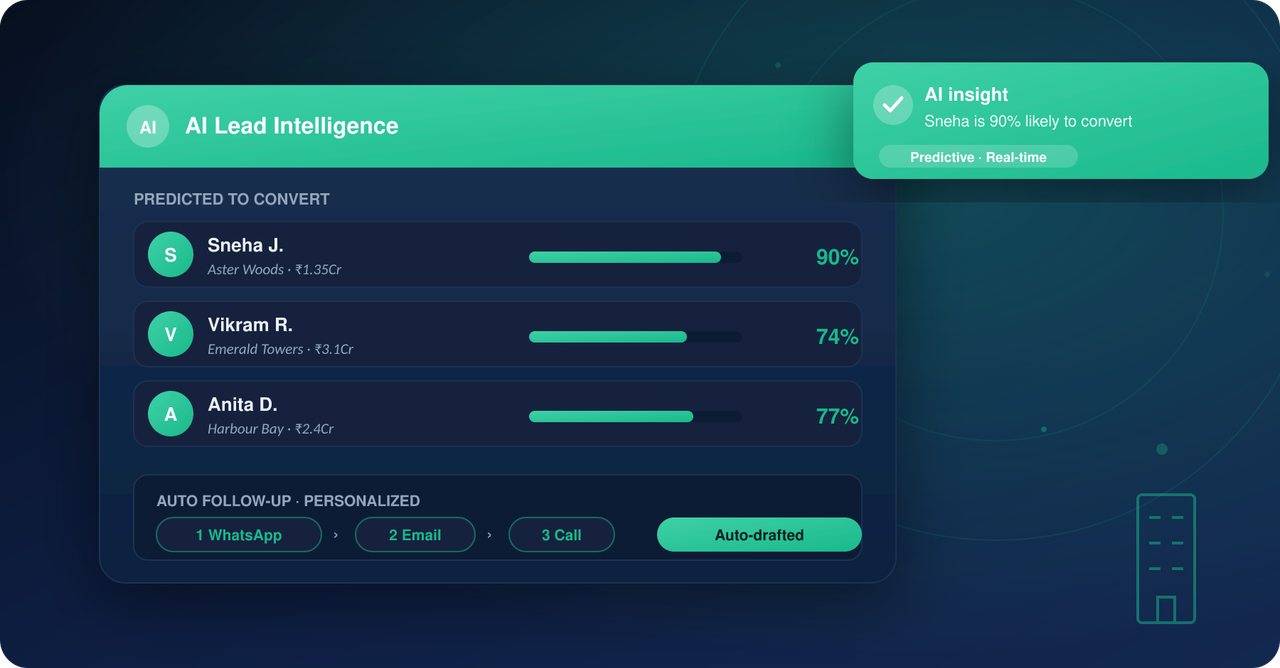
A portal lead that fills in a form at 11:40 pm on a Saturday does not wait for your presales team to log in on Monday. By then, the same buyer has usually been called by three other developers, and the lead sits in your CRM as "not reachable". For developers and brokerages handling a few thousand inbound enquiries a month, this is the core economic case for an AI voice agent: not replacing the presales team, but making sure every lead gets a real conversation within about a minute, at any hour.
This guide is for presales heads, sales heads and marketing teams who are being pitched voice AI and need a way to separate a useful system from a demo. We cover what a voice agent should actually do in the first 60 seconds, how Indian-language coverage should be tested, what it costs against a human presales seat (as indicative ranges, not quotes), the DND and consent rules you must design around, and a checklist you can hand to any vendor, including us.
Why voice, and why now
Speed matters because buyer attention decays quickly. A widely cited Harvard Business Review study of online lead response found that firms contacting a lead within an hour were around seven times more likely to qualify it than those that waited longer. Our own breakdown of the first-minute problem is in Speed to Lead in Real Estate, and the pattern holds in Indian real estate where one Meta or portal enquiry is often sold to several developers at once.
The practical constraint is human capacity. A presales caller can make perhaps 60 to 90 meaningful dial attempts in a shift, and almost none between 9 pm and 9 am, when many digital enquiries arrive. Launch weekends make it worse: a single campaign can generate in an hour what a team normally handles in a week. A voice agent absorbs the spike and the night shift; humans handle the conversations that deserve them.
If you want the wider context on how AI voice sits alongside scoring and presales workflow, read our trend view in Presales in Real Estate: How AI Voice and Predictive Scoring Are Replacing the Spreadsheet. This post stays on one question: how to evaluate and buy a voice agent.
From the team that built Sell.Do
Let Jarvis qualify, follow up and forecast — so your team sells, not types.
What a voice agent should do in the first 60 seconds
Ignore the polished demo call. Ask the vendor to run a live test on a lead you create (portal-style, with a project name and budget) and time it. A competent system should do the following in order:
- Trigger within seconds of capture. The call should start from the CRM event, not from a batch that runs every 15 minutes. If your lead arrives from 99acres, MagicBricks, Housing, Meta or your website, the source and project should already be known to the agent.
- Open with context, not a script. "Hi, you enquired about the 2 BHK at [project] a minute ago" lands very differently from a generic greeting. Callers who recognise the reason for the call stay on it.
- Qualify in three or four questions. Budget range, configuration, purchase timeline, and whether this is for self-use or investment. More than five questions and drop-off rises.
- Handle the obvious branches. "Send me details on WhatsApp", "call me after 7", "I already bought", and "wrong number" must each lead to the right CRM outcome instead of a dead end.
- Book the next step or hand off warm. A site visit slot offered inside the call, or a live transfer to a human with a summary on screen, is the real output. A transcript on its own is not.
The measure of the first minute is not how human the voice sounds. It is whether the lead ended up in the right stage, with the right tags and a next action, without anyone typing.
Indian languages, accents and the code-switching test
Most Indian buyers do not speak one clean language on a call. A Pune lead moves between Marathi, Hindi and English inside a sentence, and a Bengaluru lead mixes Kannada and English. Ask vendors for the exact languages supported in production, not on a roadmap, and then run your own test:
- Call the agent yourself in Hinglish with background noise (a car, a street) and see whether it recovers when it mishears.
- Say a budget in lakhs and crores in different forms ("1.2 cr", "one point two crore", "120 lakh") and check that the captured value is identical.
- Interrupt mid-sentence. Latency above roughly a second after you stop speaking makes the call feel broken to most listeners, and agents that talk over the buyer lose them.
- Ask for a person. The agent should transfer or schedule a callback cleanly and never argue.
What does it cost? Indicative ranges, with caveats
Voice AI pricing in India is still moving, and vendors quote in different units: per minute, per call, per connected call or as a monthly platform fee plus usage. Treat the figures below as indicative planning ranges based on typical market positioning, not quotes from any vendor, and verify against current proposals.
- AI voice agent: commonly priced somewhere between a few rupees and the low teens of rupees per connected minute once telephony, speech recognition and language model costs are bundled. A two to three minute qualification call therefore costs in the range of roughly Rs 10 to Rs 40, depending on vendor and language.
- Human presales seat: a trained presales executive in a metro typically costs a developer a fully loaded Rs 25,000 to Rs 45,000 a month (salary, seat, telephony, supervision, attrition cover). At 60 to 90 dials a day and a contact rate well under half, the cost per connected, qualified conversation is usually several times higher than the AI figure, but the human conversion on a good lead is also higher.
The right comparison is not rupees per minute. It is cost per qualified site visit, and cost per booking, which is the same reframe we argue for in Cost Per Lead vs Cost Per Booking. A cheap agent that books no visits is more expensive than a costly one that books many. Ask any vendor for qualified-lead-to-visit rates from live Indian real estate accounts, with the lead source mix disclosed.
DND, consent and recording: design around the rules
This is where many pilots stall. We are not your lawyer and rules change, so have your counsel confirm the position for your use case. The principles that matter in practice:
- DND scrubbing before dialling. India's TRAI telecom commercial communications rules distinguish promotional from service and transactional calls and require telemarketers to honour the preference register. An enquiry the buyer initiated is generally treated differently from a cold call, but you should still scrub, log the basis for contact, and respect any later opt-out.
- Use the correct calling series. TRAI has pushed telemarketers toward designated number series for promotional versus service calls. Confirm which series your telephony provider uses for AI-originated calls, and that caller ID is not masked.
- Disclose that it is an AI. Do not pretend to be a person. A one-line disclosure at the start protects trust and is good practice as regulation on AI disclosures evolves.
- Consent for recording and data. Tell the buyer the call may be recorded, store the consent flag against the lead, and align retention with the Digital Personal Data Protection Act, 2023 and its rules, whose obligations are phasing in.
- Time-of-day limits. Calling windows should be configurable, so an agent that responds at midnight sends a WhatsApp message and schedules a call for morning instead of ringing the buyer.
A vendor who cannot explain how DND scrubbing, consent flags and opt-outs flow back into the lead record is a compliance risk, regardless of how good the voice sounds.
CRM write-back is where most voice agents fail
A voice agent that lives outside your CRM creates a new silo. Every call outcome needs to land on the lead automatically: recorded call, transcript, summary, qualification fields, tags, stage change, follow-up task and the site-visit booking. This matters most for the two groups with the sharpest pain. Builders need the call tied to the source and campaign so attribution survives to booking. Brokers need every enquiry tagged correctly and called on time, so nothing leaks. For the second group, our guide on where brokers lose deals shows the cost of a missing tag or a missed callback.
Ask whether the agent writes to custom fields, whether it respects your lead assignment and routing rules, and whether a human picking up the lead later sees exactly what the AI heard. If the answer involves a CSV export or a Zapier chain, keep looking.
Call analysis: the underrated half
Once calls are recorded and transcribed, the same engine can audit your human team. Useful outputs include objections raised by project, budget mismatches, competitors named, talk-to-listen ratio, script adherence and first-call TAT per executive. This is what turns presales from anecdote into a managed process, and it is why "AI-driven sales call analysis" belongs in the buying criteria alongside the voice agent itself.
Evaluation checklist you can hand to any vendor
- Latency: time from lead capture to first ring, and silence gap during conversation. Test it live.
- Languages: production languages, accent robustness and number, budget and date capture accuracy.
- Compliance: DND scrubbing, number series, AI disclosure, recording consent, opt-out handling and data residency.
- CRM write-back: fields, tags, stages, tasks and source attribution written natively without exports.
- Handoff: live transfer with context, scheduled callbacks and site-visit booking.
- Analytics: call transcripts, summaries, sentiment and per-executive TAT dashboards.
- Commercials: unit of billing, minimum commitments, what counts as a billable call, and pilot terms with an exit.
- Proof: qualified-lead-to-visit rates from live real estate accounts, not generic contact centre benchmarks.
How to run a 30-day pilot
Pick one project and one lead source, such as Meta lead forms or a single portal. Route only after-hours and first-touch calls to the agent for two weeks while humans keep everything else. Measure first-call TAT, contact rate, qualified rate, site visits booked and cost per visit against a matched control group. Review a sample of 50 call recordings weekly for tone, compliance and mishearings. Expand to more projects only if the visit rate holds, and keep human callbacks on every high-intent lead.
Where Sell.do fits
Sell.do's AI voice agents run inside the CRM, so the call starts from the lead event, DND scrubbing is applied before dialling, and Jarvis AI call analysis writes the summary, tags and next action back to the lead without anyone re-keying it. Presales and brokers see the same record, and builders can trace the lead from campaign to booking. It is one system for the first call, the follow-up and the audit, rather than a voice tool stitched onto a CRM. You can also read how the model works in What Is an AI-Agentic CRM.
Related reading
- Speed to Lead in Real Estate: Why the First 60 Seconds Decide the Booking
- Presales in Real Estate: How AI Voice + Predictive Scoring Are Replacing the Spreadsheet
- What Is Lead Routing In Real Estate & How Does It Reduce Response Time?
Ready to see it on your own leads? See built-in calling and AI lead scoring in action: book a walkthrough at sell.do and we will run a live voice-agent test on a sample portal lead, with DND scrubbing and CRM write-back shown end to end.
Insights from the Sell.do real-estate CRM team.