
Real Estate Lead Leakage: Where Brokers Lose Deals — and How to Plug Every Gap (2026)
Lead leakage is the most expensive problem in Indian broking: leads you already paid for that never reach a human conversation. Here are the six gaps where they disappear, and how to close each one.
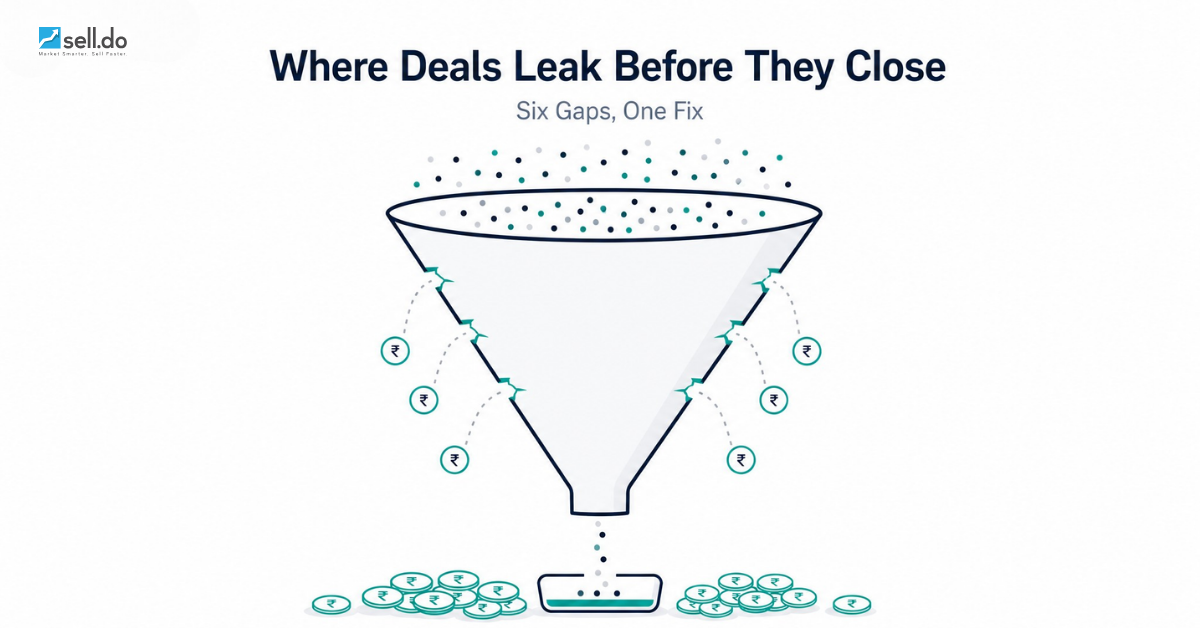
A broker in Pune buys 500 portal and Meta leads in a month. At an average of Rs 800 per lead that is Rs 4,00,000 of hard cash. By the 30th, the team has spoken to roughly 380 of them. The other 120 were never called even once. Nobody stole them, nobody deleted them. They simply fell through the cracks between a WhatsApp forward, an Excel sheet, a portal inbox and a telecaller who was on leave that week.
That is lead leakage: money already spent on demand that never reaches a human conversation. It is the single most expensive problem in Indian broking, and it is almost never on anyone's dashboard because leaked leads leave no trace. A lost deal gets a post-mortem. A lead that was never called just does not exist.
Leakage is an arithmetic problem, not a discipline problem
Most teams treat leakage as a people issue. It is not. It is what happens when lead volume grows faster than the system that holds it. Run the arithmetic on the Pune example above and the cost gets uncomfortable fast.
- 120 uncalled leads at Rs 800 CPL = Rs 96,000 of spend that produced literally nothing.
- At a conservative 4% raw-lead-to-site-visit rate, those 120 leads held roughly 5 site visits.
- At a 20% site-visit-to-booking rate, that is one booking a month walking out of the door, every month.
Indian CPLs in 2026 sit roughly between Rs 150 and Rs 2,000 on Meta and Rs 300 to Rs 2,500 on Google depending on city and ticket size, so the exact number changes, but the shape does not. Leakage of 15-25% is normal for teams running on spreadsheets, and it compounds with every new source you add. Harvard Business Review's well-known lead-response research found that firms responding within an hour were about seven times more likely to have a meaningful conversation with a decision-maker than those responding an hour later, and sixty times more likely than those who waited 24 hours. A lead nobody calls at all is the extreme end of that curve.
From the team that built Sell.Do
Onboard channel partners and track every sourced lead in one place.
The six gaps where broker leads disappear
1. The capture gap
Leads arrive from 99acres, MagicBricks, Housing, Meta lead forms, Google, the website, walk-ins, hoardings and channel-partner referrals. Each has its own inbox, export or WhatsApp group. Anything that requires a human to copy a row from one place to another is a leak waiting to happen. The test is simple: if a lead can exist in one place and not in your single lead list, you have a capture gap.
2. The tagging gap
An untagged lead is an unroutable lead. Without source, project, campaign and channel-partner tags applied automatically at the point of capture, you cannot route by project, cannot measure cost per booking by source, and cannot settle a payout dispute with a CP six weeks later. Manual tagging degrades under volume, which is exactly when you need it most.
3. The routing gap
A lead that sits unassigned for four hours is functionally a cold lead. Round-robin on a WhatsApp group is not routing. Real routing assigns by project, language, city, source and current load within seconds of capture, and escalates when nobody accepts. If you have not mapped this yet, start with how lead routing works and what it does to response time.
4. The first-call gap
This is the biggest single leak and the easiest to measure. Two numbers matter: the percentage of leads that never receive a first call, and the median time-to-first-touch. Most teams discover their true TAT is measured in hours, not minutes. The economics of that window are covered in detail in our breakdown of speed to lead in real estate — the short version is that the first 60 seconds do most of the work.
5. The duplicate gap
The same buyer enquires on a portal on Monday, clicks a Meta ad on Wednesday and walks into the site office on Sunday. Three records, three owners, three different pitches, and eventually an internal fight over whose booking it is. Duplicates do not just waste effort, they actively damage the buyer's experience and corrupt your source attribution. Dedupe on phone number at capture, merge histories rather than deleting, and let the earliest genuine source keep the credit.
6. The follow-up gap
Most Indian real estate leads convert on the fourth to seventh touch, but the average team stops at two. A lead marked 'not interested' after one unanswered call is not a dead lead, it is an abandoned one. Without scheduled follow-up sequences and WhatsApp nudges that fire automatically, the back half of your database quietly ages out.
The 20-minute leakage audit
You do not need software to find out how bad it is. Take last month's data and answer six questions honestly:
- Total leads received across all sources versus total leads present in your primary system. The gap is your capture leak.
- Percentage of leads with no source tag or no project tag.
- Percentage of leads with zero call attempts logged.
- Median minutes from lead creation to first call attempt.
- Count of records sharing the same phone number.
- Percentage of leads with fewer than three total touch attempts before being closed as lost.
Write those six numbers on a whiteboard and review them weekly. Teams that do nothing else but publish these six numbers usually recover 5-10% of their pipeline within two months, purely because the leaks become visible.
What zero-leakage operations actually look like
Plugging the gaps is mostly about removing the human copy-paste steps between a lead's arrival and a human conversation. In practice that means five things:
- Unified capture. Every portal, ad platform, website form, walk-in and CP referral lands in one list automatically, with no exports.
- Automatic tagging. Source, campaign, project and partner attach at capture, not later, so attribution and payouts are never reconstructed from memory.
- Instant routing with escalation. Assignment in seconds, reassignment if unaccepted, and a visible TAT clock per lead.
- Built-in calling and WhatsApp. With 500 million-plus WhatsApp users in India and open rates in the 70-90% range against 20-30% for email, the channel your buyer already uses should be inside the system, not on someone's personal phone.
- Automated follow-up. Sequenced attempts, reminders and re-engagement so no lead exits on a single unanswered ring.
This is the operating model Sell.do's broker and channel-partner module is built around: one lead list across every source, auto-tagging at capture, TAT dashboards that show exactly who is late, and calling plus WhatsApp inside the same screen. For brokers running a CP network, it also keeps referral attribution and payout tracking clean, which is where the other half of the arguments happen. If you are evaluating options, our guide to CRM software systems for real estate brokers walks through what to look for.
Related reading
- Speed to Lead in Real Estate: Why the First 60 Seconds Decide the Booking
- CRM Software System for Real Estate Brokers (2026)
- Top Real Estate Broker Apps for Agents in India (2026)
Plug the leaks before you buy more leads
Buying more leads to cover a 20% leak is the most expensive fix available. Audit the six gaps first, then close them with a system that captures, tags, routes and follows up without anyone remembering to. See the whitelabel channel-partner and broker module in Sell.do, and how it holds every lead from first enquiry to booking.
Insights from the Sell.do real-estate CRM team.