
Presales in Real Estate: How AI Voice + Predictive Scoring Are Replacing the Spreadsheet in 2026
Indian real estate presales teams still run on call lists and spreadsheets. In 2026, AI voice agents and predictive scoring are taking over the first touch — here is what actually changes, and what to measure.
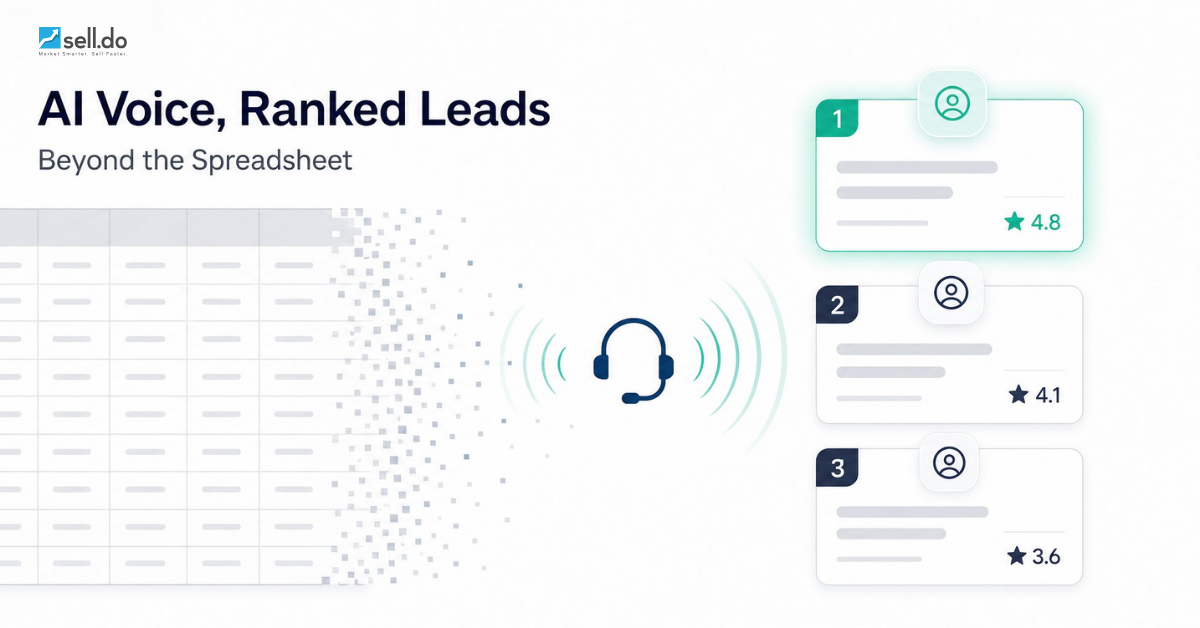
Walk into the presales floor of any mid-sized Indian developer on a launch weekend and the picture is the same everywhere. Twelve to twenty callers, a shared sheet exported from three portals and two ad platforms, a column called "Status" that half the team fills in and half doesn't, and a WhatsApp group where someone is asking whether anyone has already called the Kharadi enquiry that came in at 11:40. By Monday the sheet has 1,400 rows, roughly 300 of them have never been dialled, and nobody can say which of those 300 were worth dialling first.
That is the presales problem in one paragraph. It is not a people problem. It is a routing and ranking problem that human teams were never built to solve at portal-lead volume. In 2026 two technologies are quietly taking that job over: AI voice agents that make the first call within seconds, and predictive scoring that decides who the humans call next.
What the spreadsheet actually costs you
The cost is not the licence fee for Excel. It is the decay curve on a fresh enquiry. Harvard Business Review's study of online sales leads found firms that responded within an hour were about seven times likelier to have a meaningful qualifying conversation than those that waited two hours, and roughly sixty times likelier than those that waited a day. Real estate is worse than the average, not better: a buyer who fills a 99acres form for a 2 BHK in Wakad has usually filled three more in the same session, and the first developer to reach them frames the entire comparison.
Put rupee numbers against that. Paid enquiries for residential projects in the metros typically land somewhere between ₹800 and ₹2,500 per lead depending on city, ticket size and platform. If 20% of a 1,400-lead week is never called, and another 25% is called after the buyer has already booked a site visit elsewhere, a developer is writing off ₹5–15 lakh of media spend a month before a single sales conversation happens. The spend was fine. The first touch wasn't.
From the team that built Sell.Do
Let Jarvis qualify, follow up and forecast — so your team sells, not types.
Why presales teams can't fix this by working harder
A good presales caller manages 70–90 dials a day and holds maybe 25 real conversations. That is a hard ceiling set by human throughput, and it does not move when a launch triples your inflow for eleven days. Three failure modes follow, and every one of them is structural:
- Queue order is arbitrary. Sheets are sorted by arrival time, so a tyre-kicker from 9:02 gets called before a repeat site-visitor from 9:40.
- Source truth is lost. By the time a lead is pasted from a portal export into a master sheet, the campaign, ad set and creative that produced it are gone — so nobody can tell marketing which spend produced bookings.
- Nothing is logged reliably. Call outcomes get typed in after the shift, from memory, in whatever words the caller prefers. Three months later the data is unusable for coaching or forecasting.
None of this means spreadsheets are useless — a well-built lead tracking sheet is still the right starting point for a two-person brokerage. It means the sheet stops working at roughly the volume where presales becomes a job title.
Layer one: AI voice agents own the first touch
The first change is not that AI replaces your callers. It is that AI takes the one call your callers cannot make fast enough — the one that happens 20 seconds after the form submit, at 10:40 pm, on a Sunday, in Marathi if the buyer prefers Marathi.
A production-grade voice agent in an Indian real estate funnel does a narrow, boring set of things well: confirms the enquiry is real, checks budget band and configuration, asks about possession timeline and loan status, offers two site-visit slots, and hands off to a human the moment the conversation moves outside its script. Everything it hears is written back to the lead record as structured fields, not free text.
The compounding effect is on response time, which is the single presales metric that most reliably predicts bookings. We have written about why the first 60 seconds decide the booking — the short version is that first-touch TAT is the only lever that improves every downstream ratio at once. Sell.do's AI agent is built for exactly this slot: it picks up a lead from Meta, Google, a portal or the website, calls or messages within seconds, qualifies against your criteria, and books the site visit into the sales team's calendar.
Layer two: predictive scoring decides who humans call next
Speed alone just gets you to the wrong leads faster. The second layer is ranking. Predictive scoring reads the signals a spreadsheet cannot hold — source and campaign quality, how many project pages the buyer viewed and for how long, whether they have enquired before, response to the first WhatsApp, budget band versus your live inventory, distance from the project — and turns them into an ordered callback queue that re-sorts itself through the day.
The practical output is unglamorous and valuable: when a caller logs in at 9:30, the top of the list is the 40 people most likely to visit a site this week, not the 40 who happened to fill a form first. Two things follow. Sales stops complaining that presales sends junk, because the handover is ranked and evidence-backed. And marketing finally learns which campaigns produce high-scoring leads rather than merely cheap ones — which usually reverses at least one budget decision in the first month.
Scoring only works when it sits inside the system that captures the leads and makes the calls. A score computed in a separate tool, on a nightly export, is a report — not a queue. That difference is the whole argument for an AI-agentic CRM rather than a CRM with an AI feature bolted to the side.
So what do the humans do?
More of the work they were hired for. Teams that have made this shift report the same pattern: headcount stays flat, dial volume per person drops by a third, and conversations get longer. The caller who used to burn four hours on unreachable numbers now spends the day on buyers who have already confirmed budget and timeline to a machine. Three roles get more important, not less:
- Objection handling. Loan eligibility worries, possession-date scepticism and family decision-making are human conversations and will stay that way.
- Site-visit conversion. Confirming, reminding and re-scheduling visits is where most funnels leak; a human who knows the project wins these back.
- Teaching the model. Presales leads should be reviewing why high-scoring leads died and correcting the qualification criteria monthly. That is a new, permanent job.
What to measure from week one
Do not evaluate this on "AI calls made". Track the five numbers that move money:
- Median first-touch TAT — in seconds, by source, including nights and Sundays. Median, not average; averages hide the tail.
- Untouched leads at 24 hours — should approach zero, and it is the fastest thing to fix.
- Lead-to-site-visit ratio by source — the honest test of whether qualification improved or just got faster.
- Score-to-booking correlation — if your top decile does not book at several times the rate of the bottom, the model is decorative.
- Cost per site visit, not cost per lead — CPL rewards cheap traffic; cost per visit rewards traffic that shows up.
That last one usually starts the most useful argument in the building, because it reconnects presales performance to how media budgets are set in the first place.
Where this goes by 2027
The near-term trajectory is not more autonomy, it is more memory. The voice agent that called a buyer in March should know, in November, that the buyer's loan was rejected, that they asked about a 3 BHK, and that a tower in the same micro-market just released inventory in their band. Presales stops being a burst activity around launches and becomes a continuous re-engagement layer over the whole database — which, for most developers, is the largest pool of qualified demand they already own and never call.
The teams that get there first will be the ones who fixed the plumbing in 2026: one system capturing every source with its attribution intact, calling and WhatsApp built in, and scores that live where the callback queue lives. The spreadsheet was never the villain. It was just the last honest record of a process nobody had automated yet.
Related reading
- Speed to Lead in Real Estate: Why the First 60 Seconds Decide the Booking
- What Is an AI-Agentic CRM — And Why Real Estate Needs One Before Everyone Else
- Real Estate Lead Management: The First-Touch-to-Booking Playbook
If your presales floor is still deciding the callback order by scroll position, the fix is not a bigger team. See built-in calling, an AI agent that answers every lead in seconds, and Jarvis lead scoring working on one live pipeline — book a walkthrough with Sell.do and bring last month's lead sheet with you. Ten minutes on your own numbers will tell you more than any demo dataset.
Insights from the Sell.do real-estate CRM team.