
RERA Agent Registration in India (2026): Process, Fees, State Rules & Renewal
Who must register as a RERA agent, the documents and fees involved, how state rules differ, renewal timelines and Section 62 penalties, plus what developers should verify in every channel partner.
A Hyderabad broker closes a resale flat inside a RERA-registered project, collects a one-percent brokerage, and then gets a notice from the state authority: he was never registered as a real estate agent. The deal was clean, the buyer was happy, and the penalty clock had been running from the day he first facilitated a sale. This is more common than most brokers admit, and it is entirely avoidable.
This guide covers who must register as a RERA agent, the documents and fees involved, how state rules differ, what renewal looks like and the penalties for skipping it. If you are a developer, it also tells you what to demand from every channel partner before you pay a rupee of brokerage.
Who needs RERA agent registration?
Section 9 of the Real Estate (Regulation and Development) Act, 2016 says that no real estate agent can facilitate the sale or purchase of a plot, apartment or building in a registered project without being registered with the state Real Estate Regulatory Authority. The test is activity, not job title. If you introduce buyers, negotiate, or earn a fee for completing a transaction, you are an agent in the eyes of the law.
That covers:
- Individual brokers, including part-time and freelance agents who work from a phone and a WhatsApp group.
- Brokerage firms and proprietorships, whether a two-person shop or a regional aggregator.
- Channel partners and sub-brokers, including those onboarded by developers through a partner portal.
- Companies and LLPs, registered separately from their directors.
Salaried sales executives employed directly by a developer generally do not need their own agent registration, because they act for the promoter, not as an independent agent. The line gets blurry when a developer pays someone on pure commission without an employment contract, so check your state authority's FAQ before assuming you are exempt.
From the team that built Sell.Do
Onboard channel partners and track every sourced lead in one place.
Documents you will typically need
Every state portal has its own form, but the core file is similar across India. Keep scanned copies ready before you open the application, because most portals time out and many reject files above a size limit.
- PAN card of the individual or entity, and a photo ID such as Aadhaar.
- Address proof for the business and for the applicant.
- Passport-size photograph and a signature specimen.
- For firms and companies: incorporation or partnership documents, along with a board resolution or authorisation letter naming the signatory.
- Details of any past registration, and a declaration that no pending criminal case or RERA penalty exists against you.
- Proof of fee payment through the portal's online gateway.
How the registration process works
- Create an account: register on your state RERA portal with a mobile number and email. Keep both active, because approval and query notices are sent there.
- Fill the agent application: most states have a separate form for individuals and for firms. Spell your name exactly as on your PAN.
- Upload documents: use the scan size and format the portal lists. Rejections for blurred or oversized files are the single biggest cause of delay.
- Pay the fee: amounts depend on the state and on whether you apply as an individual or a company. Most states charge a modest sum for individuals and a larger one for firms. Always read the current fee schedule on the authority's website, since fees are revised.
- Wait for scrutiny: the authority checks documents and may raise queries. Under the Act, an application is to be decided within 30 days of receiving it.
- Receive your registration number: you get a certificate with a unique number and a validity period. Download it immediately and save it where your whole team can reach it.
State rules differ: what to check before you apply
RERA is central law, but every state notifies its own rules and runs its own portal, so the details move around. Before applying, confirm these five things on your authority's site.
- Fee and validity: amount, and whether the certificate runs for a fixed term such as five years.
- Training or certification: some states, Maharashtra among them, have moved to require an agent training or certification step. Check whether yours does. Our guide to real estate courses and certifications in India compares the options.
- Where the number must appear: rules typically require your registration number on advertisements, websites, brokerage agreements and receipts.
- Cross-state work: if you sell projects in two states, you generally need registration in each.
- Renewal window: the date by which you must apply, and whether a late fee applies.
Renewal: do not let it lapse
A registration is not permanent. When your certificate nears expiry you must apply for renewal, usually a month or more before the end date, with a fresh fee. Treat the expiry date like a GST filing date. Put it on a shared calendar, set reminders at 90, 60 and 30 days, and make one person responsible.
A lapsed registration means you are, legally, an unregistered agent again. Any sale you facilitate in that gap exposes you to the same penalties as someone who never registered. Developers who check partner credentials only once at onboarding will not catch this, which is why a recurring check matters.
What an agent must do after registering
Section 10 of the Act sets out the duties that come with the certificate. In plain terms, registered agents must:
- Not facilitate the sale of any plot, apartment or building in a project that is not registered with the authority.
- Maintain and preserve books of account, records and documents as prescribed, so a transaction can be traced if a buyer or the authority asks.
- Not engage in unfair trade practices, which includes making false statements about a project or concealing material facts from a buyer.
- Furnish to the allottee the documents the developer is required to provide, at the time of booking or sale.
Penalties for working without registration
Under Section 62 of the Act, an agent who facilitates a sale without registering faces a penalty of up to ten thousand rupees for every day the default continues, cumulatively capped at five percent of the estimated cost of the plot, apartment or building involved. On a ₹1 crore flat that ceiling is ₹5 lakh, many times the brokerage you earned. Other violations of the Act or its rules attract further penalties set by the authority.
The money is not the only cost. A developer who learns a partner was unregistered can freeze payouts, and a buyer can raise a complaint that drags your name into a public order. For brokers this is a reputation problem as much as a legal one.
What developers should demand from partners
If you run a channel-partner programme, registration is a gate, not an afterthought. Collect the RERA agent number, certificate and expiry date at onboarding, verify the number on the authority's public agent list, and refuse to release brokerage to anyone whose certificate has lapsed. Our playbook on channel partner management for real estate developers covers how to build this into onboarding, and the guide to channel partner brokerage and payouts explains why payouts should be tied to verified credentials.
The same discipline applies on your side of the table. Project registration is the developer's duty, and our walkthrough of RERA project registration for developers shows what a compliant listing looks like, which in turn tells a broker what to verify before selling it.
A simple compliance routine for brokers and partners
- Store your certificate, number and expiry date in one place that every salesperson can see.
- Quote the RERA number in every ad, WhatsApp brochure, brokerage agreement and receipt.
- Before sharing a project, confirm its project registration number on the state portal.
- Log each lead's source and the project it is tied to, so you can prove who introduced whom. This also protects you from the disputes covered in our guide to lead leakage for brokers.
- Review renewal dates monthly and apply well ahead of expiry.
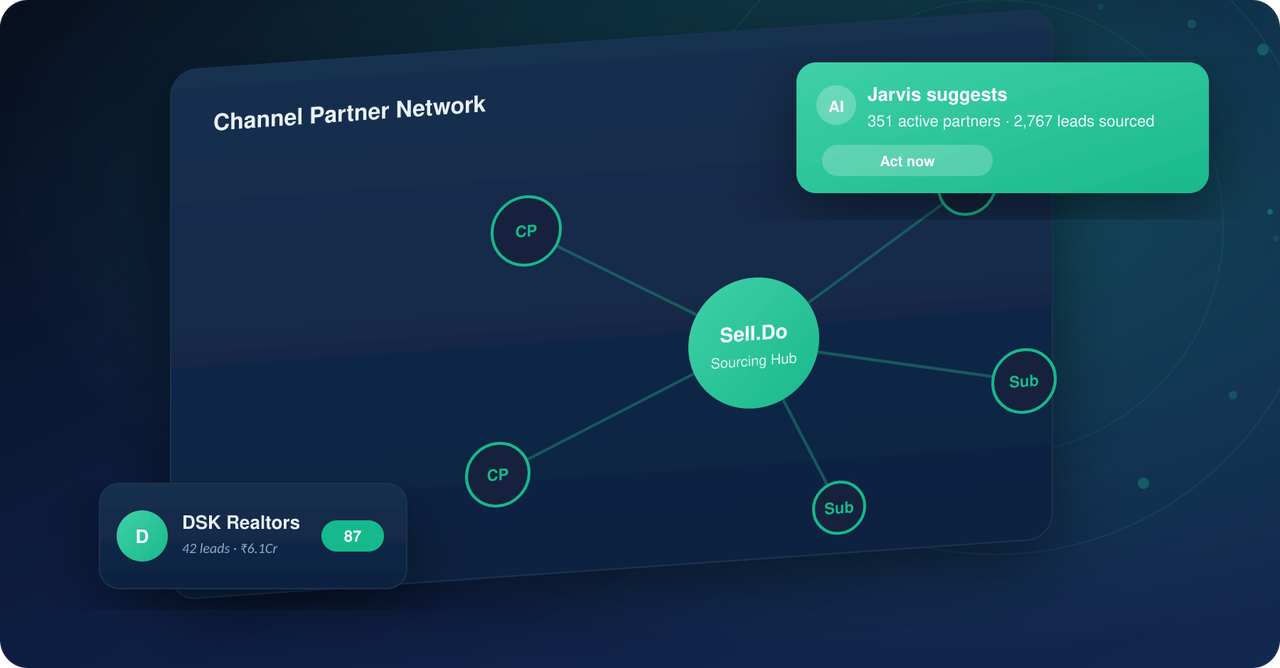
A CRM built for Indian real estate makes most of this automatic. In Sell.do, channel partners are onboarded on their own logins, leads are tagged to the partner and project the moment they arrive, and payouts are tracked per partner, so you can hold a custom RERA-number and expiry field on each partner profile instead of a spreadsheet column.
Related reading
- Understanding RERA in Real Estate: Objectives and Rules
- RERA Project Registration for Developers (2026)
- Channel Partner Brokerage and Payouts in India (2026)
Want every partner's RERA status, lead tags and payouts in one place? See the whitelabel channel-partner module in Sell.do and book a walkthrough at sell.do. It takes a few minutes to see how verified partners, tagged leads and clean payouts fit together.
Insights from the Sell.do real-estate CRM team.