
How to Improve Your Real Estate Conversion Rate in India: 7 Strategies (2026)
Seven operational fixes that lift real estate conversion in India, from first-response speed to site-visit follow-up, plus the funnel metrics to track.
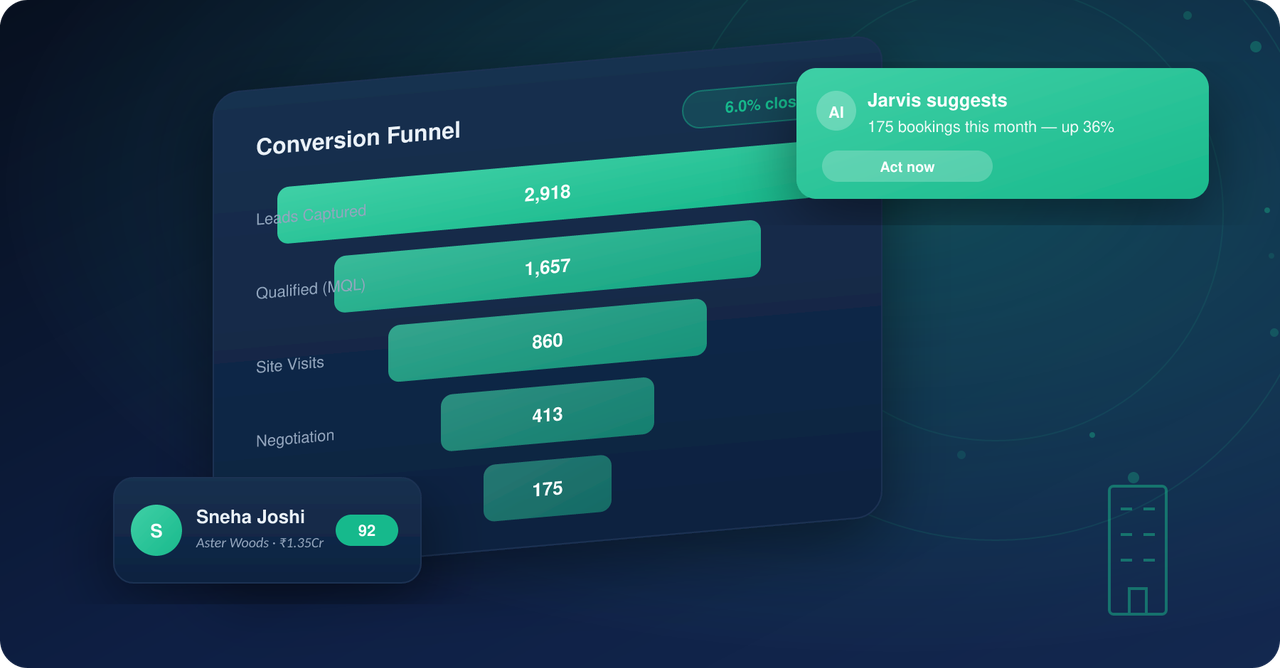
Most real estate teams do not have a lead problem, they have a conversion problem: enquiries come in, a few site visits happen, and far fewer become bookings. The fixes are mostly operational. This guide covers seven strategies that improve conversion for Indian developers and brokers, from first response to post-visit follow-up, and how to measure whether they work.
First, define the conversion rate you are measuring
"Conversion rate" means different things. Track the funnel stage by stage so you know where leads actually drop: enquiry to qualified lead, qualified lead to site visit, site visit to booking. A team with a healthy enquiry-to-visit rate but a weak visit-to-booking rate has a closing and pricing problem, not a marketing problem. A team with the opposite pattern has a response-speed and qualification problem. Fix the weakest stage first. Our post on cost per lead versus cost per booking explains why measuring only leads misleads.
From the team that built Sell.Do
See how Sell.Do runs your sales, pre-sales and marketing on one AI-first platform.
1. Respond fast, and track it
Speed to first response is the most controllable lever. Set a target (many teams aim for minutes, not hours), alert the rep and the manager when it is missed, and report TAT by rep and by source. An AI agent or auto-responder can acknowledge a lead on WhatsApp instantly and hand over to a person once the buyer replies. See speed to lead in real estate.
2. Qualify before you invest time
Reps waste hours on leads that cannot buy: wrong budget, wrong city, just browsing. Capture four things early: budget, location, configuration and purchase timeline. Score leads on fit and behaviour so the likeliest buyers are called first. Scoring does not replace judgement, but it stops a good lead from waiting behind ten weak ones.
3. Focus on the sources that produce bookings, not leads
Cheap leads from one source can be worth less than expensive leads from another. If every lead carries its source and campaign tag from the moment it arrives, you can see which sources produce site visits and bookings and move budget accordingly. This is the basis of attribution; see sources for real estate lead generation.
4. Meet buyers on their channel
Indian buyers reply on WhatsApp and answer calls far more reliably than they open email. Use WhatsApp for confirmations, brochures and reminders, calls for qualification and persuasion, and email for documents and records. Keep every conversation logged against the lead so the next rep or manager sees the full history.
5. Personalise by buyer type
An end-user family, an investor and an NRI want different things. End-users ask about schools, commute, possession date and loan eligibility. Investors ask about rental yield and appreciation. NRIs ask about legal clarity, remote paperwork and trusted representation. Tailor the material you send and the questions you ask. A single generic brochure for everyone converts worse than three focused ones.
6. Make the site visit easy and certain
The site visit is the strongest buying signal. Confirm it the day before, send the location on WhatsApp, remind the buyer on the morning, and make sure the right rep is ready with the relevant units and cost sheet. Record the visit outcome and follow up the same day. See how a CRM improves the site-visit-to-booking ratio.
7. Follow up with a plan, not a mood
Most bookings come after several touches over weeks, and most teams give up after two or three. Define a follow-up cadence per stage, have the CRM create the next task after every call outcome, and move genuinely cold leads into a slower nurture track rather than dropping them. See effective follow-up systems.
How to measure what is working
- Enquiry to qualified-lead rate, by source.
- Median time to first response, by rep.
- Qualified lead to site-visit rate, and visit show-up rate.
- Site visit to booking rate, by project and rep.
- Cost per site visit and cost per booking, by campaign.
Review these weekly with the team and change one thing at a time so you can tell what moved the number. Avoid quoting an industry-average conversion rate as a target: rates vary widely by city, segment and price band, so compare your own numbers month to month.
Where Sell.do fits
Sell.do is an AI-agentic CRM built for Indian real estate. It captures leads from every source with their tags, applies TAT alerts and AI scoring, runs calling and WhatsApp inside the platform, manages site visits and ties campaigns to bookings in its reports. See the real estate CRM page for details.
Frequently asked questions
What is a good real estate conversion rate? It depends on city, price band and lead source, so there is no reliable single benchmark. Track your own funnel stage by stage and improve against your own baseline.
Where should I start? Measure response time and follow-up discipline first. They cost nothing to fix and often show the biggest gain.
Does a CRM improve conversion by itself? No. A CRM makes speed, follow-up and tracking consistent, but the team still has to use it and the process still has to be sound.
How many follow-ups are enough? There is no fixed number. Set a cadence per stage and keep going while the lead stays engaged or has stated a future timeline.
Is lead quality or lead quantity more important? Quality, measured by site visits and bookings per rupee, not by lead count.
Related reading
Insights from the Sell.do real-estate CRM team.