
Channel Partner Management Software for Real Estate (2026): A Buyer's Guide to Portals, Lead Registration and Payout Tracking
Choosing channel partner management software? The 8 capabilities to test, India must-haves like RERA and TDS, a 45-minute vendor demo script and a scoring sheet for developers running 50-500 partners.
A channel partner head at a Bengaluru developer runs 220 empanelled partners across three projects. Lead registrations arrive on a shared Excel sheet and four WhatsApp groups. Every week brings at least three "I sent this buyer first" disputes, and the oldest unpaid brokerage invoice is 110 days old. She has now sat through five software demos, and every vendor showed her the same slick partner dashboard. None of them showed her what happens when two partners register the same phone number on the same afternoon.
That gap is what this buyer's guide is for. It is written for developer CP heads and sales heads choosing software to run anywhere from 50 to 500 channel partners. It covers the eight capabilities to test (not just tick on a feature list), the India-specific must-haves that generic partner tools miss, a demo script you can run on any vendor, a scoring sheet, and the build-vs-buy question. If you are still designing the process itself, start with our channel partner management playbook for developers and come back here when you are ready to pick a system.
What channel partner management software actually has to do
Strip away the marketing and the job is simple to state: the software must connect four records without anyone retyping anything. The partner (KYC, RERA number, agreement, tier), the lead they register, the site visit that proves they brought the buyer, and the booking that triggers brokerage. Then it has to move the money that flows from that chain: slab calculation, invoice, GST check, TDS, payout.
Wherever one of those links is manual, that is exactly where your disputes and payout delays live. A CRM with a "Source: Broker" dropdown is not channel partner software. Neither is a portal that collects registrations into a spreadsheet your presales team checks once a day. What partners say they want from a CRM is covered in our post on the CRM features channel partners actually ask for; this guide looks at it from the developer's side of the table.
From the team that built Sell.Do
See how Sell.Do runs your sales, pre-sales and marketing on one AI-first platform.
The 8 capabilities to test, not just tick
1. A whitelabel partner portal and app
Partners should see your brand on your subdomain, log in with a mobile OTP, and register a buyer from their phone. The test: can a partner who has never seen the portal register a lead in under 60 seconds on a mid-range Android phone? If not, they will go back to WhatsApping your sales manager, and your system of record goes with them.
2. Lead registration with a server timestamp and validity window
Every registration needs a time stamp the partner cannot edit and a configurable validity window (30, 60 or 90 days is typical), after which the tag lapses automatically unless a site visit or extension rule keeps it alive. This is the single rule that settles most "who owns the buyer" fights. Our guide to lead registration, timestamps and validity windows covers how to set the policy; the software's job is to enforce it without exceptions being negotiated on the phone.
3. Duplicate check against your whole database
This is where most tools quietly fail. A duplicate check is only as good as the database it checks against. If the CP portal cannot see the leads that came in yesterday from Meta, Google, 99acres, MagicBricks or a walk-in, it will happily accept a "new" registration for a buyer your own marketing already paid for. Test for an instant accept or reject with a visible reason, not a "pending approval" status that sits for three days.
4. Live inventory visibility
Partners mis-sell when they work off last month's price list PDF. The software should show unit-level availability by tower, the current price sheet and cost sheet, and let a partner request a hold or block that your sales team approves. Stale inventory is a common cause of cancelled bookings in the CP channel.
5. Site-visit tagging and verification
The site visit is the evidence. Look for OTP or QR verification at the site, automatic linking of the visit to the partner's registration, and clear handling of revisits and buyers who show up with a different partner the second time.
6. A brokerage slab engine
Real brokerage structures are not flat. They vary by project, ticket size and quarterly volume, with launch-period kickers and occasional spot incentives. The software should calculate the applicable slab automatically at booking, including retroactive tier jumps when a partner crosses a volume threshold. For how to design those slabs, see our guide to channel partner brokerage and payouts in India.
7. Payout and TDS tracking
Payout should move through visible stages tied to milestones you define (booking, agreement registration, or a percentage of collections), with invoice upload, GST and PAN validation, and TDS computed under Section 194H of the Income Tax Act. That rate has been 2 per cent since 1 October 2024, and brokerage itself attracts 18 per cent GST, so a system that gets either wrong creates reconciliation work every month. Most important: the partner should be able to see his own payout status without calling anyone.
8. Dashboards and a partner leaderboard
You need registrations, site visits, bookings and conversion by partner, plus payout ageing, on one screen. Partners need their own view: their leads, their visits, their earnings, and where they rank. A leaderboard sounds like a gimmick until you see it shift volume toward your project in a launch month.
India-specific must-haves generic partner tools miss
Global partner relationship management (PRM) tools are built for software resellers and manufacturers. They handle deal registration well and real estate poorly. Before you shortlist, check for:
- RERA agent registration capture. Section 9 of RERA requires agents facilitating sales in registered projects to be registered with the state authority. Store the number, state and expiry date against each partner, with expiry alerts.
- WhatsApp-native workflows. Indian brokers live on WhatsApp. Registration confirmations, visit reminders and payout updates should go out there, not just by email.
- PAN and GST capture at empanelment. Many payout delays trace back to a missing GST number or PAN mismatch discovered at invoice time, months after the booking.
- Multi-project, multi-tower inventory. Partners sell across your portfolio; the portal should too.
- Consent and data handling. Partners pass you buyer phone numbers. Under the Digital Personal Data Protection Act, 2023, you need to know what consent was captured and who can see which record.
- Empanelment workflow. Onboarding, document collection and probation reviews should be in the system. For the partner's view of that process, see how brokers get empanelled with a developer.
Build vs buy vs generic PRM
- Build in-house. Full control, but plan for 6 to 12 months of development, and the hard parts (the dedup logic, the slab engine, TDS) are always underestimated. You also inherit maintenance every time a tax rule or your brokerage policy changes.
- Generic PRM tool. Quick to start, but no unit inventory, no site-visit verification, no RERA fields and no milestone-based brokerage. You end up building those as custom fields and spreadsheets on the side.
- A real estate CRM with a native CP module. Direct leads, portal leads and CP leads sit in one database, so the duplicate check and source-to-booking attribution actually work. The trade-off is that you adopt the vendor's model of how a CP channel runs, so check that it matches your agreement terms.
For most developers running more than 50 active partners, the third option wins on one point alone: a separate CP portal cannot dedupe against leads it cannot see.
A 45-minute demo script to run on every vendor
Do not let the vendor drive the demo. Hand them this script and ask them to do it live, on their production product:
- Register a buyer as a partner from a phone. Time it.
- Register the same phone number as a second partner. What happens, and what reason does the second partner see?
- Register a number that came in from a property portal yesterday. Does the system flag it as an existing lead?
- Move the date past the validity window. Does the tag lapse and notify the partner automatically?
- Book a unit for a partner who has just crossed a volume slab. Is the higher brokerage computed without manual input?
- Mark the agreement as registered. Does the payout move to "due" with TDS calculated?
- Log in as the partner. Can he see payout status, inventory and his leaderboard rank?
- Pull a report: bookings and payout ageing by partner for the last 90 days. How many clicks?
Any step the vendor answers with "we can configure that" deserves a follow-up question: configured by whom, and in how many weeks?
How to score the shortlist
A simple weighted scorecard keeps the decision honest when every demo looks good:
- Registration rules and dedup: 25 per cent
- Brokerage engine and payout tracking: 20 per cent
- Partner portal and app adoption: 20 per cent
- Reporting and attribution: 15 per cent
- Inventory visibility: 10 per cent
- Implementation, migration and support: 10 per cent
Ask every vendor for two reference customers running 100 or more partners, and ask those references one question: what percentage of your CP registrations now come through the portal instead of WhatsApp? Adoption, not features, is the real risk in this category. A sensible target is most registrations flowing through the portal within 60 days of launch, starting with one project before rolling out across the portfolio.
Where Sell.do fits
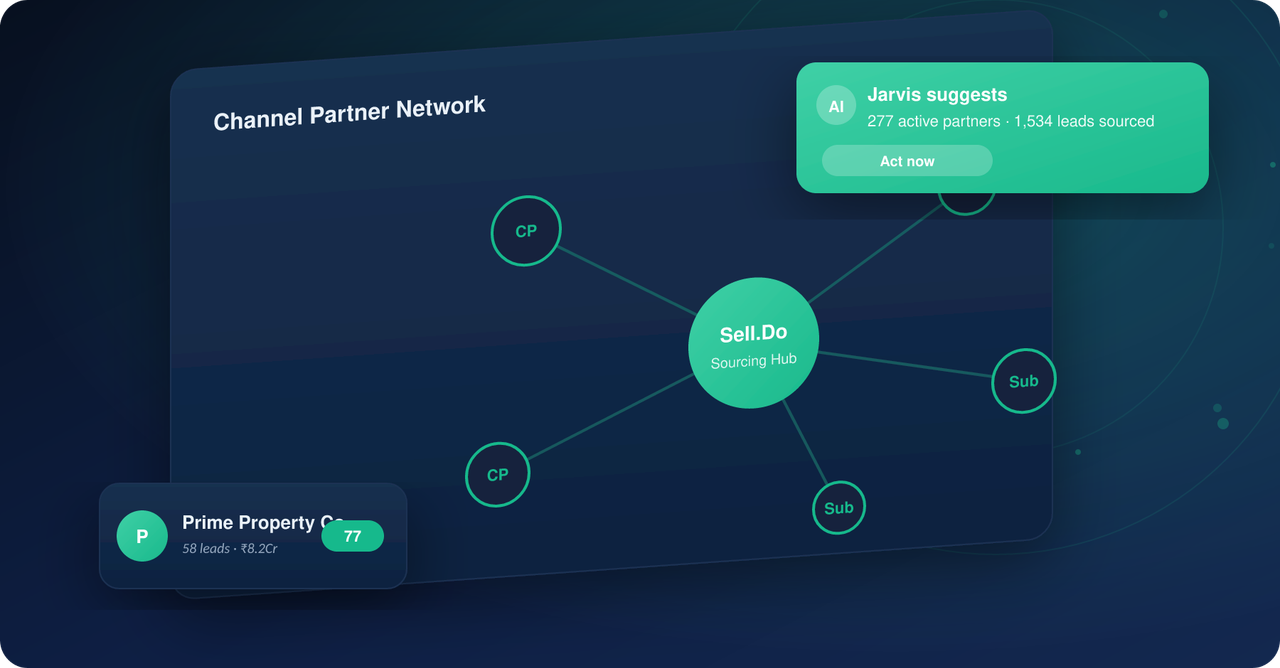
Sell.do's channel partner module sits inside the same CRM that runs your marketing and presales, which is the point. Partners get a whitelabel portal on your subdomain with their own logins, register leads that are checked against every source in your database, and see live inventory from Sell.do's IRIS module. Site visits, bookings and payout tracking stay linked to the original registration, and RERA details are captured at empanelment.
The honest caveat: if you only need a partner directory and a monthly newsletter, it is more system than you need. It is built for developers running dozens to hundreds of partners across multiple projects, where one disputed booking costs more than the software.
Related reading
- Channel Partner Management for Real Estate Developers: The Complete 2026 Playbook
- Who Owns the Buyer? Lead Registration for Channel Partners in India (2026)
- Channel Partner Brokerage and Payouts in India (2026)
See the whitelabel channel-partner module
If your CP registrations still live in WhatsApp groups and spreadsheets, run the demo script above on Sell.do first. See the whitelabel channel-partner module and how registrations, site visits and payouts stay linked to one lead record, so the next "who sent this buyer" question is answered by a timestamp, not a phone call.
Insights from the Sell.do real-estate CRM team.