
Real Estate CRM Dashboards & Analytics: What to Track in 2026
If you are new to a real estate business, it's natural to wonder how to manage bulk data that comes to your business on a daily basis.
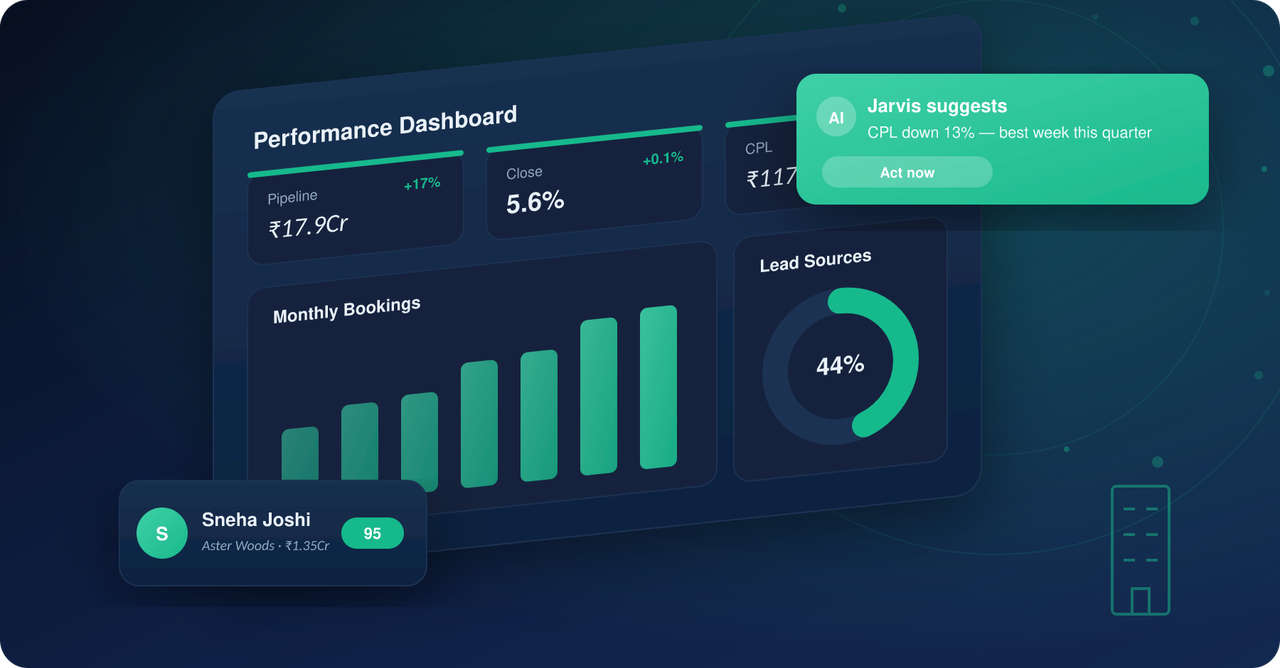
If you run marketing or sales for a real estate developer, your problem in 2026 isn't a shortage of data — it's making sense of leads pouring in from Meta, Google, 99acres, MagicBricks, your website and channel partners every day. A real estate CRM dashboard turns that flood into a few numbers you can act on: which source is cheapest, where deals stall, and who hasn't been followed up. Here's what a good dashboard does, and the metrics developers should actually track this year.
- 1 Provides Complete Overview: Real estate CRM software optimizes bulk data through a dashboard to ensure you can get access to any information with a single touch. CRM optimizes bulk data management, managing clientele, prioritizing inquiries, tracking trends, and organizing transactions using preloaded parameters for a seamless experience. Hence, whether it is the latest market trends or nearest competitors' features, a CRM-enabled dashboard micromanages all parameters from customer onboarding to final sales deeds.
- 2 Complete Access: Anywhere, Anytime: Complete access in real estate management refers to the availability of information accessible in and out of the workplace. CRM-managed dashboard optimizes access across multiple platforms (mobile, desktop) and various OS. This feature is advantageous for any real estate agent who strives to act promptly to any potential query. In addition, it comes with remote access laced with encryption to curb any unauthorized access. Real estate CRM software enables round-the-clock access, thanks to seamless cloud connectivity. In addition, it allows you to crunch bulk data without hard storage.
- 3 Prioritize Lead Management: Most real estate agents often receive multiple inquiries over a potential property sale. Managing a bunch of diverse leads requires more than manual management, which at oftentimes can become cumbersome.
A real estate CRM with powerful data analysis can help find leads based on pre-decided criteria, saving time as you keep an in-built track of customers requiring immediate service or communicating as a potentially interested buyer. - 4 One Platform for all Properties: Given the sheer number of search traffic generated per minute, it's natural to get overwhelmed by the sudden rush of potential leads.
With CRM analytics in real estate, you can showcase multiple properties across diversified domains, receiving bulk traffic from potential clients. The best part herein is that the agents get a multitude of data to make the best choice and provide relevant, personalized information to the customers. - 5 Uniform Management of Contracts and Expenses: Using a CRM dashboard saves resources besides keeping your contracts, expenses, transaction details, lead engagement all in one place. From verifying client records, collecting payments, handing over the contract, or managing all clients in one interface, CRM software has you covered. Moreover, customers immensely benefit, thanks to centralized features complementing their real estate experience.
- 6 Deep Engagement With Customers: Real estate data analytics in India helps to highlight the vitality of engagement in enhancing traffic. With CRM software, you can solve mitigation issues, speedy evaluation of customer demands, and meet customized requirements. In addition, it helps gather bulk data that helps you understand customer behavior.
CRM analytics help tailor the marketing approach while reaching out to a greater audience through social media. Such an arrangement makes it easy for agents to provide customers with their preferable features. - 7 Personalized Marketing Campaigns: The advantage of analytics in real estate includes the mining of massive data. Mining is vital for deducing individual preferences and requirements. The extracted information can then be spread through email and social media marketing. It means every potential buyer subscribed with a CRM-enabled dashboard receives personalized offerings. These features enhance revenue generation, save cost, and add to the reputation as a reliable real estate broker.
- 8 Immaculate Operability: Real estate agents look for optimization besides seamless operability. Incorporating state-of-the-art technologies like the Internet of Things (IoT), Machine Learning (ML), and Artificial Intelligence (AI) compiles clients' data along with their specifications to zero on the most compatible choice of property. In addition, enabling GPS supports a custom virtual house tour with real-time data available, making it more accessible to consumers.
Such a versatile user interface minimizes loss of leads, ensuring maximum compatible properties on offer reach every potential buyer. - 9 Broadening Business Horizon: Real estate CRM software does more than a personalized promotion of properties. Its dashboard attracts traffic from insurance and loan companies who look forth to offering their products at attractive rates, incorporating the same with real estate properties.
These features enhance revenue generation from B2B sources that attract higher traffic and generous B2C sales. Most customers shopping in real estate choose comprehensive offers (property with attractive finance, house insurance). Customer preferences suggest real estate properties offering long-term finance are more likely to receive maximum engagement. - 10 In-Built Audit Reports: When coupled with real estate data analysis, CRM software comes real handy in preparing a variety of reports necessary to track performance: Generating these reports from the dashboard reduces paper usage, and saves time and resources. Being available in real-time in the CRM dashboard, these act as a reference to measure overall performance. You can also design customized reports providing the parameters as per availability. Sales performed Lead generation Marketing and conversion Traffic and engagement Revenue generation Expenses Profitability
Why Do You Need Real Estate CRM Software?
The real estate business thoroughly thrives on brand-customer relationships. Within the digital world, and the vast amounts of data generated on a daily basis, it's hard to leave an impression on potential buyers without dedicated customer relationship management (CRM). The use of CRM software improvises all the human-like features in a digital interface, enhancing personalized engagements efficiently.
Residential real estate analytics shows that the advent of social media marketing has opened up a whole new horizon to approaching potential buyers across a vast population. Integrating customer experience data also helps pick up compatible offers otherwise impossible through a manual integration.

Also Read:
How Artificial Intelligence (AI) & Machine Learning (ML) Are Elevating the Real Estate Industry?
From the team that built Sell.Do
See how Sell.Do runs your sales, pre-sales and marketing on one AI-first platform.
What Real Estate Developers Should Actually Track in 2026
Most dashboards drown you in vanity metrics. These are the ones that move bookings — map each to a widget in your CRM's reporting so it updates in real time:
- Cost per lead (CPL) by source and campaign — know exactly what a 99acres lead costs versus a Meta lead, and shift budget to the channels that produce site visits, not just clicks.
- Funnel conversion by stage — new → contacted → site visit → negotiation → booking. The stage where the biggest drop-off happens is where your next revenue is hiding.
- First-response TAT / SLA — the average time from enquiry to first call or WhatsApp. Leads contacted within five minutes convert far better; a dashboard that flags breaches is worth more than any monthly report.
- Source-to-booking attribution — not just where a lead came from, but which campaign produced an actual booking. This is the single number that justifies your marketing spend to management.
- Team and channel-partner performance — leads assigned, calls made on time, and conversion per salesperson or CP, so you can spot who needs coaching and which partner deserves more inventory.
- Inventory and booking velocity — units held, blocked and sold per project, so sales and post-sales are working off the same live picture.
In Sell.do, these live in the reporting suite out of the box — CPL by source, full-funnel analysis, TAT dashboards and campaign ROI attribution — so you're not stitching together exports. For a deeper look at report types, see our guide to real estate CRM reports and detailed reporting.
Summary:
The current digital state of real estate showcases the demand for CRM in the industry. And for the businesses involved in real estate, it means leveraging digital tools to analyze a versatile audience or improve client conversion rates. Sell.Do, a real estate CRM software solution comes as a rescue for these enterprises to stand out.
Related reading
Insights from the Sell.do real-estate CRM team.