
Real Estate CRM Pricing in India (2026): What It Actually Costs & How to Compare
A clear breakdown of what a real estate CRM actually costs in India in 2026 — per-seat fees, hidden add-ons for calling and WhatsApp, integration charges — plus a framework to compare quotes on total cost, not sticker price.
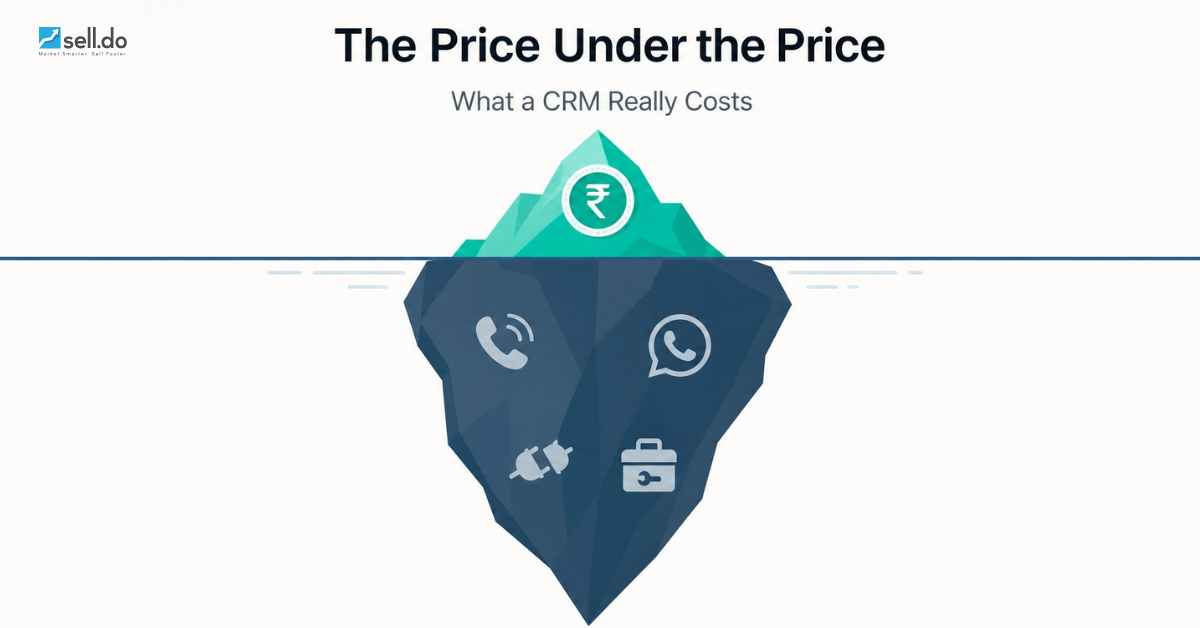
Ask three real estate CRM vendors for a quote and you will get three numbers that look nothing alike — one prices per user, one bundles "unlimited" users but charges for every WhatsApp message, and one quotes a low base that doubles the moment you add calling. For a developer running two towers and a 15-person presales-to-sales team, or a broker firm juggling channel-partner logins, the sticker price on the proposal is rarely the price you actually pay. This guide breaks down what a real estate CRM genuinely costs in India in 2026, where the hidden line items hide, and how to compare quotes on total cost of ownership instead of the headline number.
What you are actually paying for
A real estate CRM bill in India is almost never one line. It is a stack of charges, and vendors differ enormously in what they fold into the base price versus what they bolt on later. The five drivers that move your invoice the most:
- Seats (per-user licence). The most common model. Real estate CRMs in India typically run anywhere from roughly Rs 700 to Rs 3,000+ per user per month depending on tier. A team of 20 at Rs 1,200 is Rs 2.88 lakh a year before anything else — so how a vendor counts "users" (do CP logins count? presales callers?) matters as much as the rate.
- Built-in calling. Cloud telephony, IVR, click-to-call, call recording and virtual numbers are either included or sold as a per-minute or per-number add-on. This is the single biggest surprise on most real estate invoices, because calling volume in presales is high and per-minute charges compound fast.
- WhatsApp. Since Meta moved to per-message pricing, marketing and utility template conversations carry a per-conversation cost on top of any platform fee your CRM charges to run the WhatsApp Business API. At scale this is a real, recurring number, not a rounding error.
- Integrations and lead sources. Connecting Meta and Google lead forms, 99acres, MagicBricks, Housing, your website and IVR is sometimes included and sometimes a per-integration or setup fee. If leads from a portal are not flowing in automatically, someone is copying them by hand — a hidden cost that does not appear on the quote at all.
- Onboarding, add-on modules and support. One-time implementation and data-migration fees, inventory or channel-partner modules, AI scoring, and premium support tiers are frequently priced separately. A low monthly rate with a heavy setup fee and paid support can cost more in year one than a higher all-in plan.
From the team that built Sell.Do
See how Sell.Do runs your sales, pre-sales and marketing on one AI-first platform.
The hidden costs that don't show up on the quote
The most expensive part of a CRM is often invisible on the proposal. Generic global platforms priced in dollars — Salesforce, HubSpot and similar — look competitive per seat until you add the real-estate-specific work: custom fields for units and towers, third-party telephony, WhatsApp middleware, and an implementation partner to wire it all together. That is exactly why so many Indian developers are re-evaluating them, as we covered in why developers are switching away from Salesforce. Beyond the platform fee, budget for these:
- Lead leakage. If the CRM does not capture every source automatically and call leads on time, some percentage of hard-bought leads never gets worked. At a blended cost per lead of Rs 300 to Rs 2,500 in Indian real estate, a leaky pipeline quietly wastes more than the licence fee.
- Tool sprawl. A cheap core CRM plus a separate dialer, a separate WhatsApp tool, and a separate reporting sheet usually costs more in total — and in team time — than one platform that does all three.
- Adoption and training time. A platform your presales callers will not use is a 100% waste regardless of price. Ease of use and India-based support are cost factors, not soft ones.
A framework to compare quotes fairly
Sticker price is the wrong number to compare. Put every vendor on the same total-cost-of-ownership footing for 12 months and one team size before you decide. Our guide to selecting the right CRM fit covers the feature side; on the money side, ask each vendor to price the same basket:
- Total seats you will actually license (include presales callers and, for brokers, channel-partner logins) at the tier that has the features you need — not the cheapest tier.
- Calling: is telephony included, and at what per-minute rate and number rental? Estimate it against your real monthly call minutes.
- WhatsApp: platform fee plus Meta per-conversation cost at your expected volume.
- One-time onboarding, data migration and any per-integration fees for your lead sources (Meta, Google, portals, website, IVR).
- Add-on modules you need on day one: inventory, channel-partner ecosystem, AI lead scoring, reporting and attribution.
- Support tier and contract terms: is India-based support included, and does the price hold on renewal or jump in year two?
Add those up per vendor for a full year and the ranking usually reorders itself. The lowest per-seat quote often finishes most expensive once telephony, WhatsApp and integrations are in; an all-in platform that bundles calling and WhatsApp frequently wins on total cost even at a higher headline seat price.
Where Sell.do fits on cost
Sell.do is priced as an all-in platform built for Indian real estate, so most of the line items that inflate other quotes are inside the product rather than bolted on. Unified lead capture from Meta, Google, portals, website, walk-ins and channel partners is built in — no per-integration surprises and no spreadsheet exports. Calling and WhatsApp are native, so you are not stitching in a separate dialer or messaging vendor. And the AI-agentic layer — Jarvis AI scoring leads, auto-logging calls and running follow-ups — reduces the head-count cost of chasing every lead by hand. For developers, IRIS handles inventory and cost sheets; for brokers, whitelabel channel-partner portals and RERA-ready logins come with the platform, not as a bespoke build.
The honest way to see your real number is to price your exact team, call volume and lead sources against a single all-in plan and compare it to the fully-loaded total of a cheaper base plus its add-ons. That apples-to-apples math is where a real-estate-native platform tends to pull ahead — not on the sticker, but on everything the sticker leaves out.
Related reading
- Top CRM Software for Real Estate Developers in India
- Salesforce Alternative for Real Estate: Why Indian Developers Are Switching in 2026
- Real Estate CRM Software: Selecting the Right Fit for Your Business
Want to know what Sell.do would actually cost for your team? Tell us your team size, call volume and lead sources and we will price it all-in — calling, WhatsApp and integrations included — so you can compare it fairly against any quote on your desk. See the AI-agentic CRM built for Indian real estate and book a walkthrough at sell.do.
Insights from the Sell.do real-estate CRM team.