
Real Estate Lead Generation in India: Strategies That Work in 2026
What actually generates real estate leads in India in 2026: Meta and Google, portals, WhatsApp, channel partners and referrals, plus the speed-to-lead and automation layer that converts them.
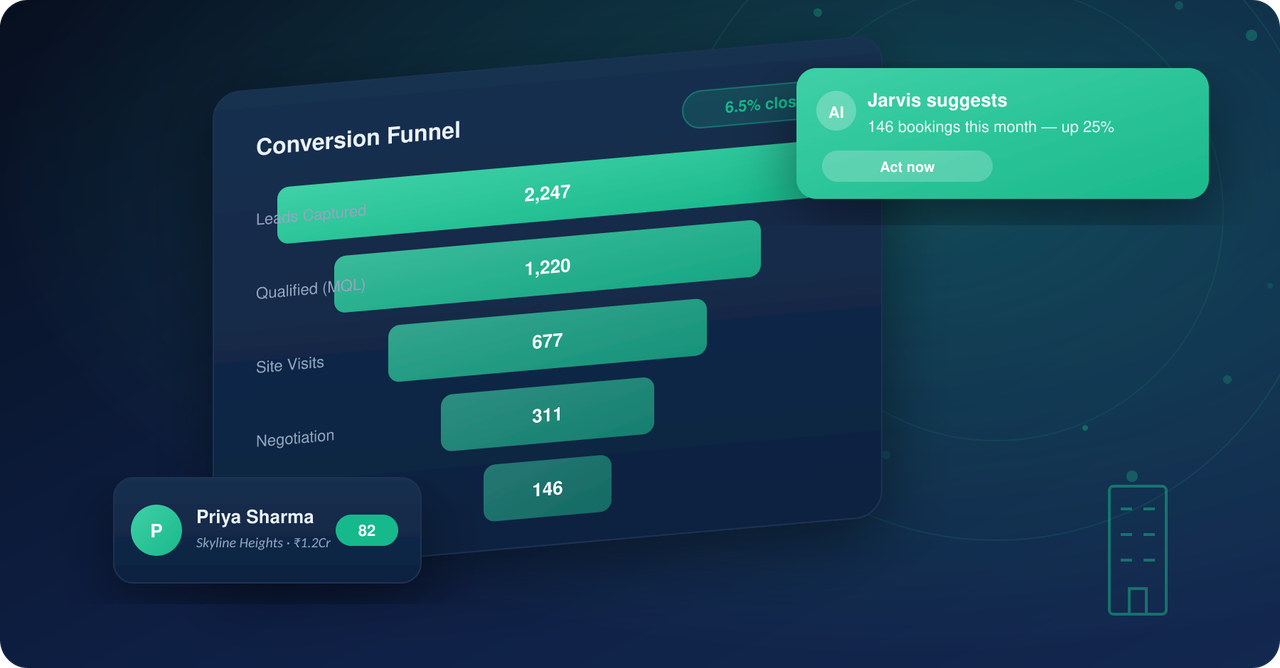
Every Indian real estate business measures itself on the same thing: how many qualified enquiries came in this month, and what each one cost. Lead generation is not a marketing sub-task - for a developer, a broker or a channel partner, it is the business. And the strategies that produced cheap, workable leads in 2023 have quietly stopped working.
Detailed interest targeting on Meta has been narrowed. Signal loss from ATT means platforms optimise on less. Portal leads are shared with four other projects before you finish reading the notification. Meanwhile Indian buyers have moved their conversations to WhatsApp and their shortlisting to Reels and Google reviews. On Sell.do's benchmark work, Meta leads for Indian residential now land in the Rs 150-2,000 range and Google search leads in the Rs 300-2,500 range - and where you sit in that band is a function of execution, not luck. The paid lead-generation playbook goes deeper on the budget side.
This guide covers what still generates real estate leads in India in 2026: the channels that produce site visits rather than form fills, the traditional methods that stubbornly still work, the automation layer that decides whether any of it converts, and the metrics that keep you honest. Whether you are an agent working a locality, a broker running a team, or a developer marketing a launch, the sequence is the same.
What Changed in Real Estate Lead Generation for 2026
- Creative outranks targeting. With interest stacks narrowed, the variable that still moves cost per lead is the offer and the creative. Four to six variants per ad set, refreshed every two to three weeks, beats any audience-building trick.
- WhatsApp is the entry point, not the follow-up. Click-to-WhatsApp campaigns routinely produce better-qualified enquiries than native lead forms, because the buyer has to start a conversation to get in.
- AI moved from scoring to acting. An AI agent that answers the first WhatsApp message in seconds, asks the three qualifying questions and offers site-visit slots does more for conversion than a lead score sitting in a dashboard.
- Video does the pre-qualification. A buyer who watched the walkthrough arrives at site with realistic expectations. Video views are also a retargetable audience, which is where the cheap second-touch leads come from.
- Cost per booking replaced cost per lead. A Rs 300 lead with a 3 percent qualification rate is more expensive than a Rs 1,200 lead that converts. Judge sources on cost per site visit at minimum.
The maths behind that last point - and how to build the reporting view for it - is in cost per lead vs cost per booking.
From the team that built Sell.Do
See how Sell.Do runs your sales, pre-sales and marketing on one AI-first platform.
Digital Lead Generation Strategies That Produce Site Visits
Meta ads: the volume engine
Facebook and Instagram remain the highest-volume paid source for Indian residential. In 2026 the working setup is Advantage+ Audience with strong creative signals rather than hand-built interest stacks, plus Conversions API so the platform optimises against real downstream events. Run both native lead forms and click-to-WhatsApp and compare them on qualified-lead rate, not CPL - the WhatsApp variant usually costs more per lead and less per site visit. Targeting mechanics are covered in detail in our Facebook ad targeting guide.
Google Search and Performance Max: buying intent
Search is your highest-intent, highest-cost source. Reserve it for locality plus configuration plus budget queries ('2 BHK in Kharadi under 90 lakhs') and project-name terms. Negative keywords are not optional: rent, PG, hostel, jobs and salary variants routinely absorb 20 to 30 percent of an unmanaged real estate search budget. Add call extensions - a meaningful share of Indian enquiries prefer to dial rather than fill a form.
Portals: a speed race, not a nurture play
99acres, MagicBricks and Housing deliver reliable volume with zero exclusivity. The same buyer has enquired on four listings. Whoever calls first usually books the site visit. Treat portal leads as a turnaround-time problem: auto-capture into your CRM, auto-acknowledge on WhatsApp, first call attempt inside ten minutes.
Organic search and content: the compounding channel
The only lead source whose cost falls over time. Locality guides, price-trend pages, RERA and home-loan explainers, and honest project comparisons attract buyers early in the decision and keep attracting them after the campaign budget stops. Slow to start, hard for a competitor to switch off.
Video and short-form
Reels and YouTube walkthroughs now do the work a full-page print ad used to, at a fraction of the cost and with a retargetable audience attached. Construction-progress updates, honest locality tours and handover moments outperform glossy brand films. Practical production notes are in our guide to shooting real estate videos.
Landing pages and lead magnets
Send paid traffic to a focused page, never the homepage. One project, one offer, one form with three fields, price and location above the fold, and a WhatsApp button for buyers who will not fill a form. Give the visitor a reason: a price list, floor-plan pack, locality report or EMI calculator. Landing page examples that convert has working patterns.
Retargeting the people who already showed intent
Most first-time visitors will not enquire. Retarget site visitors, video viewers and Instagram engagers with a specific next step rather than the same brand creative they already scrolled past. This is consistently the cheapest qualified traffic in a real estate account.
Traditional Lead Generation That Still Works in India
Digital does not replace ground game in Indian real estate - it feeds it.
- Channel partners and broker networks. For most developers this is still the single largest booking source. It only scales when CP-sourced leads are tagged, tracked and paid out as cleanly as digital ones - otherwise you get disputes and duplicate claims instead of volume.
- Referrals from past buyers. The cheapest lead you will ever get. A structured post-possession referral programme, run as a campaign rather than an afterthought, routinely outperforms a month of display spend.
- Site and locality activations. Society activities, mall kiosks, corporate tie-ups and walk-ins. The failure mode is always the same: walk-in details end up in a paper register instead of the CRM, and nobody follows up.
- Outbound calling to owned data. Dormant enquiries, old site-visit lists and unconverted bookings are an underused pool. High-performing teams get 15 to 25 percent of bookings from leads older than 90 days.
- Print, hoardings and events. Still meaningful for large launches and premium projects - but only if every asset carries a trackable number, QR or WhatsApp link so the lead can be attributed.
Speed-to-Lead: The Cheapest Conversion Lift Available
Most Indian real estate teams do not have a lead-generation problem. They have a lead-response problem. A portal lead contacted in ten minutes and the same lead contacted four hours later are not the same asset - by the time you call, the buyer has spoken to three competitors and stopped answering unknown numbers.
The operating standard worth holding your team to:
- Automated WhatsApp acknowledgement within seconds of capture, with the project name, price band and a site-visit slot offer.
- First human or AI call attempt inside ten minutes, tracked as a median TAT per team member, not an average across the month.
- A defined follow-up cadence - day 0, day 1, day 3, day 7 - until the site visit is booked or the lead is disqualified with a coded reason.
- Disqualify with a reason. 'Budget below range', 'wanted possession-ready', 'different locality' are what let you re-target the dormant pool intelligently and tell Meta and Google what a good lead looks like. 'Not interested' teaches nobody anything.
The full first-touch-to-booking sequence, including qualification frameworks and nurture cadences, is in the real estate lead management playbook.
Automation and AI: Turning Leads Into Site Visits
Generating leads is the easy half. The systems that decide whether they convert:
- Unified capture with source tags. Meta, Google, portals, website, walk-ins, channel partners and inbound calls landing in one pipeline with campaign and creative attached automatically. Every spreadsheet export loses the tag, the timestamp and usually the lead.
- Built-in calling and WhatsApp. Click-to-call with automatic logging, recordings for coaching, and WhatsApp threads attached to the lead record - so a follow-up does not depend on which executive's personal phone the conversation happened on.
- AI agents on first response. An AI agent that replies instantly, asks the three qualifying questions and books a site-visit slot converts the after-hours and weekend leads that human teams routinely lose.
- Predictive lead scoring. When presales has 400 open leads, the ordering of the call list is worth more than the size of it. Scoring on budget fit, engagement and response behaviour puts the workable leads at the top.
- Auto follow-ups and reminders. Nothing sits untouched. Missed follow-ups escalate to a manager rather than quietly ageing out.
This is exactly what Sell.do does for Indian developers and brokers: unified capture across every source, built-in calling and WhatsApp, Jarvis AI for scoring and auto follow-ups, live inventory, and source-to-booking attribution. See the AI-agentic CRM built for Indian real estate.
The Numbers to Track
- Cost per lead by source and campaign - the entry metric, meaningless alone.
- Qualified lead rate - share meeting budget, locality and timeline. Exposes cheap sources that waste presales hours.
- First-response TAT - median minutes to first contact, per executive.
- Lead-to-site-visit rate - the first metric that correlates with revenue.
- Cost per site visit and cost per booking - the two numbers to allocate budget on.
- Dormant-pool conversion - bookings from leads older than 90 days. If this is near zero, you have a nurture problem, not a lead-gen problem.
Which dashboards to build first, and what each one should show, is covered in real estate CRM dashboards and analytics.
The Right Mix Depends on Who You Are
Generic lead-generation advice fails in Indian real estate because a solo agent, a broking firm and a developer are solving three different problems with three different cost structures.
Solo agents and small teams
- Your edge is locality depth, not budget. One neighbourhood, owned properly: locality content, a Google Business Profile with real reviews, an active Instagram, and society WhatsApp groups.
- Portals are your paid baseline. Buy fewer leads and respond faster rather than buying more and calling late.
- Referrals and repeat business should be your largest source within three years. If they are not, the follow-up process is the problem.
Brokers and channel partners
Your problem is rarely volume - it is leakage and turnaround time. Leads arrive on four executives' personal phones, three portal dashboards and a developer's CP portal, and nobody can tell you which source produced last month's bookings. Tag every source, route automatically, enforce a first-call SLA, and track dormant re-engagement. The tooling side is covered in CRM software for real estate brokers.
- Developer inventory access is your differentiator against portals: buyers come to you for options across projects, not one listing.
- Registration and payout hygiene decides whether developers keep giving you inventory. Untagged CP leads become disputed brokerage.
Developers and builders
- Your lead generation is phased, not always-on: pre-launch waitlist, launch push, sustenance, then inventory-led campaigns for slow-moving configurations.
- Channel partners are usually the largest booking source. Digital's job is often to generate demand that CPs then convert - so measure the two together, not in competition.
- Marketing must be able to see live inventory. Generating demand for a sold-out configuration is the most expensive mistake in the category.
Channel Comparison: What to Expect
Indicative bands from Sell.do's benchmark work with Indian residential projects. Treat them as a sanity check on your own numbers, not a target - ticket size, city tier and project stage move all of them.
- Meta lead ads and click-to-WhatsApp - highest volume, Rs 150-2,000 per lead, low-to-medium qualification rate. Best for pre-launch and launch. Quality swings hard with creative.
- Google Search - Rs 300-2,500 per lead, highest qualification rate of the paid channels. Best for sustenance and project-name defence. Volume is capped by actual search demand.
- Portals - predictable volume, medium cost, low exclusivity. Wins or loses entirely on response time.
- Organic search and content - high effort up front, falling cost over time, strong qualification. The channel that makes the others cheaper by warming the audience.
- Channel partners - highest booking conversion, cost expressed as brokerage rather than CPL. Needs tagging discipline or it becomes unmeasurable.
- Referrals and dormant re-engagement - lowest cost per booking of anything on this list, and the most consistently neglected.
Staying Compliant While You Scale
Two things quietly break Indian real estate lead-gen programmes:
- SMS and calling. Promotional SMS requires DLT registration of headers and templates, and outbound calling has to respect DND registries. Bulk-blasting an unverified purchased list is a fast route to blocked routes and penalties.
- WhatsApp. The Business API runs on opt-in and approved message templates. Click-to-WhatsApp ads are compliant because the buyer initiates; scraped-number broadcasts are not, and get numbers banned.
Alongside this, RERA requires that advertised projects carry a valid registration number and that claims in creative match the registered particulars. A campaign that generates leads and a notice is not a successful campaign.
Frequently Asked Questions
What is the cheapest way to generate real estate leads in India?
Referrals from past buyers and re-engagement of your own dormant enquiry pool, by a wide margin - both cost almost nothing in media. Among paid channels, Meta typically produces the lowest cost per lead and Google Search the lowest cost per qualified lead.
How many leads does it take to get one booking?
For Indian residential, teams commonly see a low single-digit percentage of raw enquiries converting to bookings, with the site-visit rate as the real bottleneck. Rather than benchmarking against someone else's ratio, track your own lead-to-site-visit and site-visit-to-booking rates by source - the variation between sources inside one project is usually larger than the variation between companies.
Are purchased lead lists worth it?
Rarely. Purchased lists are usually stale, shared, and carry DLT and DND exposure. Money spent on faster response to the leads you already generate almost always returns more.
Do I need a CRM for real estate lead generation?
You need one the moment leads arrive from more than one source or more than one person handles follow-up - which is to say, almost immediately. Without unified capture you lose source tags, response times and follow-up history, and none of the metrics in this guide can be measured. See the lead management playbook for what that process looks like end to end.
Where to Start
If your lead generation is not working, resist the urge to add another channel. Fix capture and source tagging first - it costs nothing in media and makes every subsequent decision measurable. Then fix response time, which is usually worth more than any targeting change. Then re-allocate budget on cost per site visit rather than cost per lead. Only after those three does creative and audience optimisation deliver what the case studies promise.
Do that, and lead generation stops being a monthly scramble and becomes a system you can forecast against.
Related reading
Insights from the Sell.do real-estate CRM team.