
Sell.do vs LeadSquared vs Zoho: Which Real Estate CRM Actually Fits Indian Developers?
An honest head-to-head of the three CRMs on most Indian developer shortlists - lead capture, calling and WhatsApp, inventory, channel partners, post-sales, AI and real 24-month cost.
You run four projects across Pune and Nashik. Leads arrive from Meta lead forms, Google search ads, 99acres, MagicBricks, your own website, walk-ins and eleven channel partners. Your presales team of twelve is meant to call every one of them within ten minutes. Right now, on a Monday morning, nobody can tell you how many of Friday's leads were never called at all.
That gap is what a CRM is supposed to close, and it is why most Indian developer shortlists end up at the same three names: Zoho CRM, LeadSquared and Sell.do. This is an honest read on where each one fits. If you want the wider field first, our guide to CRM software for real estate developers in India covers the full market; this piece is the head-to-head.
The one-line version
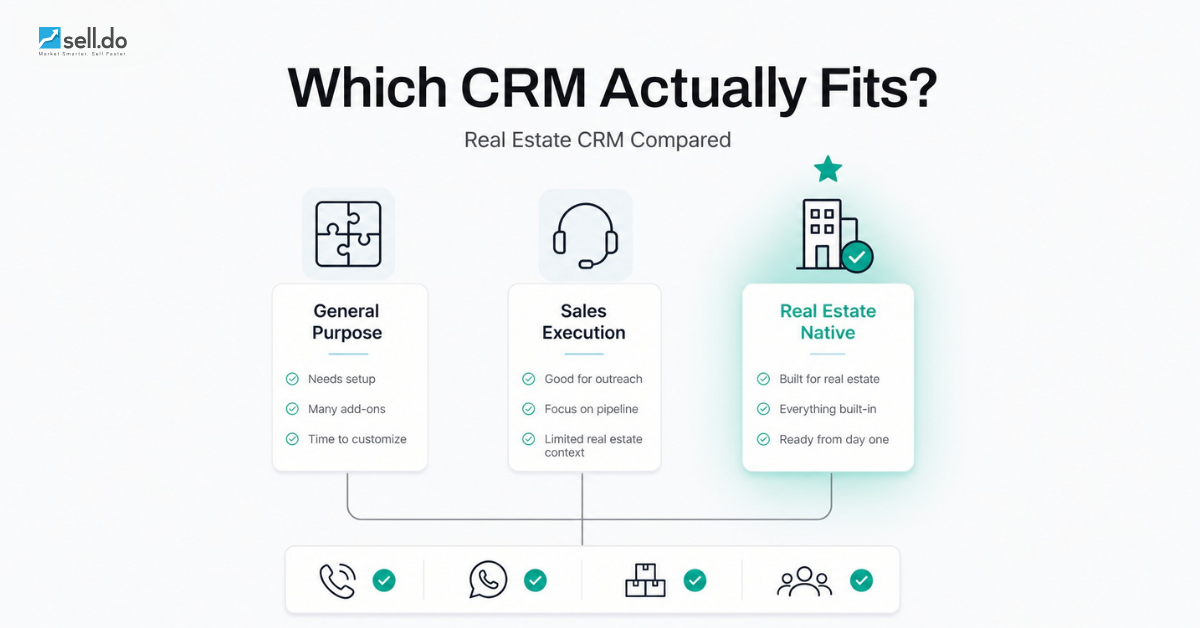
- Zoho CRM is a horizontal, general-purpose CRM with an enormous app ecosystem and the lowest sticker price of the three. Real estate structure is something you build on top of it.
- LeadSquared is a sales-execution and lead-management platform built for high-volume inside-sales teams across education, BFSI, healthcare and real estate. Strong on routing and activity discipline; real estate is one vertical among several.
- Sell.do is real-estate-native and AI-agentic: leads, site visits, inventory, channel partners and post-sales are first-class objects, not custom fields, with calling and WhatsApp built in rather than bolted on.
All three will manage a contact and a follow-up. The decision is never about that. It is about the seven things below, where the three products behave very differently.
From the team that built Sell.Do
See how Sell.Do runs your sales, pre-sales and marketing on one AI-first platform.
The seven things that actually differ
1. Lead capture and source tagging
A builder's real question is not 'can it store leads' but 'can it prove which campaign produced which booking'. Zoho captures leads through webforms and connectors, but portal feeds (99acres, MagicBricks, Housing) and channel-partner submissions usually arrive through a third-party integrator or a CSV routine, and every hop is a place where the source tag gets lost or overwritten. LeadSquared has strong native capture and de-duplication for digital sources. Sell.do captures Meta, Google, portals, website, walk-ins and CP submissions into one pipe with the source, campaign and sub-source tagged at the point of entry, which is what makes source-to-booking attribution possible later.
- Ask in the demo: show me a lead that came from a 99acres listing and trace it to a booking, with the campaign intact.
2. Calling and WhatsApp
This is where Indian real estate diverges hardest from global CRM design. Your presales team lives on the phone and on WhatsApp; more than 500 million Indians use WhatsApp, and template messages routinely see 70-90% open rates against 20-30% for email. Zoho supports telephony and WhatsApp through marketplace connectors and the WhatsApp Business API via partners, so you are integrating and paying for two or three vendors. LeadSquared offers a native dialler and WhatsApp connectors. Sell.do ships built-in calling and WhatsApp, so recordings, transcripts, response times and message threads sit on the lead record without a middleware bill.
- Ask in the demo: from this lead screen, call the buyer and send a WhatsApp template without leaving the page.
3. Inventory, cost sheets and hold-block
No general-purpose CRM ships with towers, units, availability states or cost sheets. In Zoho you model these as custom modules, and someone on your team owns that build forever. LeadSquared handles the lead side well but is not an inventory system. Sell.do's IRIS module treats unit and tower availability, hold-block logic and cost sheets as core, so a sales manager blocking a unit during a site visit does it in the same system that holds the lead. If inventory is central to your evaluation, our piece on running leads and units in one system goes deeper.
4. Channel partners
Most Indian developers get a third to a half of their bookings through channel partners, and CP operations have their own requirements: separate logins, whitelabel portals or subdomains, lead-submission rules, RERA-registration records and payout tracking. Neither Zoho nor LeadSquared has a native CP ecosystem; you replicate it with roles, portals and custom fields. Sell.do has it as a module. If your CP network is small and informal, this matters less. If you have 40 partners submitting leads for a launch, it decides the shortlist.
5. Post-sales
Booking is not the end of the record in Indian real estate. Agreements, demand letters, collections, loan status and possession run for years afterwards, and the team owning them is usually called the CRM department. Zoho and LeadSquared both stop, in practice, at the deal. Sell.do carries the same record through bookings, agreements, collections and possession, which is why post-sales is often the deciding module for developers rather than a nice-to-have.
6. AI: assistive versus agentic
All three now market AI. The useful distinction is whether the AI suggests or acts. Assistive AI drafts an email and summarises a call. Agentic AI qualifies the lead, calls it, books the site visit and logs the outcome without a human starting the task. Zoho's Zia and LeadSquared's AI features sit mostly on the assistive side. Sell.do's Jarvis does predictive lead scoring, auto-logs calls and runs follow-up sequences autonomously. We unpacked the difference properly in our explainer on what an AI-agentic CRM actually is.
7. Cost of getting live
Sticker price is the least useful number in this decision. Zoho has the lowest per-user list price of the three and the highest hidden cost, because telephony, WhatsApp, portal integration, inventory modelling and an implementation partner are all separate line items. LeadSquared prices in the mid band and adds dialler and messaging costs. Sell.do bundles more of the stack, so the per-user number is higher and the integration bill is smaller. Compare total cost over 24 months including implementation, integrations, message credits and the internal admin time, not the monthly per-seat figure. We broke the mechanics down in our guide to real estate CRM pricing in India.
Where each one is the right answer
Choose Zoho CRM if
- Your team is small, budget-led, and comfortable configuring software; you have someone internally who will own customisation.
- Real estate is one of several businesses you run and you want one CRM across all of them.
- You already live inside Zoho One and the ecosystem lock-in works in your favour.
Where it breaks: portal and CP lead flows, inventory, post-sales, and the accumulated maintenance cost of the custom modules you built in year one and nobody understands in year three.
Choose LeadSquared if
- Your dominant problem is inside-sales throughput: routing, calling discipline, TAT and activity reporting across a large presales floor.
- You sell mostly ready inventory or a single project, so unit-level inventory and post-sales are handled elsewhere.
- You need mature workflow automation and are willing to integrate for telephony and WhatsApp.
Where it breaks: developer-specific structure - towers, units, hold-block, cost sheets, CP payouts, collections and possession all live outside it.
Choose Sell.do if
- You are a developer or a broker whose entire operation is real estate, and you want marketing, presales, sales, channel partners, inventory and post-sales in one record.
- Source-to-booking attribution matters because you spend real money on Meta, Google and portals.
- You want calling, WhatsApp and AI follow-up built in rather than assembled.
Where it does not fit: if you sell something other than property, a vertical real estate CRM is the wrong tool, and a horizontal platform will serve you better.
Ten questions to ask in every demo
- Show me a lead entering from a portal feed with its source and campaign intact.
- What happens to a duplicate lead submitted by two channel partners on the same day?
- How long from lead creation to the first call attempt, and where do I see that as a number?
- Call a lead and send a WhatsApp template from this screen - what does it cost per month?
- Block a unit for 48 hours during a site visit. Who can release it?
- Generate a cost sheet for that unit with the current scheme applied.
- Give a channel partner a login and show me what they can and cannot see.
- Show cost per booking by campaign for last quarter, not cost per lead.
- Take one booking through agreement, two collection milestones and possession.
- What is the 24-month total, including implementation, integrations and message credits?
If a vendor answers eight of ten cleanly on a live system rather than a slide, you have your shortlist. Most evaluations go wrong because the demo stays on the lead screen, which every CRM does well.
How to run this in three weeks
- Week 1: export 500 real leads from your last launch, with sources, and hand the same file to all three vendors. Ask each to load it and show routing, de-duplication and tagging.
- Week 2: run a live pilot with one project and one presales pod. Measure first-response time, calls per lead and untouched leads after 24 hours. Speed is the metric that moves bookings - the case for it is in our piece on the first sixty seconds after a lead arrives.
- Week 3: price the 24-month total for each, including everything you would have to buy separately, and score against the ten questions above.
Related reading
- Real Estate CRM Pricing in India (2026): What It Actually Costs & How to Compare
- Salesforce Alternative for Real Estate: Why Indian Developers Are Switching in 2026
- Speed to Lead in Real Estate: Why the First 60 Seconds Decide the Booking
If your shortlist is down to these three, the fastest way to settle it is to watch each one handle your own leads, your own towers and your own channel partners. See the AI-agentic CRM built for Indian real estate, and ask for a walkthrough on your data rather than a demo dataset. Bring the ten questions - the answers will separate the three faster than any feature grid.
Insights from the Sell.do real-estate CRM team.