
The Real Estate Sales Stack of 2026: Marketing, Presales, Sales & Channel Partners in One System
Indian developers sold 6% fewer homes in Q2 2026 while unsold inventory climbed 10%. That gap is rarely a demand problem. It is a sales stack split across four systems that never share a lead.
- The four-system problem
- What 2026 actually changed
- Layer 1 — Marketing: attribution that survives the handoff
- Layer 2 — Presales: TAT is the only number that matters before qualification
- Layer 3 — Sales and inventory: one version of what is available
- Layer 4 — Channel partners: most of your distribution, usually unmanaged
Across India's top seven cities, developers sold roughly 90,715 homes in Q2 2026 — about 6% fewer than a year earlier — while new launches rose 7% and unsold inventory crossed 6.16 lakh units, a 10% annual increase. Bengaluru alone added 34% more unsold stock, taking it to around 79,180 units (ANAROCK, Q2 2026).
Flat absorption against rising supply is not usually fixed by buying more leads. It is fixed by not losing the ones you have already paid for. And the reason most developer and large-brokerage teams lose them is structural: marketing, presales, sales and channel partners each run on a different system, and the lead changes format every time it crosses a boundary.
The four-system problem
A typical mid-size developer running three live projects in 2026 operates something close to this:
- Marketing runs Meta and Google lead forms plus 99acres, MagicBricks and Housing, and measures itself inside each ad platform's own dashboard.
- Presales works a call list exported to a spreadsheet each morning, dials from personal phones or a standalone dialer, and logs outcomes in a second sheet.
- Sales lives on a site-visit register and a shared inventory Excel that is reliably one version behind the real hold-block status at the site office.
- Channel partners send lead claims and booking confirmations into WhatsApp groups, and payouts get reconciled from screenshots at the end of the quarter.
Each of those is defensible on its own. Together they produce four different numbers for the same funnel, none of which agree, and four different definitions of what counts as a lead. The cost shows up as duplicate leads called twice by two teams, portal enquiries that nobody owns for six hours, and partner-sourced bookings that get disputed because two people claim the same buyer. We have mapped the specific gaps in detail in where leads actually leak out of a real estate funnel.
From the team that built Sell.Do
See how Sell.Do runs your sales, pre-sales and marketing on one AI-first platform.
What 2026 actually changed
Three shifts turned an inconvenience into a revenue problem:
- Speed became the differentiator, not the tiebreaker. Average first response on Indian portal leads still runs four to six hours. Enquiries answered inside five minutes convert to a site visit at roughly 60-75%; past the sixty-minute mark that collapses to 5-12%. On shared portal leads the first team to call or message effectively owns the buyer.
- Distribution consolidated around partners. Industry estimates put roughly 70% of new residential project sales in India through channel partners; CREDAI-MCHI has pegged the MMR figure near 60%. For most launches, the partner network is not a supplementary channel — it is the channel.
- The buyer moved to WhatsApp. With 535 million-plus monthly active users in India, launch broadcasts to opted-in databases are clicking at 20-35% against 3-6% for the same content over email. Buyers now expect the brochure, the cost sheet and the site-visit confirmation in the same thread.
None of these is a software problem in isolation. They become one the moment you try to act on all three at once — because responding in five minutes, across a partner network you do not employ, on a channel your CRM does not own, is not something a spreadsheet handoff can support.
Layer 1 — Marketing: attribution that survives the handoff
Most marketing teams can tell you cost per lead by campaign. Far fewer can tell you cost per site visit, and almost none can tell you cost per booking by campaign and creative — because the booking is recorded in a system that never learned where the lead came from. The tag dies at the handoff.
The fix is unglamorous: a single source-and-campaign tag written at capture, carried unchanged through presales, site visit, booking and collection, and never re-keyed by a human. Once that holds, the CPL conversation changes shape entirely — you stop optimising toward the cheapest lead and start optimising toward the cheapest booking, which are frequently different campaigns. Our guide to cutting CPL across Google and Meta walks through the measurement setup that makes this possible.
Layer 2 — Presales: TAT is the only number that matters before qualification
Presales teams are usually measured on calls made and leads qualified. Both are lagging indicators. The leading indicator is turnaround time on first touch, measured from the moment the lead lands — not from the moment someone opens the spreadsheet. A team averaging four hours and a team averaging four minutes will report similar call volumes and wildly different site-visit numbers.
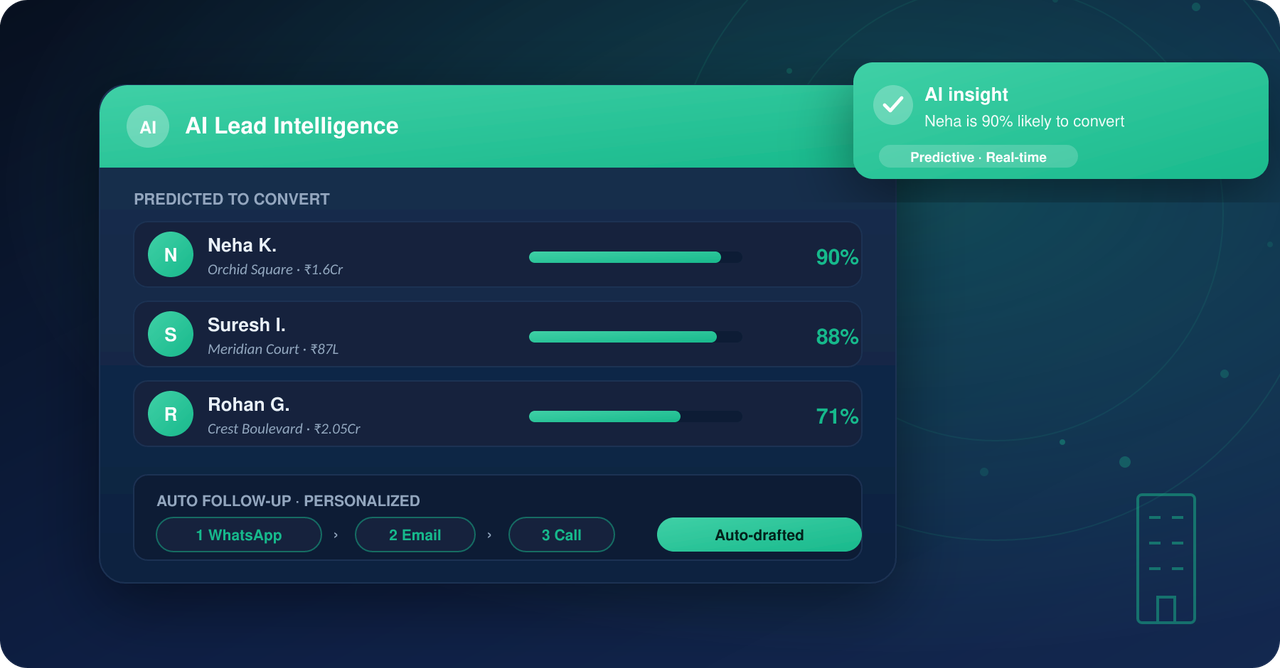
This is the layer where AI has moved fastest. Platforms like Sell.do now route the lead the second it arrives, have an AI agent open the conversation on WhatsApp or by voice, score intent from what the buyer actually said, and push only the warm ones into a human's call queue — with the call recorded and logged automatically rather than typed up afterwards. The presales head's job shifts from chasing a dial count to auditing a TAT dashboard. We covered the mechanics in how AI voice and predictive scoring are rebuilding presales.
Layer 3 — Sales and inventory: one version of what is available
With 6.16 lakh units unsold nationally, the projects that clear stock are rarely the ones with the best ads — they are the ones where a closing manager can answer "is the 3 BHK on the 11th floor of Tower B still open?" in ten seconds, generate the cost sheet in the same breath, and place a hold that everyone else immediately sees. An inventory sheet mailed around on Monday cannot do that by Wednesday.
Unit-level availability, hold-block status, cost sheets and approvals belong in the same system as the lead, so the site visit, the negotiation and the booking all attach to one record. The project launch playbook sets out how to structure inventory before a launch rather than during one.
Layer 4 — Channel partners: most of your distribution, usually unmanaged
If 70% of bookings come through partners, running that network on WhatsApp groups and a quarterly reconciliation is the single largest unmanaged surface in the business. Partners need their own login, their own lead-registration flow with a visible timestamp, live inventory for the projects they are empanelled on, and a payout ledger they can check without calling anyone. Developers need the mirror image: which partner sourced which booking, whose claim came first, and what is owed this month.
A whitelabel partner portal sitting on the same database as the in-house CRM solves the dispute problem structurally rather than diplomatically — the registration timestamp is the answer, and everyone is looking at it.
What "one system" actually means
It is a narrower claim than most vendors make. A unified 2026 stack means five things:
- One lead record, created at capture from every source — ads, portals, website, walk-ins, partners — with no export step anywhere in the chain.
- One identity per buyer, so the same person enquiring on two portals and a partner's form is deduplicated before anyone dials.
- Native calling and WhatsApp inside the CRM, so conversations are logged without anyone retyping them and TAT is measurable rather than self-reported.
- Shared inventory, where presales, closing and partners read the same availability and hold-block state.
- One attribution model that runs source to booking to collection, so finance and marketing argue from the same table.
It does not mean one vendor for everything. Meta, Google and the portals stay where they are; so does accounting. The consolidation that matters is of the lead record and the inventory record — the two objects every team touches.
A 90-day sequence for consolidating
- Days 1-30: connect every source directly into one system and freeze all manual uploads. Publish a baseline TAT and duplicate rate. Expect both numbers to be worse than anyone believed.
- Days 31-60: move calling and WhatsApp inside the CRM, set a first-touch SLA in minutes rather than hours, and turn on automated first response for after-hours and weekend enquiries.
- Days 61-90: onboard partners onto the portal with timestamped lead registration, put live inventory behind it, and run the first month's payouts off the system's ledger instead of a spreadsheet.
Ninety days will not change your absorption rate on its own. It will change what you can see — and in a market with 6.16 lakh unsold units and buyers who reward the first responder, visibility into where the funnel breaks is the prerequisite for every other decision.
Related reading
- What is an AI-agentic CRM — and why real estate needs one first
- Channel partners in real estate: role, benefits and how the model works in India
- WhatsApp-first real estate: the 2026 playbook for Indian developers and brokers
Sell.do runs all four layers on one database — capture from every source, AI-agentic presales with built-in calling and WhatsApp, live unit inventory, and a whitelabel channel-partner portal with payout tracking. If you want to see what your funnel looks like when marketing, presales, sales and partners share one lead record, book a walkthrough with the team at sell.do and bring your own numbers to compare against.
Insights from the Sell.do real-estate CRM team.