
Facebook Ads: A Facebook Advertising Guide for Real Estate (2026)
A 2026 guide to Facebook ads for real estate: objectives, Advantage+ targeting, lead ads wired to your CRM, and how to keep CPL low while lifting lead quality.
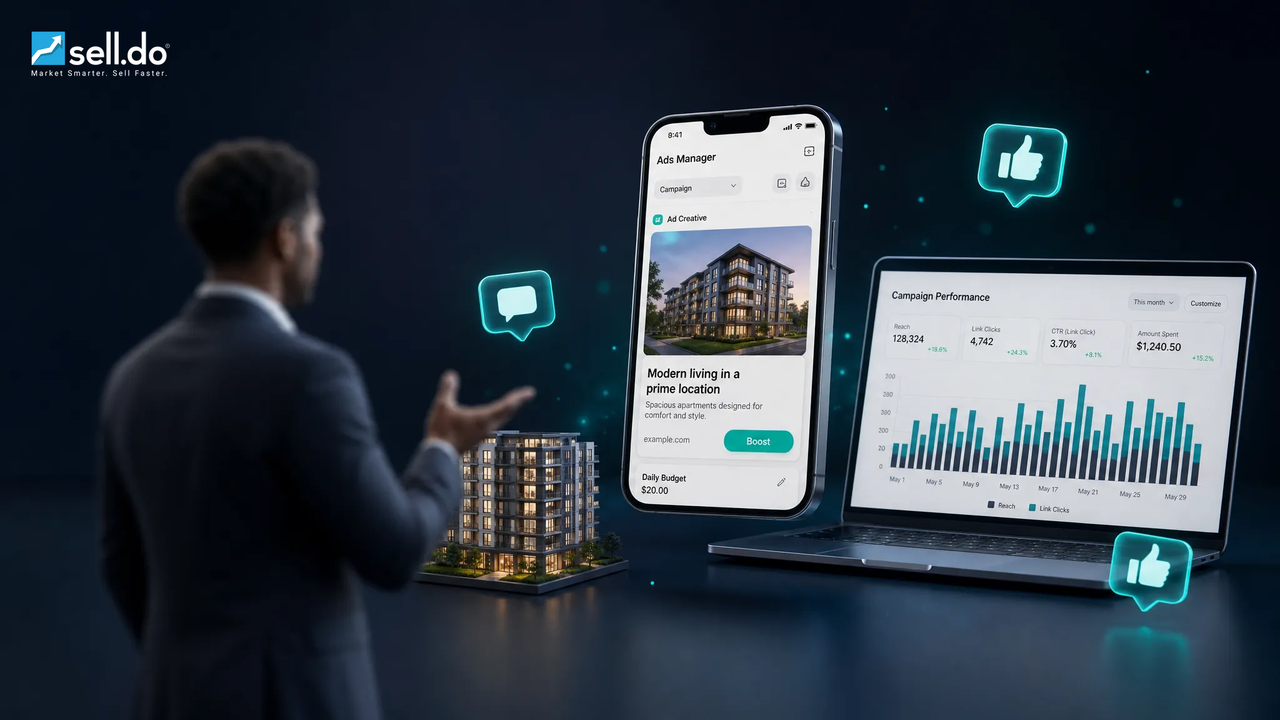
For most Indian developers and brokers, Meta (Facebook and Instagram) is still where the cheapest real-estate leads come from — but only when your cost per lead (CPL) stays low and those leads reach sales fast enough to convert. This guide walks through running a Facebook ad campaign for real estate the way it works in 2026: choosing the right objective, targeting the right buyers, and wiring leads straight into your CRM. For the full paid-channel playbook across both Google and Meta, see our Paid Lead Gen for Indian Real Estate (2026) pillar.
Facebook advertising is the best and the easiest way to get more reach for your real estate project and generate leads. With a daily user base of 1.5 billion active users, it is one of the best platforms to reach prospective buyers. Having said that, it also means you are not alone in the race to draw buyers’ attention.
To get the best out of the platform, real estate marketers must take note of the factors that affect the costing of your Facebook advertising campaigns.
What Changed in Facebook Ads for Real Estate in 2026
Facebook advertising still works for real estate, but the mechanics have moved on. If your last campaign was a few years ago, update these first:
Detailed targeting is thinner; automation is smarter: Meta has retired many granular interest options and now leans on Advantage+ Audience, where you give a suggestion and its AI expands the audience. Lean on first-party data and lookalikes rather than stacking narrow interests.
Relevance score is gone: It was replaced by three ad relevance diagnostics — quality ranking, engagement rate ranking and conversion rate ranking. Optimise creative and landing experience against those, not a single number.
Lead ads plus instant forms, wired to your CRM: Instant (on-Facebook) lead forms cut CPL, but only pay off if leads sync to your CRM in real time and get a call within minutes. A form that sits in a spreadsheet overnight is a wasted rupee.
Conversions API for signal loss: After iOS/ATT privacy changes, browser pixels miss conversions. Sending events server-side via the Conversions API restores the booking and site-visit signal Meta needs to optimise.
WhatsApp click-to-message ads: For Indian buyers who prefer chat, click-to-WhatsApp ads often beat form ads on both intent and speed-to-first-reply.
Optimise for outcomes, not just leads: Feed booking and site-visit events back to Meta so it learns to find buyers, not just form-fillers — that is how you push CPL down without dropping quality.
First is your goal. Facebook may charge your advertising campaigns differently based on the goals you would want to achieve. These goals include getting/achieving:
- Impressions on your post
- Post Reach
- Lead Generation
- More Conversion
- More Link Clicks
This makes it even more important to choose your goals carefully. For Real Estate projects, these goals may change depending on the phase of the project.
For instance, consider below set of scenarios and goals for each of them.
Development Phase | Business Goal | Facebook Ads Goal
Project development begins | Create awareness before pre-launch | Impressions on your post Post Reach
Development in the final phase, inventory ready for pre-launch | Start generating leads and get more reach within micro-markets | Post Reach Lead Generation
The project is possession-ready | Sell remaining inventory | Lead Generation More Conversion More Link Clicks (if there is an offer based campaign)
To excel at Facebook ad campaigns for real estate, you should understand these three core aspects. Each section shows important considerations one needs to take, followed by its effect on the results of your advertising campaign.
Now the second part. This is perhaps the most crucial consideration if you want maximum reach and quality leads:
- Target Group (TG): Target audience demographics that is most looked for by others generally are high priced. Hence, the generic audience must be avoided. Target the audience that is most relevant to your domain should provide better returns.
From the team that built Sell.Do
See how Sell.Do runs your sales, pre-sales and marketing on one AI-first platform.
- Relevance score: depending on the level of engagement of your post, i.e. number of likes, shares & comments your post has received, Facebook gives a score to your posts. This signifies how relevant is your communication for the TG you’ve selected.
However, we've made it easier for real estate marketers to ace lead generation through Facebook ad campaigns.
Curate Right Communication & Create A Good Design Performance of your Facebook ad is highly dependent on the above-mentioned factors. And an ad with appealing post copy & design can considerably bring down your Cost Per Click (CPC) for Facebook ads. As mentioned earlier, real estate buying is not frequent. So, buyers are influenced by multiple factors. Here are the four points you should consider while making a Facebook ad for your real estate project.
Location Aspirations Example: The first point that buyers consider is the project location. Because urban lifestyle influences your buyers to put more emphasis on location than any other factor and probably even motivates them to push their budget constraints. So, you must clearly mention the location of your project in the ad if it is a USP. This will improve the engagement of the ad.
And better engagement means better relevance score, which in turn means you spend less per impression earned or lead generated. Budget Considerations Example: You may know that the average merchandise cost in real estate home purchase is around 45-50 lakhs. And this is no small amount. Therefore, the budget is another major consideration for homebuyers. If the location is not so strong a point to play around, the next big engaging factor is the price/budget.
Again, this is more likely to boost your ad performance and fetch the right engagement level and bring down your CPCs. Lifestyle Aspirations: Example: After location and budget come the aspiration to lead a better lifestyle. This is where your buyers give more preference to the lifestyle promise your brand has to offer. You might have noticed that the same project has ads on location as well as lifestyle.
Now, this is the kind of strategy you need to target the audience with all possible routes of your communication. It will bring down your overall cost. How? Say, the location route could only achieve half the reach you targeted. To counter this, if the lifestyle route of your communication is well-appreciated that it gets twice the reach than expected, the overall cost will come down and you will get the desired reach and number of leads.
Design Consideration: Example: If luxury home buyers are your TG or just a part of your broader TG, you must showcase the design of your homes.
How To Set-Up A Facebook Ad And Select The Right TG To be able to manage your Facebook ad campaigns, you must have a Facebook Business Manager account in place. Here are some quick steps to create a campaign: Log in to your Facebook ad manager account. Click on “+” to quickly create your ad. Define your buying type to “Auction” to run a paid ad campaign.
Now there are 2 types of ads that work best for real estate campaigns: Facebook LeadGen and Facebook Newsfeed Ads. For LeadGen, the campaign objective is lead generation and for Newsfeed, the campaign objective is lead conversion. For best results, we suggest a combination of both. Because with Newsfeed, you redirect the TG to your website to for more information and with LeadGen, you ask your TG to fill information forms on their Facebook timeline itself.
Here’s a step-by-step visual guide to create a Facebook ad campaign. Select the ad type Define the area of your TG This step is important as you need relevant leads and better qualification rate. Select the interest group This is a very crucial step as the selection of an interest group will play very important in targeting the right Facebook users. An accurate judgment here will define your “Relevance Score”. Here, your experience adds value.
However, we suggest targeting followers of property portals and followers of keywords like Property & Investment, Real Estate, Flats, Apartments etc. Additionally, Facebook also provides a suggestion once you select some interests. Define Budgets Depending on your budget, you can choose from the Lowest Cost campaign or set an upper cap through the Target Cost campaign.
Choose Ad Placement For Real Estate projects, we have seen Facebook Newsfeed and Righ-hand column ads deliver better results. Add Ad Image & Content Now add content for your ad with the image, post text, headline, etc. Also, in the case of LeadGen ads, ask intent related questions to optimize and better qualify your leads. Preview & Publish Once you have published your ad, you can monitor your reach count on the Facebook Ad Manager dashboard.
So now your campaign is up & running, but this is not the end. The goal is to get maximum leads at minimal cost. Unless you track your leads and understand the data to optimize the performance, your campaign is only half done.
Track your leads & Optimize your campaign Now, this is the analytical part of your Facebook ad campaign. The in-built Facebook dashboard is not enough to give you the idea of the actual business generated and how can you improve. You need a smart, intelligent and comprehensive idea about your campaign performance and the business value generated.
Sell.do, a CRM built for Indian real estate, has default Facebook lead-ads integration so every lead flows straight into your pipeline, auto-tagged by campaign. With built-in calling and WhatsApp plus AI lead scoring, your team responds in minutes and you can track real outcomes — cost per qualified lead, cost per site visit and cost per booking — not just cost per lead. That closed loop is what tells you which Meta campaigns to scale and which to cut.
An overview of your Facebook campaign with funnel stage analysis allows you to check with your campaign performance. A complete “Lead Pipeline Analysis” provides information on the velocity of your lead progression. With this, you can check with your sales performance at each stage in your lead’s journey, address the issue and increase conversion rate. Leads generated through Facebook usual needs to be serviced quicker and to the best of its potential.
Data on meetings conducted by your sales team will provide a strong insight on their productivity and performance. Finally, while your campaign is live you must track campaign spends versus traffic generated. Having this data on a single dashboard will allow you to act with agility and re-strategize your campaigns if required.

Also read
Why Have Pre-sales Become Crucial for the Real Estate Industry
Related reading
A Detailed Guide to Facebook Ad Targeting for Real Estate Marketing (2026)
Paid Lead Gen for Indian Real Estate (2026): Cutting CPL Across Google & Meta
Creative Real Estate Ad Examples and Marketing Ideas (2026)
Start your real estate marketing automation free trial and get the best out of your Facebook advertising campaigns.
Insights from the Sell.do real-estate CRM team.