
Impact Of Vertical CRM On Marketing Automation And Sales Management
A Vertical CRM is made exclusively for any specific industry verticals like BFSI, Real Estate, Manufacturing, Healthcare & Retail. The software has all necessary considerations like sales cycle, business process, market…
Technology space, for a very long time, has been working towards solving business problems through innovative products and solutions. However, it is only in recent times that enterprises have started exploring solutions that are specific to their industry vertical and not some generic solution that can be customized.
Customer Relationship Management or CRM within SaaS space is witnessing this more than any other industry, and this has been confirmed by even market studies carried out by “MarketsAndMarkets” that says, investments in social CRM will increase across geographies and verticals, with the need of more business-specific solutions for enterprises.
So What is a Vertical Sales CRM? And how are they different from Generic or Horizontal Sales CRMs?
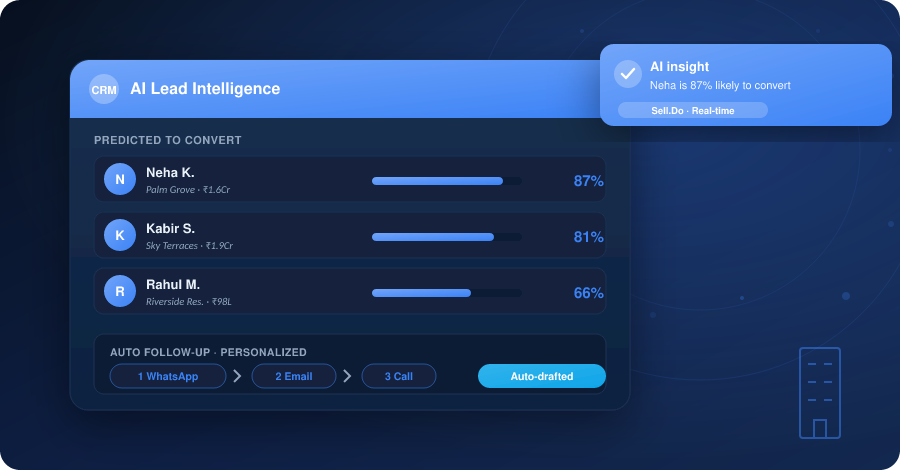
A Vertical CRM is made exclusively for any specific industry verticals like BFSI, Real Estate, Manufacturing, Healthcare & Retail. The software has all necessary considerations like sales cycle, business process, marketing channels, and prospect journey pre-programmed as per respective industry segment.
From the team that built Sell.Do
See how Sell.Do runs your sales, pre-sales and marketing on one AI-first platform.
How is Vertical sales CRM different from any Generic CRM or Horizontal CRM?
Let us understand this difference through an analogy. Generic CRM offers an ‘à la carte, set-up where you order food as per your need with incremental costs additions after each ordered item. A vertical CRM is like those full-sized unlimited combo meals offered for every cuisine type. Here, based on past requirements and demands, a combo is offered that is unique for every cuisine type offered at an optimum cost and fit for a particular requirement.
Let us now understand this difference through practical considerations.
Implementation time Like most SaaS products, even CRM needs time to set-up. If your CRM is a generic one like Salesforce, SAP, Oracle or Freshsales, they all need time in months to set-up and configure.
Generally, a variety of integrations like call center software, social media integrations, sales workflow development, setting-up marketing automation, lead nurturing set-up and other 3rd party implementations are needed.
Now, these set-ups take times of somewhere around 2-3 months. In contrast, vertical CRMs come with pre-built integrations, workflows, and other lead journey activities, hence generally it takes 1/60th time to go live. This means you spend more time selling your products than setting your CRM.
- 1Implementation Cost Every industry needs its own set of customizations for the CRM to implement properly. Generally, these customizations include: Industry-specific workflows Cloud telephony and contact center integrations Inventory/Product Management Reporting & Dashboards Marketing KPIs Drip set-ups The necessary support to maintain all of this Each of the above implementations invites additional costs. While these are mostly general customizations, there can be more customizations over and above the ones already mentioned, each of these adding to your overall costing.
Illustration of a Vertical Sales CRM Vs Generic Sales CRM: Example of a Real Estate CRM For the sake of clear understanding, let us explore how Real Estate CRM affects overall sales management and marketing as compared to generic CRM used by real estate industry. “Over the years we realized that, with CRM implementations either you spend time trying to adjust and learn the system or take time to adjust the system your way.
Do Generic Sales CRM Lead Capture Web Lead Capture Built-in, No Additional Cost Customization Required, Additional Cost Facebook LeadGen & Lead Capture Built-in, No Additional Cost Customization Required, Additional Cost LinkedIn Lead Capture Built-in, No Additional Cost Customization Required, Additional Cost Property Portal Integration Built-in , No Additional Cost Customization Required, Additional Cost Billboard & Print Ad Lead Capture Built-in, No Additional Cost Customization Required, Additional Cost Channel Partner Lead Capture Built-in, No Additional Cost Customization Required, Additional Cost Lead Management Assignment & Routing Built-in, No Additional Cost Customization Required, Additional Cost Duplicate Booking Built-in, No Additional Cost Customization Required, Additional Cost Lead Tracking Built-in, No Additional Cost Customization Required, Additional Cost Machine Learning based Lead scoring Built-in, No Additional Cost Customization Required, Additional Cost Sales Management Task Management Built-in, No Additional Cost Customization Required, Additional Cost Mobile App Built-in, No Additional Cost Customization Required, Additional Cost Automated Email & SMS as per lead journey Built-in, No Additional Cost Customization Required, Additional Cost Inventory Management Built-in, No Additional Cost Customization Required, Additional Cost Cost Sheet Built-in, No Additional Cost Not Available Booking Built-in, No Additional Cost Not Available Marketing Automation Campaign Management Built-in, No Additional Cost Customization Required, Additional Cost Bulk Email & SMS Built-in, No Additional Cost Customization Required, Additional Cost Drip Campaigns Built-in, No Additional Cost Customization Required, Additional Cost Google Ads Integration Built-in, No Additional Cost Customization Required, Additional Cost Facebook Adverts Integration Built-in, No Additional Cost Customization Required, Additional Cost Above comparison makes the picture clear on how impactful it is to have a vertical CRM deployed instead of a generic one.
Access a detailed product comparison report of all generic CRM and real estate CRM for free. The report has detailed features, cost applications and feature list. Download report for free. Even Forbes’ recent article affirms this vertical sales CRM impact. Here is what they said “The universe of B2B-focused SaaS companies can be split into two categories: those with a horizontal focus and those with a vertical focus.
While generic CRM has broad-reaching solution sold to thousands of sales departments globally across a multitude of industries and across companies of all sizes.
Also Read :
What Is CRM in Real Estate and Why Is It Important?
Conclusion
In the vertical SaaS movement, enterprise customers are the ultimate winners. Not only do they have a better-suited product but also save a lot of time and capital resources that can be employed for faster sales growth.
Reviewing a product and it’s deliverables from known sources and to evaluate value for money is far better than just going by the brand name. Hence, enterprises must have their CRM strategy worked out, post which, they can explore the market with a neutral view and choose the best available option.
Insights from the Sell.do real-estate CRM team.