
Best Real Estate Software for Agents & Brokers in India (2026): The Complete Stack
The software Indian agents and brokers need in 2026, job by job: CRM, calling, WhatsApp, portals, inventory, e-sign and GST invoicing, with the tools worth shortlisting and how to avoid a leaky stack.
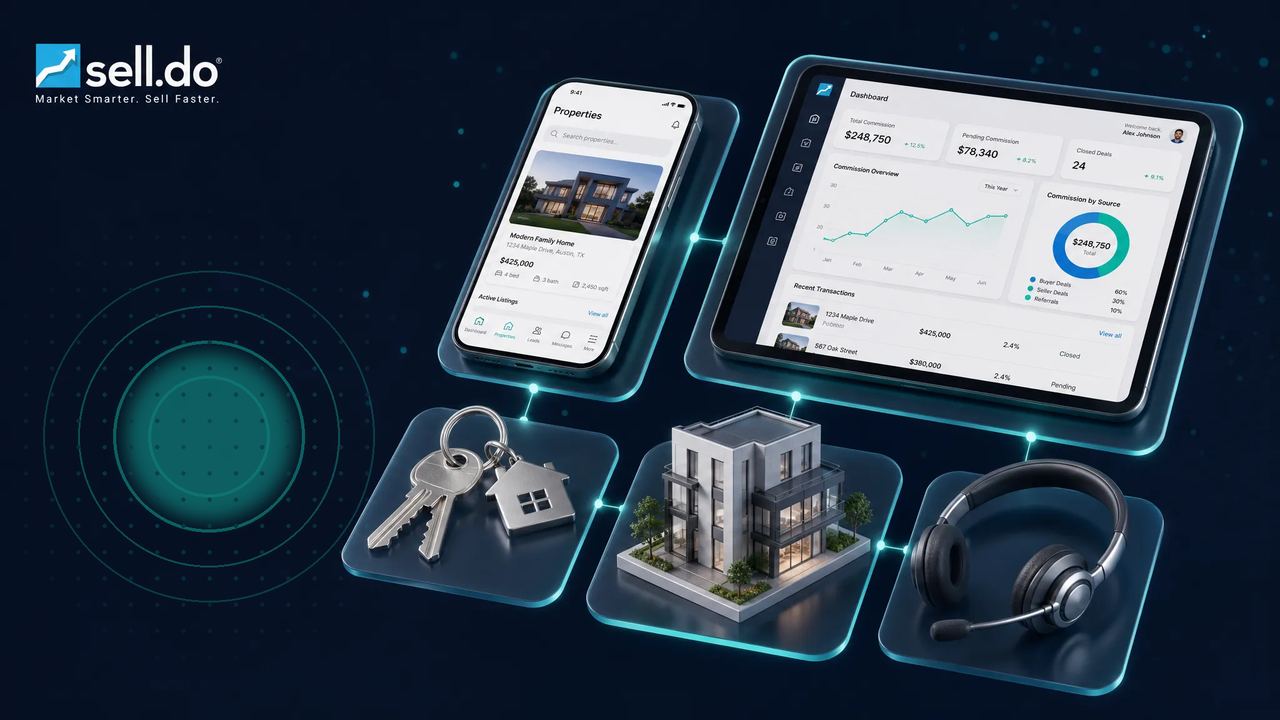
Ask ten Indian brokers what real estate software they use and most will name a portal subscription, WhatsApp on their phone and an Excel sheet someone updates on Sundays. That setup works until the business has more than three people or more than one lead source. Then enquiries start slipping between a portal inbox, a personal WhatsApp and a call log nobody exports, and nobody can say which rupee of ad spend produced which commission cheque.
This guide is for agents, brokerages and channel partners in India deciding what to buy in 2026. Instead of another list of seven CRMs, it breaks the question down by the jobs software has to do in a brokerage, names the tools Indian teams actually shortlist for each job, and shows where one platform beats a stitched-together stack, and where it does not.
The short answer
- Core system: a real estate CRM that captures every lead with its source, routes it to the right agent and holds the full history. Everything else plugs into this.
- Calling: cloud telephony with click-to-call and recordings that log against the lead, ideally built into the CRM.
- WhatsApp: the WhatsApp Business Platform (API) through a Meta partner or your CRM, not personal WhatsApp on each salesperson's phone.
- Lead sources: portal subscriptions (99acres, MagicBricks, Housing.com) and Meta and Google lead forms, all imported automatically with source tags.
- Paperwork and money: an e-sign tool for agreements and consents, and accounting software that handles GST on brokerage and TDS tracking.
A solo agent can start with a CRM plus the portal apps. A 10 to 50-person brokerage needs the first three tightly connected, because that is where leads leak.
From the team that built Sell.Do
See how Sell.Do runs your sales, pre-sales and marketing on one AI-first platform.
The seven jobs real estate software has to do in a brokerage
Before comparing brands, list the jobs. Every tool below exists to do one or more of them, and the gaps between tools are where deals get lost.
- 1Capture: pull every enquiry from portals, Meta and Google lead forms, your website, WhatsApp, walk-ins and sub-brokers into one place, tagged with its source.
- 2Respond: get a person (or an AI agent) on the phone or WhatsApp within minutes, and prove it with a turnaround-time (TAT) report.
- 3Nurture: keep warm the large share of enquiries that are not ready to visit this week, without relying on a salesperson's memory.
- 4Match inventory: know which resale, rental or new-project units are available and send the right ones fast.
- 5Close: schedule and confirm site visits, then handle offers, agreements, KYC and signatures.
- 6Get paid: raise brokerage invoices with GST, track TDS and chase developer or client payouts.
- 7Measure: see cost per lead and cost per closure by source, and which agent is sitting on leads.
1. Real estate CRM software: the core of the stack
The CRM is the system of record. If a lead, a call or a message is not in it, it did not happen, and when an agent leaves, it leaves with them. For Indian brokers the non-negotiables are native capture from portals and Meta and Google lead forms with source tags, duplicate detection across sources, rule-based assignment, TAT alerts, a mobile app that works on a site visit with patchy signal, and sub-broker or channel-partner logins with controlled visibility.
The tools Indian brokerages most often shortlist:
Sell.do
Built specifically for Indian real estate: developers, brokers and channel partners. Leads from portals, Meta, Google, the website, walk-ins and partners land in one pipeline with source tags. Calling and WhatsApp are built in, an AI agent can reply, qualify and book site visits, and there are inventory tools and whitelabel channel-partner portals.
Best for: brokerages and CP firms that want capture, calling, WhatsApp and reporting in one system rather than four.
LeadSquared
An Indian sales-execution CRM used across several industries, including real estate, with lead capture and distribution, a field-sales mobile app and marketing automation.
Best for: larger teams with an internal admin who can configure it for a real estate workflow.
Zoho CRM
A widely used general-purpose CRM from an Indian company, with a large ecosystem of connected apps (Zoho Books and Zoho Sign among them) and customisable modules.
Best for: price-sensitive teams comfortable building their own real estate pipeline, fields and integrations.
Salesforce
The enterprise standard: extremely configurable, and usually deployed for real estate through an implementation partner.
Best for: large developers or brokerages with budget for licences, implementation and an in-house admin. For most Indian brokerages it is more platform than they need.
HubSpot
A marketing-led CRM that is strong on email, forms and content, with a free tier. Calling, WhatsApp and portal capture typically need add-ons or third-party integrations.
Best for: brokerages whose leads come mainly from their own website and content marketing.
If budget is the constraint, our comparison of free real estate CRM software in India covers what the free tiers leave out. Brokerage owners should also read CRM software for real estate brokers, and developers comparing enterprise options should start with the best real estate CRM software in India.
2. Calling and telephony software
Most Indian real estate deals still move forward on the phone, which makes calling software the second most important purchase and the most common source of leakage. When agents call from personal SIMs there is no recording, no logged outcome and no way to know whether a lead was called at all.
Indian cloud telephony providers such as Exotel, Knowlarity, MyOperator and Ozonetel offer virtual numbers, IVR, call routing and recordings. The question that matters is integration: does every call, its recording and its outcome attach automatically to the right lead in your CRM, and does a missed inbound call create a callback task?
What to check:
- Click-to-call from the CRM and the mobile app, with buyers always seeing one consistent business number.
- Automatic call logging and recording against the lead, with no manual entry.
- Missed-call and after-hours handling that creates a task instead of a voicemail nobody hears.
- An offline or SIM-based dialer option for field agents in low-connectivity areas that syncs call records later.
- Compliance: promotional calls and SMS are governed by TRAI's commercial communication rules (DND and DLT), so record each lead's consent and source.
3. WhatsApp Business Platform software
Indian buyers answer WhatsApp faster than calls, and brokers know it. The problem is where those chats live. On personal WhatsApp or the WhatsApp Business app, conversations sit on one phone, cannot be shared across a team and walk out of the door when the agent does.
The WhatsApp Business Platform (the API) fixes that. You access it through a Meta business solution provider such as Gupshup, Interakt, WATI or AiSensy, or through a CRM that integrates it natively. It gives the team one verified business number, approved message templates for follow-ups outside the 24-hour customer-service window, and chat history stored against each lead.
What to check:
- Conversations thread against the lead record in the CRM, not in a separate inbox.
- Template approval and opt-in handling are built in, because outbound marketing templates need the buyer's prior consent.
- Pricing is clear upfront: Meta charges per delivered template message by category (marketing, utility, authentication), on top of the provider's own fee.
- Automation covers instant replies to new portal and ad leads, brochure and location sharing, and site-visit reminders.
For the full channel strategy, see WhatsApp-first real estate: the 2026 playbook.
4. Property portals and lead-source tools
For most brokers, 99acres, MagicBricks, Housing.com and NoBroker are both listing platforms and the largest paid lead source. The portal subscription is often the biggest software line on the P&L, and the same buyer is usually talking to several brokers, so the first few minutes after an enquiry matter.
What to check:
- How each portal delivers leads (email, API or manual export) and whether your CRM imports them automatically with the portal and listing recorded as the source.
- Duplicate detection when the same buyer enquires on two portals or through an ad and a portal.
- Cost per lead and, more usefully, cost per site visit and per closure by portal, so renewals are decided on outcomes.
The mechanics are covered step by step in how to capture, tag and route 99acres, MagicBricks and Housing leads.
5. Inventory and listing management
Brokers juggle three kinds of inventory: resale and rental listings they source themselves, new-project inventory from developers they are empanelled with, and pre-launch allocations. A spreadsheet can hold the list. It cannot tell an agent on a site visit that the 2BHK on the 12th floor was blocked an hour ago.
What to check:
- Real-time availability with hold and block status, so two agents never promise the same unit.
- Matching: filter units against a lead's budget, location and configuration, then share them on WhatsApp in one step.
- For channel partners, access to developer inventory and cost sheets without calling the developer's sales manager for every quote.
Developers and larger brokerages should read real estate CRM with inventory management for what one system for leads and units looks like.
6. Documents, KYC and e-sign
Token forms, brokerage agreements and KYC collection still eat hours of back-and-forth. Indian e-sign providers such as Leegality and Digio support Aadhaar-based eSign, and global tools such as DocuSign cover standard electronic signatures.
One caution: India's Information Technology Act excludes contracts for the sale or conveyance of immovable property, and powers of attorney, from electronic signature. Use e-sign for brokerage and service agreements, booking acknowledgements and consents, and follow the physical or state registration process for sale agreements and deeds. Check with your lawyer for your state.
7. Accounting, GST and brokerage payouts
Brokerage income attracts GST at 18%, developers deduct TDS on commission under Section 194H (currently 2%), and payouts often arrive in tranches tied to the buyer's payment milestones. Tally and Zoho Books are the usual accounting choices. The gap is usually upstream of the accounts: which booking generated which invoice, which developer has not paid, and which sub-broker is owed a share.
- Bookings in the CRM should carry the brokerage slab, invoice status and payout due date.
- Sub-broker and channel-partner splits should be calculated from the same record, not a separate sheet.
- Invoices should export to your accounting software without retyping.
Slabs, timelines and how to dispute-proof payouts are covered in channel partner brokerage and payouts in India.
8. Marketing and reporting
Meta and Google lead forms, a fast landing page per project and a simple WhatsApp or email update cover most brokerage marketing. What most teams lack is the report that connects spend to outcomes. Your software should show, by source and campaign: leads, contact rate within TAT, site visits, closures and cost per closure. If you can only see cost per lead, you will keep buying the cheapest leads, which are rarely the cheapest closures.
Stitched stack or integrated platform?
There are two ways to assemble all of this. A stitched stack picks a separate tool for each job and connects them with integrations. An integrated platform does most jobs in one system and connects to the rest, usually accounting and e-sign.
When a stitched stack makes sense
- You already have a CRM your team uses well and only need to add calling or WhatsApp.
- Someone on the team can own the integrations and fix them when a portal changes its format.
- Your lead volume is low enough that a missed sync costs little.
When an integrated platform wins
- You have more than a handful of agents, or leads from three or more sources.
- You need TAT and source-to-closure reporting that includes calls and WhatsApp, not just form fills.
- Agent turnover is high and leads, calls and chats must stay with the company.
- You work with sub-brokers or channel partners who need controlled access.
The hidden cost of a stitched stack is rarely the licences. It is the enquiry that arrived in a portal inbox at 9 pm, did not sync, and got its first call the next afternoon, after two other brokers had already spoken to the buyer. We map that failure point by point in where brokers lose deals to lead leakage.
How to choose: a checklist for Indian brokerages
Put every shortlisted tool through these questions in a demo, using your own leads rather than the vendor's sample data.
- 1Does it import leads automatically from every portal and ad platform you use, with source and campaign tagged?
- 2Does it catch duplicates across sources and show who owns the lead?
- 3Can agents call and WhatsApp from inside it, with calls recorded and chats saved against the lead?
- 4Is there a TAT report showing time to first contact by agent and by source?
- 5Does the mobile app hold up on a site visit, including with weak connectivity?
- 6Can sub-brokers or channel partners log in with limited visibility, and can you mask customer numbers?
- 7Can you export all of your data at any time, in a usable format?
- 8Is pricing clear per user, per month, in rupees, including WhatsApp and telephony usage?
For price ranges and how to compare quotes like for like, see real estate CRM pricing in India.
Where Sell.do fits
Sell.do is an AI-agentic CRM built for Indian real estate. For brokers and channel partners it covers capture, response, nurture, inventory and measurement in one system: every lead from portals, Meta, Google, your website, walk-ins and partners arrives with its source; built-in calling and WhatsApp keep conversations with the company; the AI agent can reply instantly, qualify and book site visits; and reports show TAT and cost per closure by source. It connects to your accounting and e-sign tools rather than replacing them.
If you are rebuilding your broker stack this year, see the AI-agentic CRM built for Indian real estate and book a walkthrough using your own lead sources.
Frequently asked questions
What software do real estate agents use in India?
Most use a mix of portal subscriptions (99acres, MagicBricks, Housing.com), WhatsApp and a CRM. Growing teams add cloud telephony, the WhatsApp Business Platform and accounting software. The CRM is the piece that connects the others.
What is the best real estate software for a small brokerage?
For a team of two to ten, a real estate CRM with built-in calling, WhatsApp and automatic portal capture usually beats buying three separate tools. It keeps the setup simple and stops leads leaking to personal phones.
Is there free real estate software?
Several CRMs offer free tiers or trials, but they rarely include calling, WhatsApp Business Platform access or portal integrations. Our guide to free real estate CRM software shows what each free plan covers.
Does RERA require brokers to use specific software?
No. RERA requires agents who facilitate the sale of registered projects to register with the state authority and to maintain books of account, records and documents. Good software makes those records easier to keep, but the obligation sits with you. See our RERA explainer for the rules.
Should a brokerage use Salesforce or a real estate CRM?
Salesforce suits large organisations with an admin and an implementation budget. Most Indian brokerages get results faster from a real estate CRM that already understands portals, site visits, inventory and channel partners.
Related reading
Insights from the Sell.do real-estate CRM team.